
| AGENDA | POSTERS | PARTICIPANTS | ABSTRACTS | TRAVEL | FAQ |
2026 SCEC Annual Meeting
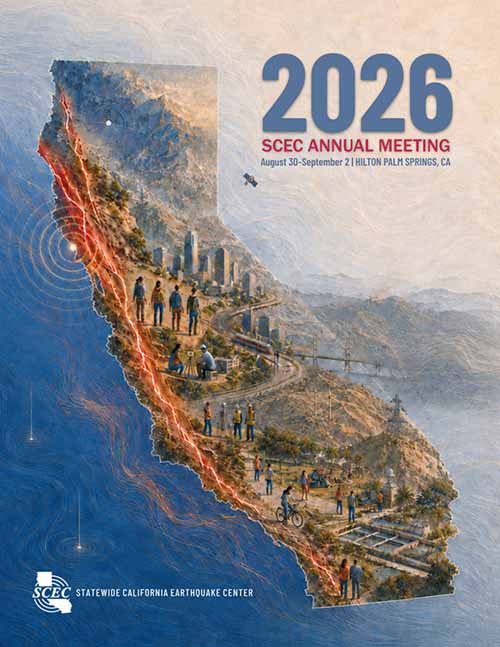 The SCEC Annual Meeting was held in Palm Springs from August 30 to September 2, 2026. The program featured interactive plenary sessions, panels, and moderated discussions focused on the frontiers of statewide earthquake system science—from pioneering observational techniques in geodesy and geology to advanced physics-based multi-cycle simulations and ground motion forecasting. Bridging the gap between science and action, there were dedicated sessions with practitioners, utilities, and emergency planners to discuss statewide preparedness and risk communication. The meeting also launched 12 new SCEC Technical Activity Groups (TAGs), creating new opportunities for the community to collaborate on emerging research priorities and help shape SCEC’s scientific agenda for the years ahead. The community showcased their work through poster presentations, working together to identify the scientific grand challenges of the next decade and shape our collective priorities.
 |
 |
 |
 |
 |
 |
 |
Sunday, August 30, 2026
| 13:00 - 15:30 | SCEC Annual Meeting Check-In, Hilton Lobby |
| 13:00 - 15:30 | Poster Setup: Group A, Plaza Ballroom and Hilton Lobby |
| 15:30 - 17:00 |
Session 1. State of SCEC, Horizon Ballroom
Why Earthquake System Science Matters Now. The Sunday opening session will include the State of SCEC address from the Director and a 35th-anniversary recognition of SCEC’s scientific accomplishments, community impact, and major service contributions. This will set the stage for SCEC2026 and the Center’s next phase.
Moderator: Greg Beroza (Stanford)
|
| 15:30 - 16:00 | State of SCEC (PDF), Ahmed Elbanna (USC)
|
| 16:00 - 16:15 | Community Engagement and Workforce Development (PDF), Mark Benthien (USC)
|
| 16:15 - 16:50 |
Outcomes from 2026 Community Workshops:
|
| 16:50 - 17:00 | Q&A |
| 17:00 - 17:30 | Break |
| 17:30 - 18:30 | Distinguished Lecture from Roland Bürgmann (UC Berkeley), Aseismology - Learning from slow fault slip in California
|
| 18:30 - 20:00 | Welcome Dinner, Hilton Poolside |
| 20:00 - 22:00 |
Poster Viewing 1 (Group A), Plaza Ballroom, Hilton Lobby, and the online poster gallery
The poster room and virtual poster gallery are open!
|
Monday, August 31, 2026
| 07:00 - 08:00 | Continental Breakfast, Hilton Poolside |
| 07:00 - 08:00 |
SCEC Transitions Program Breakfast Club, Tapestry Room Join fellow students and early-career peers and connect with experienced SCEC researchers in a relaxed, informal setting. Participants will gain valuable insights on networking strategies, fostering collaboration, maintaining work-life balance, and more. |
| 08:00 - 09:30 |
Session 2. Get Ready to ShakeOut, Horizon Ballroom
Preparing California for the Next Great Earthquake. This session will highlight the role of transdisciplinary collaboration across earthquake science, earthquake engineering, social sciences, and risk modeling in strengthening public preparedness and statewide resilience. Invited speakers will discuss lessons from large earthquake scenarios, other major earthquakes, and advances in risk communication in helping communities, agencies, and decision-makers prepare for future seismic events.
Moderator: Ashley Griffith (OSU)
|
| 08:00 - 08:10 | Remarks from SCEC Sponsor: Jon Foster (FEMA) - PDF
|
| 08:10 - 08:30 |
ShakeOut Scenario 2.0: Leading the way for a Quake-safe Future Across California, Lucy Jones (Caltech) |
| 08:30 - 08:50 |
Building the scientific foundations of the ShakeOut Scenario 2.0, Kate Scharer (USGS) |
| 08:50 - 09:10 | |
| 09:10 - 09:30 | Community Discussion |
| 09:30 - 10:00 | Break |
| 10:00 - 11:30 |
Session 3. Frontiers in Statewide California Earthquake System Science I – Observing the Earthquake Cycle, Horizon Ballroom
New Frontiers in Geodesy, Geology, and Distributed Sensing. This session will highlight observational advances and data needs for understanding the earthquake cycle across California. Invited speakers will discuss observations from seismology, earthquake geology, geodesy, remote sensing, distributed acoustic sensing, and imaging of crustal structure and fluids. The session will emphasize how new observing capabilities can support SCEC’s statewide mission while identifying persistent data gaps across the transform plate boundary.
Moderator: Gareth Funning (UCR)
|
| 10:00 - 10:10 |
Remarks from SCEC Sponsor: Gavin Hayes (USGS) |
| 10:10 - 10:30 |
From Seconds to Millennia: Fault Mechanics Across the Earthquake Cycle, Alba Rodriguez Padilla (USU) |
| 10:30 - 10:50 |
Better Earthquake Imaging Through NISAR, Molly Zebker (UCSD) |
| 10:50 - 11:15 | Community Discussion |
| 11:15 - 11:30 |
2026 SCEC Technical Activity Groups: |
| 11:30 - 12:00 | Live Poster Lightning Talks (Group A), Horizon Ballroom |
| 12:00 - 14:00 | Group Lunch, Hilton Poolside, Terrace Restaurant, Tapestry Room |
| 14:00 - 15:30 |
Session 4. Frontiers in Statewide California Earthquake System Science II – Modeling the Earthquake Cycle, Horizon Ballroom
New Frontiers in Physics-Based Multi-cycle Earthquake Simulations. This session will focus on modeling approaches that connect earthquake processes across spatial and temporal scales. Topics will include earthquake-cycle simulations, dynamic rupture modeling, multicycle and system-level models, AI-accelerated simulations, complex fault geometries, and time-dependent seismic hazard. The session will also consider how models can be tested against observations and how simulation-based science can inform future hazard assessment and community products. Moderator: Morgan Page (USGS)
|
| 14:00 - 14:10 |
Remarks from SCEC Sponsor: Luciana Astiz (NSF) - PDF |
| 14:10 - 14:30 |
From hazard to design variable: slip-induced permeability enhancement in understressed faults and the future of geothermal energy, Taeho Kim (Stanford) |
| 14:30 - 14:50 |
Why we need Multicycle Physics-Based Earthquake Simulators, Ned Field (USGS) |
| 14:50 - 15:15 |
Community Discussion |
| 15:15 - 15:30 |
2026 SCEC Technical Activity Groups:
|
| 15:30 - 17:30 | Poster Viewing 2 (Group A), Plaza Ballroom, Hilton Lobby, and the online poster gallery |
| 17:30 - 18:00 | Poster Switch Out: Group A posters removed by 6:00 pm. Group B posters installed by 6:30 pm. |
| 18:30 - 20:00 | Group Dinner, Hilton Poolside |
| 20:00 - 22:00 | Poster Viewing 3 (Group B), Plaza Ballroom, Hilton Lobby, and the online poster gallery |
Tuesday, September 1, 2026
| 07:00 - 08:00 | Continental Breakfast, Hilton Poolside |
| 08:00 - 09:30 |
Session 5. Frontiers in Statewide California Earthquake System Science III – Physics-Based Seismic Hazard Analysis & Ground Motion Forecasting, Horizon Ballroom
Transforming Earthquake Physics into Hazard Information. This session will showcase SCEC community products and their role in connecting earthquake science to practical applications. Short presentations will highlight products such as Community Earth Models, CyberShake, and the Broadband Platform. The session will focus on current capabilities, statewide expansion, validation needs, and opportunities to make SCEC products more useful to researchers, engineers, and agencies.
Moderator: Morgan Moschetti (USGS)
|
| 08:00 - 08:20 | SCEC’s Rupture and Ground Motion Forecasting, Xiaofeng Meng (USC)
|
| 08:20 - 08:40 | SCEC’s Physics-Based Seismic Hazard Modeling Platforms, Scott Callaghan (USC)
|
| 08:40 - 09:00 |
SCEC Ground Motion Tools Supporting Engineering Applications, Edric Pauk (USC) |
| 09:00 - 09:30 |
2026 SCEC Technical Activity Groups:
|
| 09:30 - 10:00 | Break |
| 10:00 - 11:30 |
Session 6. Who Uses Earthquake Science—and What Do They Need Next?, Horizon Ballroom
Perspectives from Practitioners and the User Community. This moderated panel will bring together industry and partner perspectives on how SCEC products and science are used in practice. Panelists will discuss needs from utilities, engineering, insurance, and building-code development. The discussion will identify where SCEC science has had practical impact, where product development or communication can be improved, and how partnerships can support California’s earthquake resilience.
Moderators: Tran Huynh (USC) and Jillian Maloney (SDSU)
|
| 10:00 - 10:20 |
2026 SCEC Technical Activity Groups: |
| 10:20 - 10:40 |
Practitioner Decision Stories:
|
| 10:40 - 11:15 | Community Discussion: Exploring the Gaps |
| 11:15 - 11:30 | Community Discussion: Collective Opportunities |
| 11:30 - 12:00 | Live Poster Lightning Talks (Group B), Horizon Ballroom |
| 12:00 - 14:00 | Group Lunch, Hilton Poolside, Terrace Restaurant, Tapestry Room |
| 14:00 - 15:30 |
Session 7. Translating Earthquake Science into Action, Horizon Ballroom
Building More Resilient Communities Through Engineering, Policy, and Planning. This session will examine how earthquake science informs societal resilience and public policy. Topics may include cascading hazards, infrastructure impacts, emergency planning, and risk communication. The session will emphasize how SCEC can help translate scientific advances into actionable knowledge for communities, agencies, policymakers, and the public.
Moderator: Christie Rowe (UNR)
|
| 14:00 - 14:10 |
Remarks from SCEC Sponsor: Jose Lara (Cal OES)
|
| 14:10 - 14:30 |
Closing the Earthquake Science to Public Action Gap, Lori Peek (CU Boulder) |
| 14:30 - 14:50 |
Science, Safety and Solvency: Working with Governments, Utilities and Insurers to Enhance California’s Earthquake Readiness and Resilience, Laurie Johnson (LJC) |
| 14:50 - 15:15 |
Community Discussion |
| 15:15 - 15:30 | Remarks from the SCEC External Advisory Council: Steve Bohlen (LLNL, retired)
|
| 15:30 - 17:30 | Poster Viewing 4 (Group B), Plaza Ballroom, Hilton Lobby, and the online poster gallery. This is the final dedicated session for Group B posters. Authors must remove their posters by 6:00 pm, 30 minutes after Poster Viewing 4 ends. |
| 18:30 - 20:00 | Group Dinner, Hilton Poolside |
Wednesday, September 2, 2026
| 07:00 - 08:00 | Continental Breakfast, Hilton Poolside |
| 08:00 - 09:30 |
Session 8. Open Problems in Earthquake System Science, Horizon Ballroom
Scientific Grand Challenges for the Next Decade. This moderated panel will explore grand open questions in earthquake science and the opportunities created by SCEC’s statewide scope, new TAG structure, and expanded partnerships. The session will bring together diverse viewpoints and career stages to identify scientific questions that SCEC is uniquely positioned to address.
Moderators: Alice Gabriel (UCSD) and Greg Beroza (Stanford)
|
| 08:00 - 08:15 |
2026 SCEC Technical Activity Groups:
|
| 08:15 - 08:30 |
Panelists Opening Statements: |
| 08:30 - 08:45 | Moderated Discussion |
| 08:45 - 09:25 | Community Discussion |
| 09:25 - 09:30 | Synthesis and Closing |
| 09:30 - 10:00 | Break |
| 10:00 - 11:55 |
Session 9. What Should SCEC Build Together?, Horizon Ballroom
Community Priorities for California's Earthquake System Science Enterprise. This closing session will synthesize priorities emerging from SCEC2026 and perspectives from across the SCEC community. The session will provide an opportunity for broad community input on priorities, questions, and future directions for SCEC. View Session 9 Slides
Moderator: Ahmed Elbanna (USC)
|
| 10:00 - 10:25 |
Key Priorities Emerging from SCEC2026:
|
| 10:25 - 10:45 |
Perspectives from Across the SCEC Community:
|
| 10:45 - 11:20 | Open Community Discussion: Priorities and Opportunities for SCEC’s Next Phase |
| 11:20 - 11:55 | How community input from The SCEC Wish Wall and meeting discussions will shape SCEC’s programs and future directions, Ahmed Elbanna (USC) |
| 11:55 - 12:00 | Closing Remarks, SCEC2026 Adjourns |
The Statewide California Earthquake Center is committed to providing a safe, productive, and welcoming environment for all participants. We take pride in fostering a diverse and inclusive SCEC community, and therefore expect all participants to abide by the SCEC Activities Code of Conduct.


