
Group B, Poster #076, Community Earth Models (CEM)
Planning SCEC CFM 8.0 and the TAG: updates, analysis and use cases




Poster Image:
Poster Presentation
2026 SCEC Annual Meeting, Poster #076, SCEC Contribution #15413 VIEW PDF
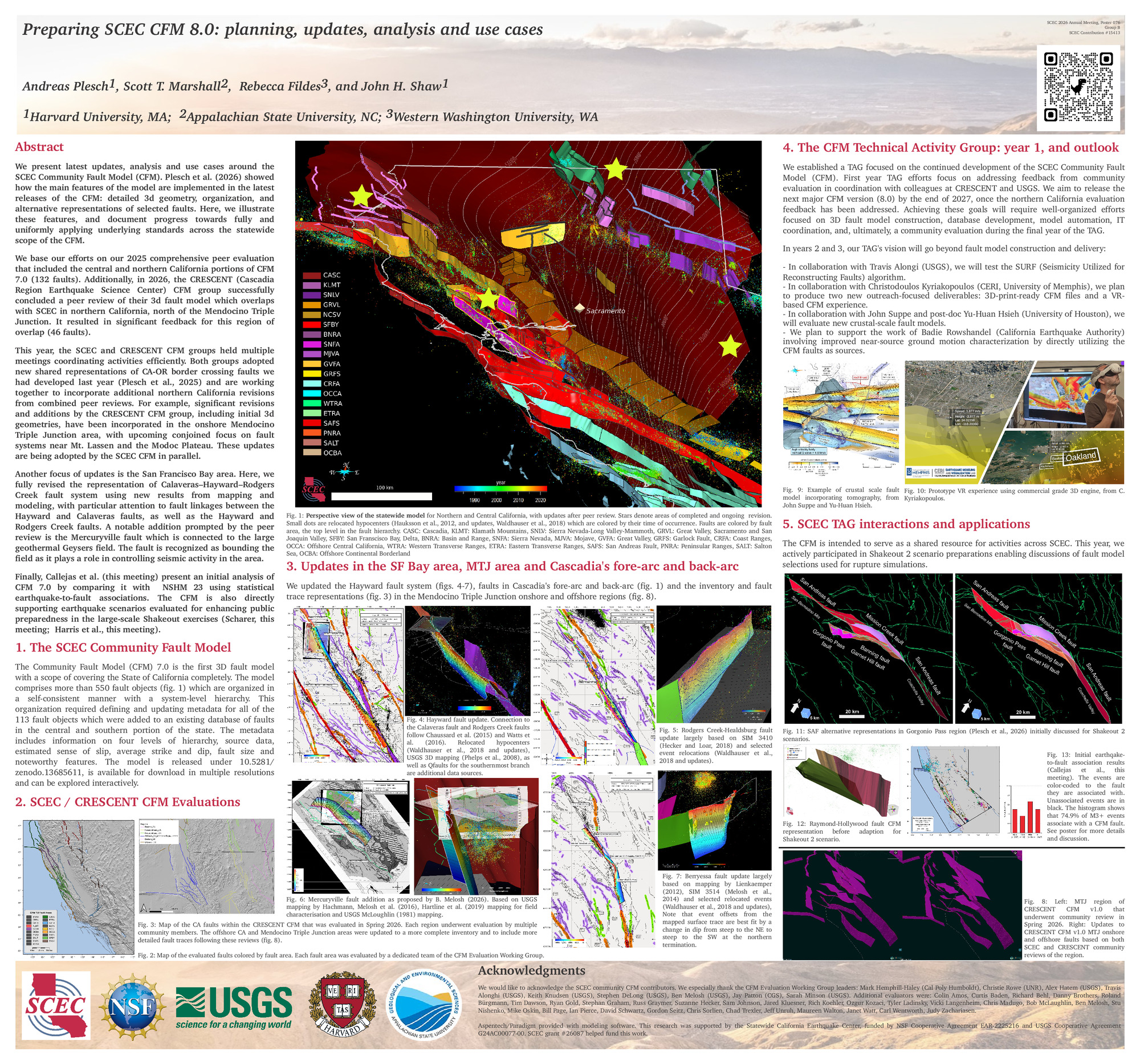
We present latest updates, analysis and use cases around the SCEC Community Fault Model (CFM). Plesch et al. (2026) showed how the main features of the model are implemented in the latest releases of the CFM: detailed 3d geometry, organization, and alternative representations of selected faults. Here, we illustrate these features, and document progress towards fully and uniformly applying underlying standards across the statewide scope of the CFM.
We base our efforts on our 2025 comprehensive peer evaluation that included the central and northern California portions of CFM 7.0 (132 faults). Additionally, in 2026, the CRESCENT (Cascadia Region Earthquake Science Center) CFM group successfully concluded a peer review of their 3d fault model which overlaps with SCEC in northern California, north of the Mendocino Triple Junction. It resulted in significant feedback for this region of overlap (46 faults).
This year, the SCEC and CRESCENT CFM groups held multiple meetings coordinating activities efficiently. Both groups adopted new shared representations of CA-OR border crossing faults we had developed last year (Plesch et al., 2025) and are working together to incorporate additional northern California revisions from combined peer reviews. For example, significant revisions and additions by the CRESCENT CFM group, including initial 3d geometries, have been incorporated in the onshore Mendocino Triple Junction area, with upcoming conjoined focus on fault systems near Mt. Lassen and the Modoc Plateau. These updates are being adopted by the SCEC CFM in parallel.
Another focus of updates is the San Francisco Bay area. Here, we fully revised the representation of Calaveras–Hayward–Rodgers Creek–Maacama–North Bay fault system using new results from mapping and modeling, with particular attention to fault linkages between the Hayward and Calaveras faults, as well as the Hayward and Rodgers Creek faults. A notable addition prompted by the peer review is the Mercuryville fault which is connected to the large geothermal Geysers field. The fault is recognized as bounding the field as it plays a role in controlling seismic activity in the area.
Finally, Callejas et al. (this meeting) present an initial analysis of CFM 7.0 by comparing it with NSHM 23 using statistical earthquake-to-fault associations. The CFM is also directly supporting earthquake scenarios evaluated for enhancing public preparedness in the large-scale Shakeout exercises (Scharer et al., this meeting).
We base our efforts on our 2025 comprehensive peer evaluation that included the central and northern California portions of CFM 7.0 (132 faults). Additionally, in 2026, the CRESCENT (Cascadia Region Earthquake Science Center) CFM group successfully concluded a peer review of their 3d fault model which overlaps with SCEC in northern California, north of the Mendocino Triple Junction. It resulted in significant feedback for this region of overlap (46 faults).
This year, the SCEC and CRESCENT CFM groups held multiple meetings coordinating activities efficiently. Both groups adopted new shared representations of CA-OR border crossing faults we had developed last year (Plesch et al., 2025) and are working together to incorporate additional northern California revisions from combined peer reviews. For example, significant revisions and additions by the CRESCENT CFM group, including initial 3d geometries, have been incorporated in the onshore Mendocino Triple Junction area, with upcoming conjoined focus on fault systems near Mt. Lassen and the Modoc Plateau. These updates are being adopted by the SCEC CFM in parallel.
Another focus of updates is the San Francisco Bay area. Here, we fully revised the representation of Calaveras–Hayward–Rodgers Creek–Maacama–North Bay fault system using new results from mapping and modeling, with particular attention to fault linkages between the Hayward and Calaveras faults, as well as the Hayward and Rodgers Creek faults. A notable addition prompted by the peer review is the Mercuryville fault which is connected to the large geothermal Geysers field. The fault is recognized as bounding the field as it plays a role in controlling seismic activity in the area.
Finally, Callejas et al. (this meeting) present an initial analysis of CFM 7.0 by comparing it with NSHM 23 using statistical earthquake-to-fault associations. The CFM is also directly supporting earthquake scenarios evaluated for enhancing public preparedness in the large-scale Shakeout exercises (Scharer et al., this meeting).
Citation: Plesch, A., Marshall, S. T., Fildes, R. A., & Shaw, J. H. (2026, 08). Planning SCEC CFM 8.0 and the TAG: updates, analysis and use cases. Poster Presentation at 2026 SCEC Annual Meeting.
Keywords: CFM, planning, updates, northern California
SCEC Award: 26087
Relevant SCEC Themes:
Advancing Community Earth Models for Hazard Analyses
MORE POSTERS BY THE AUTHORS
|
|
|
|
|
|


