

| AGENDA | POSTERS | PARTICIPANTS | ABSTRACTS | TRAVEL | FAQ |
Meeting Abstracts
The Statewide California Earthquake Center (SCEC) collaborates with academic, government, industry, and other organizations to advance earthquake science, community resilience, and education by: (1) Gathering and analyzing data from field observations and laboratory experiments. (2) Developing system-level models and simulations of earthquake processes to synthesize knowledge as a physics-based understanding of seismic hazard. (3) Communicating that understanding to expand knowledge and reduce earthquake risk.
Participants are invited to present recent work aligned with SCEC priorities during the poster sessions.
- 1 of 5
- >
| SCEC ID | Category | Title and Authors | SCEC Award |
|---|---|---|---|
|
Group B Poster 212 |
RC |
Strategies for accelerating scientific software development with artificial intelligence
Brad Aagaard Artificial intelligence (AI) tools, such as large language models, can accelerate software development by suggesting designs and writing code. However, AI tools often make unstated assumptions and can generate confident but false information (“... more |
|
Group B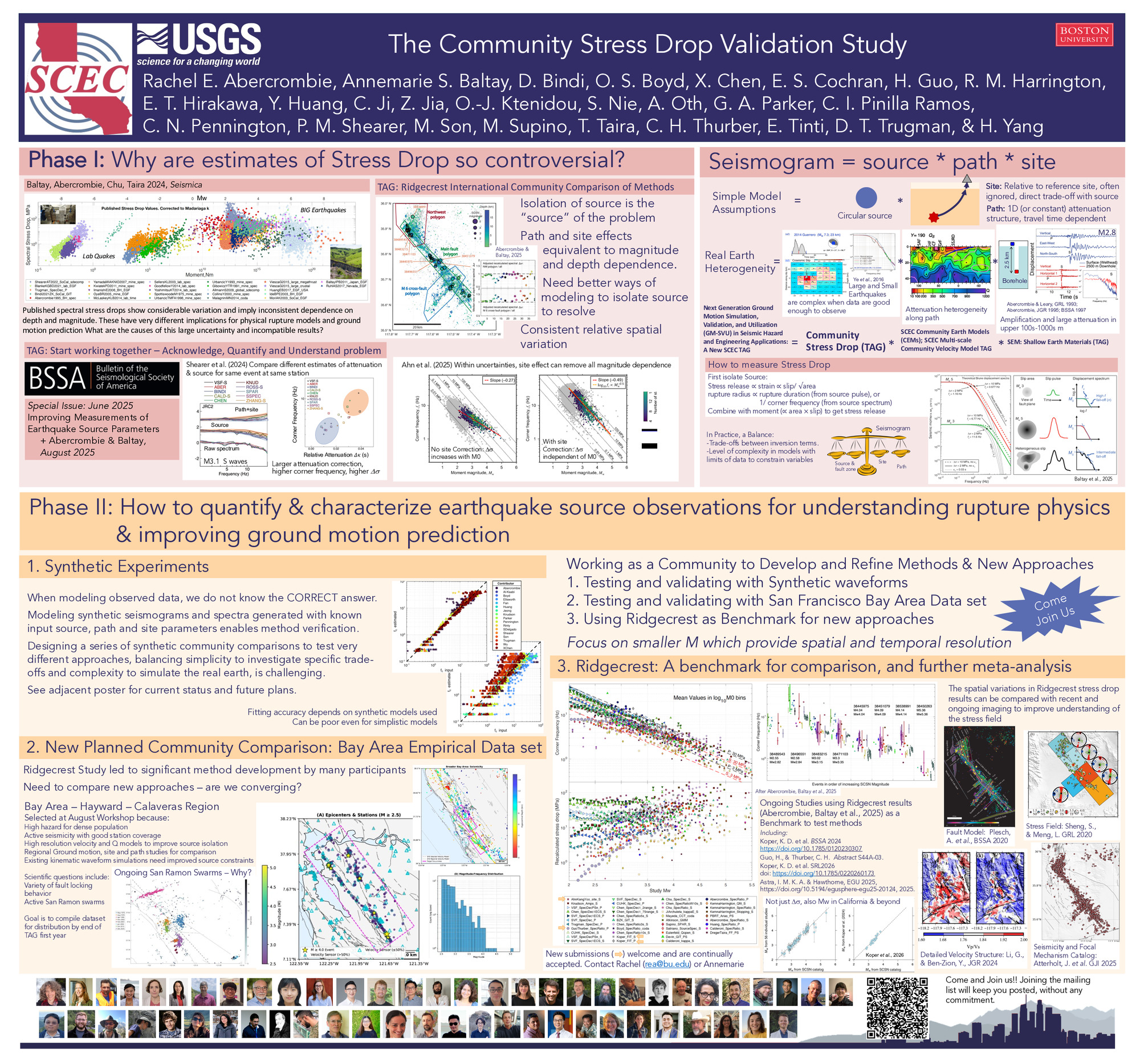 |
Seismology |
The Community Stress Drop Validation Study
Rachel Abercrombie, Annemarie Baltay, Dino Bindi, Oliver Boyd, Xiaowei Chen, Elizabeth Cochran, Hao Guo, Rebecca Harrington, Evan Hirakawa, Yihe Huang, Chen Ji, Zhe Jia, Olga-Joan Ktenidou, Shiying Nie, Adrien Oth, Grace Parker, Camilo Ignacio Pinilla Ramos, Colin Pennington, Peter Shearer, Minkyung Son, Mariano Supino, Taka'aki Taira, Clifford Thurber, Elisa Tinti, Daniel Trugman, Hongfeng Yang The SCEC/USGS Community Stress Drop Validation Study aims to reduce uncertainties in estimated spectral stress drop and related source parameters, strengthening their use in empirical ground motion models and earthquake source simulations. This... more Themes: Advancing Community Earth Models for Hazard Analyses | Physics-Based Ground Motion Simulations & Validation |
26069, 26018, 25134
|
|
Group A Poster 113 |
Geology |
Paleoseismic Evidence for Multiple Strand Ruptures Along the Amanos section of the East Anatolian Fault, Turkey
Sinan Akciz, Aynur Dikbas, Musa Balkaya, Angel Beltran, Andrew Azzam, Muhammed Seyyid Demir On February 6, 2023, an Mw 7.8 earthquake ruptured ~300 km of the left-lateral East Anatolian Fault (EAF), followed ~9 hours later by an Mw 7.6 event on the Çardak Fault. The ~700 km-long EAF accommodates westward extrusion of the Anatolian... more Themes: Advancing Community Earth Models for Hazard Analyses | Rapid Post-Earthquake Investigations & Communications |
|
Group B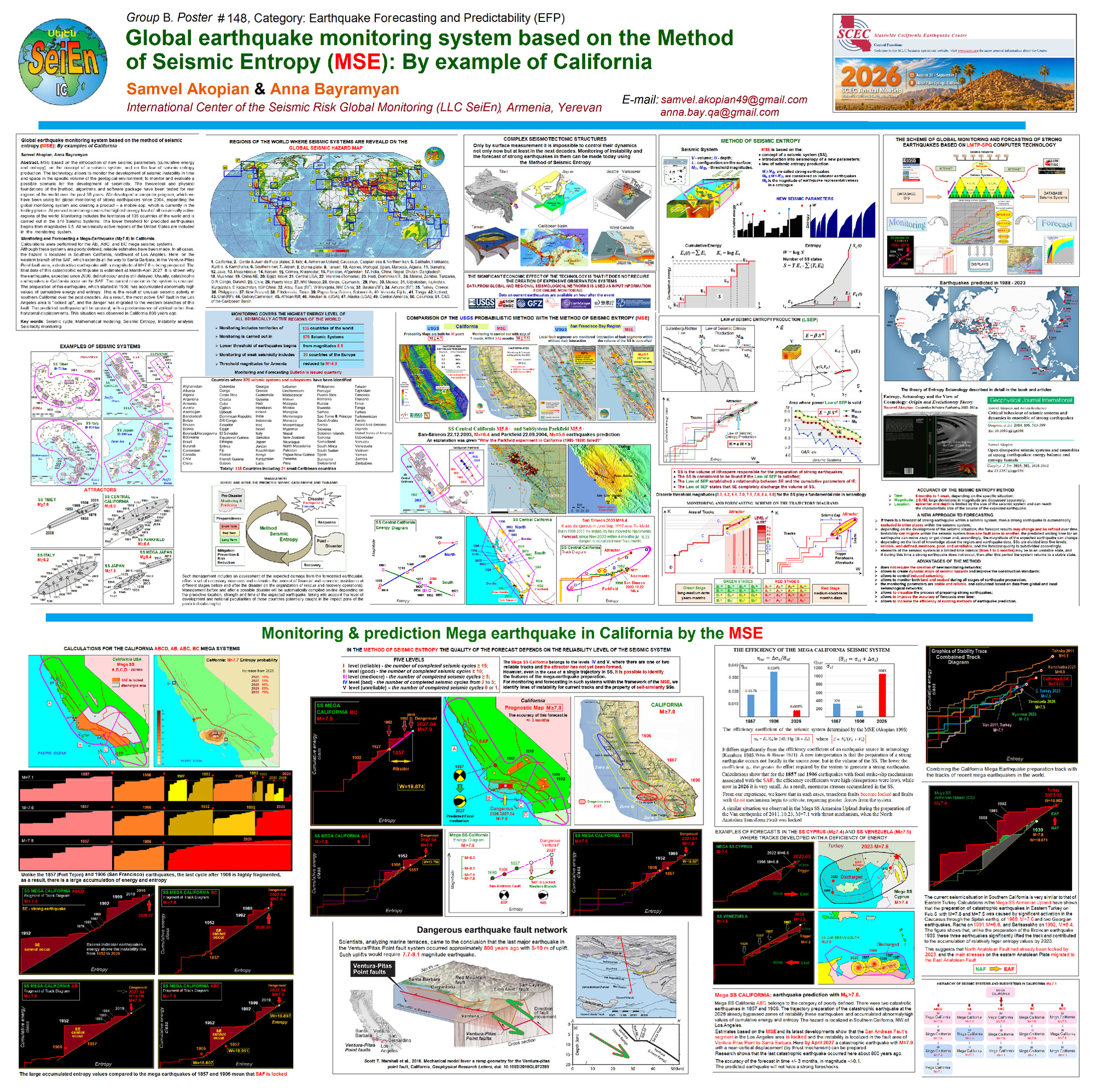 |
EFP |
Global earthquake monitoring system based on the method of seismic entropy (MSE): By example of California
Samvel Akopian, Anna Bayramyan MSE based on the introduction of new seismic parameters (cumulative energy and entropy), on the concept of a seismic system, and on the law of seismic entropy production. The technology allows to monitor the development of seismic instability in... more Themes: Advancing Community Earth Models for Hazard Analyses | Earthquake Scenarios for Hazard and Risk Assessment | Earthquake Cycle Simulations & Forecasting |
|
|
Group B Poster 166 |
CCB |
Beyond the shaking: mapping human experience and recovery after a major earthquake
LaMar Anderson, Ishmael Legaspi, Sandi Shwe Win, Lucile Jones, Keith Porter Research in decision-making suggests affect and narrative can influence how people respond to information about disasters. This project developed a human-centered, narrative-based risk communication framework for ShakeOut Scenario 2.0. The framework... more Themes: Earthquake Scenarios for Hazard and Risk Assessment |
26067
|
Group B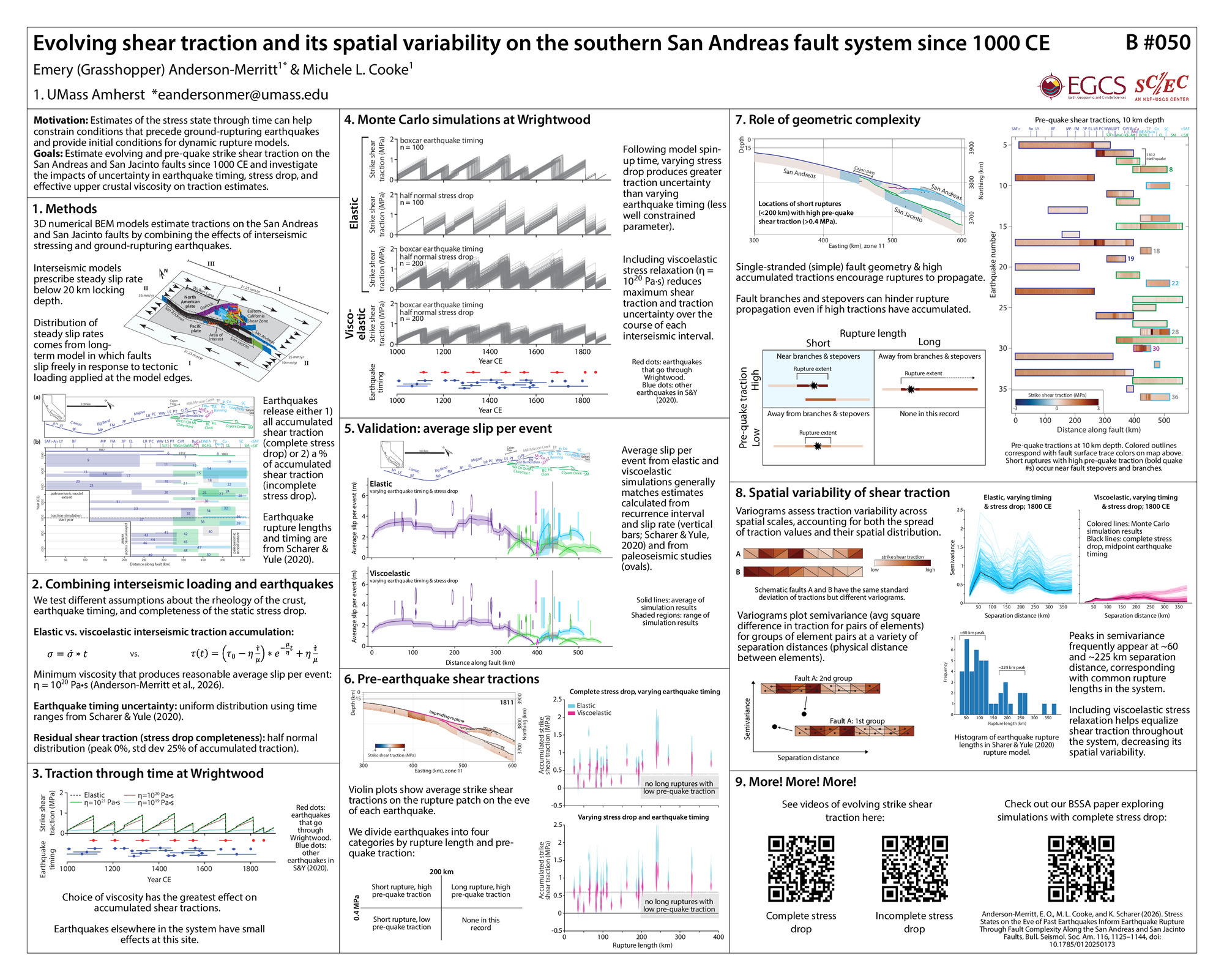 |
SDOT |
Evolving shear traction and its spatial variability on the southern San Andreas fault system since 1000 CE
Emery Anderson-Merritt, Michele Cooke Estimates of evolving strike shear tractions across multiple earthquake cycles can shed light on the conditions that produce large earthquakes, inform the interpretation of earthquake recurrence and open intervals, and provide key inputs for dynamic... more |
22030, 23104
|
Group A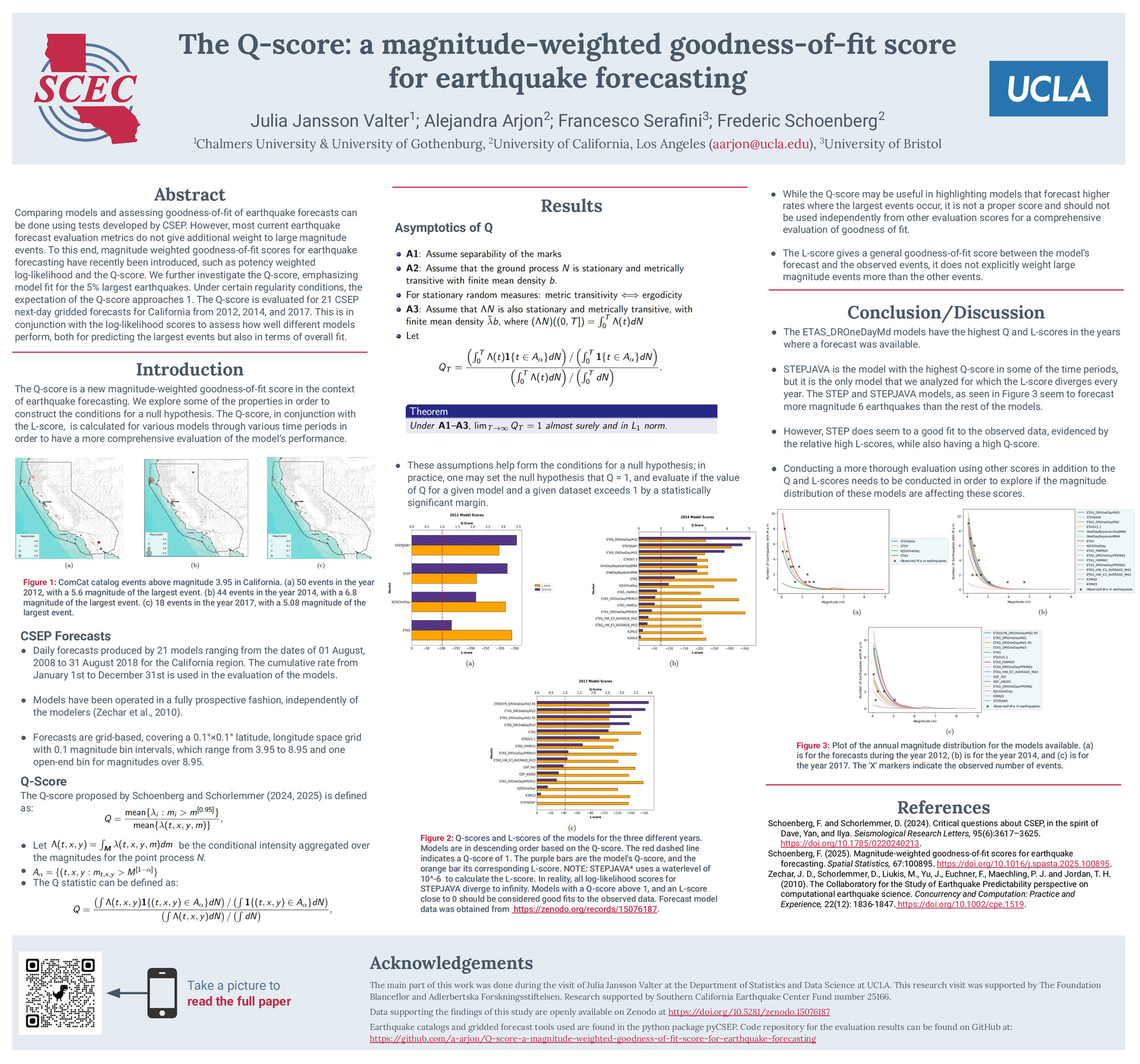 |
EFP |
The Q-Score: A Magnitude-Weighted Goodness-of-Fit Score for Earthquake Forecasting
Alejandra Arjon, Julia Jansson Valter, Francesco Serafini, Frederic Schoenberg Earthquake occurrences are often modelled with spatial-temporal point process models, such as the Epidemic-Type-Aftershock-Sequence (ETAS) model. Comparing models and assessing goodness-of-fit of earthquake forecasts can be done using tests... more |
25166
|
Group B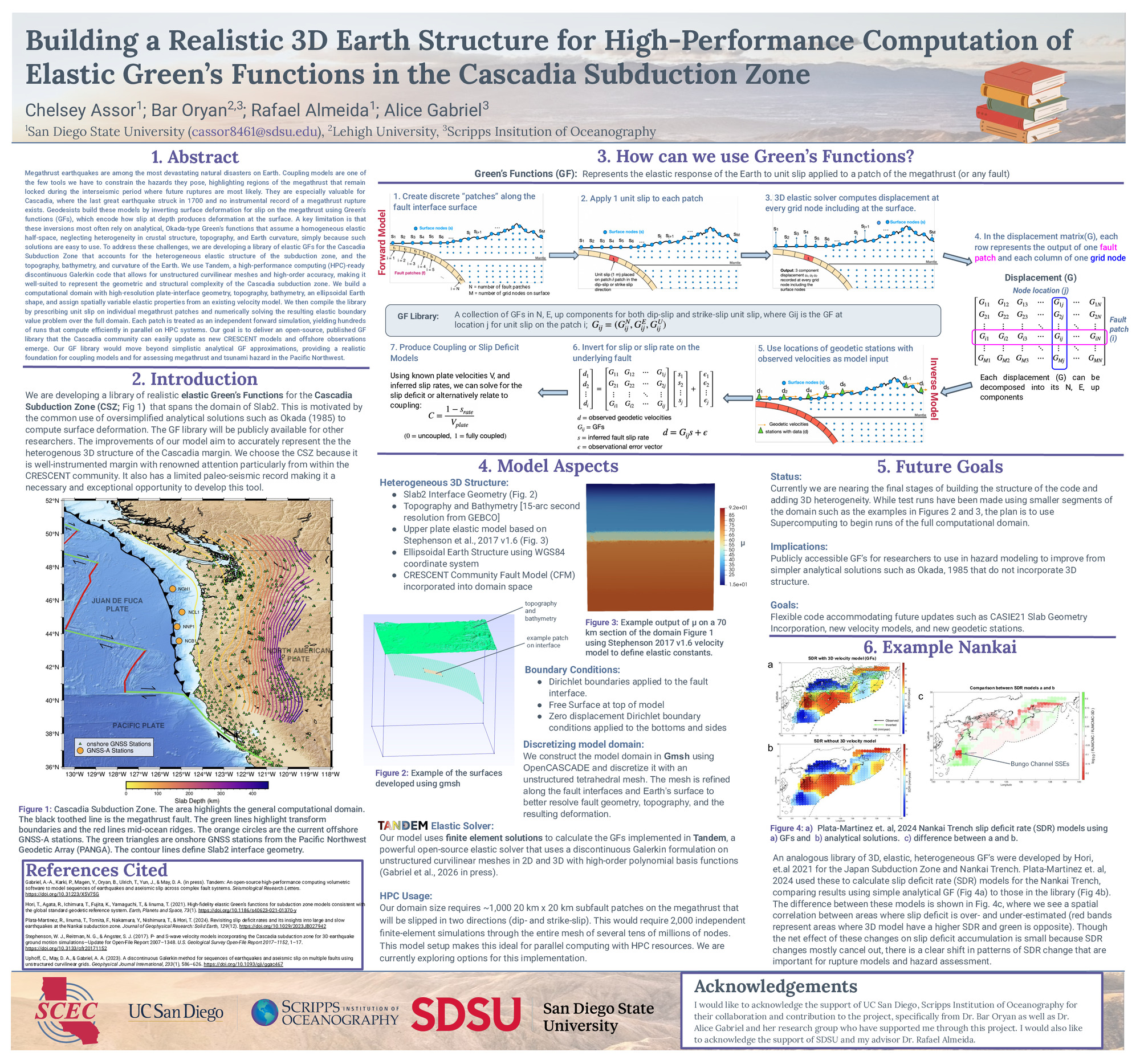 |
CEM |
Building a Realistic 3D Earth Structure for High-Performance Computation of Elastic Green's Functions in the Cascadia Subduction Zone
Chelsey Assor, Bar Oryan, Rafael Almeida, Alice-Agnes Gabriel Megathrust earthquakes are among the most devastating natural disasters on Earth. Coupling models are one of the few tools we have to constrain the hazards they pose, highlighting regions of the megathrust that remain locked during the interseismic... more Themes: Advancing Community Earth Models for Hazard Analyses |
|
|
Group A Poster 041 |
FARM |
Surface CO2 flux tracks rupture-dependent healing along continental strike-slip faults
Alexis Ault, Dennis Newell, Musa Balkaya, Sinan Akciz, Srisharan Shreedharan, Greg Hirth Faults must heal between earthquakes to rupture again, in part by sealing the fracture networks that each rupture creates. Laboratory experiments document time-dependent permeability reduction in fault zone materials, but spatially and temporally... more Themes: Advancing Community Earth Models for Hazard Analyses | Rapid Post-Earthquake Investigations & Communications |
|
|
Group A Poster 003 |
FARM |
Shallow Geomaterial Properties Control Strike-Slip Surface Rupture Expression
Curtis Baden, Josie Nevitt, Fernando Garcia Observations of strike-slip surface rupture show that rupture-zone width, distributed shear, vertical deformation, and surface slip interpretations can vary dramatically between earthquakes. Natural ruptures illustrate the complexity of surface... more |
|
|
Group B Poster 164 |
CCB |
Great social science for great earthquakes
Dare Baldwin, Samantha Stanley, Robert de Groot In 2008, the ShakeOut Scenario was published, using the most cutting edge science and instruments available at the time to illustrate what Southern California might experience if a M7.8 earthquake were to take place on the San Andreas. Now, 20 years... more Themes: Engaging Communities in Earthquake Preparedness |
|
Group B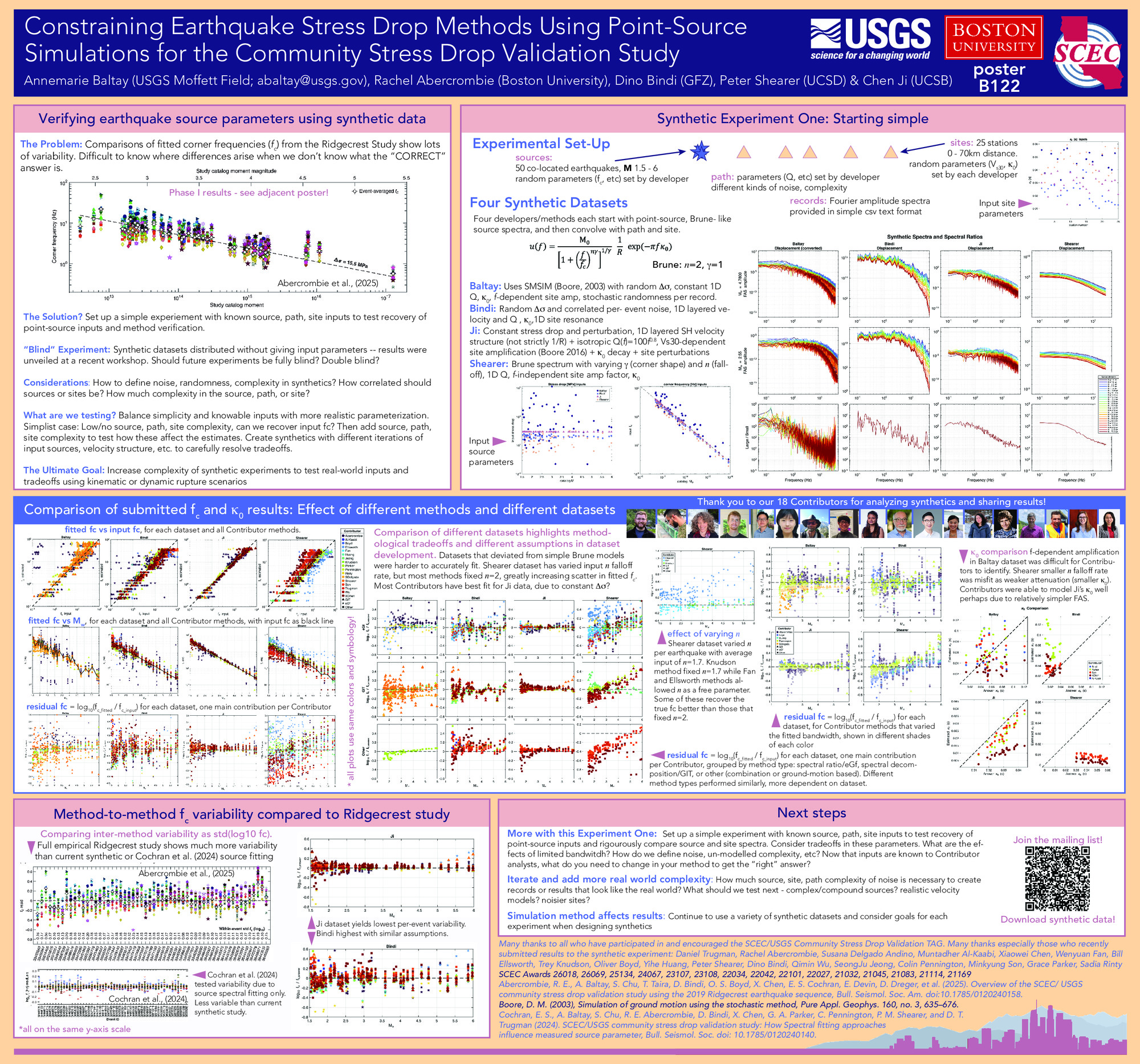 |
Seismology |
Constraining earthquake stress drop methods using point-source simulations for the Community Stress Drop Validation Study
Annemarie Baltay, Rachel Abercrombie, Dino Bindi, Peter Shearer, Chen Ji As a part of the newly supported Community Stress Drop Validation Study Technical Activity Group (TAG), we present recent initial results from several datasets of simple, point-source simulated earthquake Fourier amplitude spectra for use in... more Themes: Physics-Based Ground Motion Simulations & Validation | Utilization of Ground Motion Simulations & Records | Engaging Communities in Earthquake Preparedness |
26069, 26018, 25134, 24067, 23108, 23107
|
|
Group B Poster 072 |
Geodesy |
What mechanical coupling reveals about seismic potential: A case study in the Chilean Atacama Gap
Valeria Becerra-Carreño, Jorge Crempien, Marcos Moreno, Roberto Benavente Plate interface locking distributions are essential for estimating the potential size of future subduction zone earthquakes. However, they do not directly reveal the stress state, namely mechanical coupling, along the seismogenic zone, which is... more Themes: Advancing Community Earth Models for Hazard Analyses | Earthquake Scenarios for Hazard and Risk Assessment | Earthquake Cycle Simulations & Forecasting |
|
Group B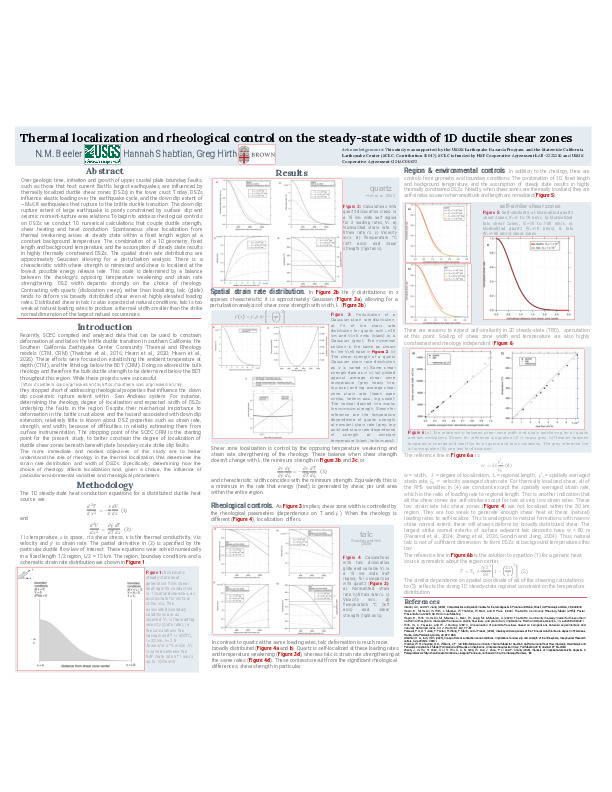 |
FARM |
Thermal localization and rheological control on the steady-state width of 1D ductile shear zones
N. Beeler, Hannah Shabtian, Greg Hirth Over geologic time, initiation and growth of upper crustal plate boundary faults, such as those that host Earth's largest earthquakes today, are influenced by thermally localized ductile shear zones (DSZs) in the lower crust. Today DSZs... more |
|
|
Group A Poster 137 |
Seismology |
High-Resolution DAS Observations of Fault-Zone Structure at SAFOD
Alina Belyalova, Andrew Barbour, Stephen Hickman, William Ellsworth, Martin Karrenbach, Ettore Biondi Seismic imaging, vertical seismic profiling (VSP), and borehole logging at the San Andreas Fault Observatory at Depth (SAFOD) have characterized the San Andreas Fault Zone at Parkfield, California, as a structurally complex volume featuring sharp... more |
|
|
Group A Poster 175 |
Seismology |
Increasing High-frequency Seismic Radiation before Large Earthquakes
Yehuda Ben-Zion, Fengjiang Ju, Longtan Wang, Haoran Meng Detecting precursory information before large earthquakes is a fundamental goal of earthquake science with considerable societal implications. We present observational results on increasing high-frequency seismic radiation during several years... more |
|
|
Group B Poster 068 |
Geodesy |
Analyzing GNSS Time-Series Parameterization of Interseismic and Early Postseismic Deformation
Aubrey Bennett, Yehuda Bock, Lavoisiane Ferreira Both the 2003 Mw 6.5 San Simeon and the 2004 Mw 6.0 Parkfield earthquakes were recorded by a near-fault GNSS network that captured coseismic and postseismic deformation. However, the short pre-earthquake record produced strong tradeoffs among... more |
|
|
Group A Poster 135 |
Seismology |
Monitoring Seismic Velocity Changes with Borehole DAS at SAFOD Using Ambient Noise and Active Source Surveys
Natalia Berrios-Rivera, Andrew Barbour, Stephen Hickman, William Ellsworth, Rufus Catchings, Coyn Criley, Mark Goldman, Martin Karrenbach, Robert Sickler, James Atterholt, Albert Aguilar, Alina Belyalova, Ettore Biondi The San Andreas Fault Observatory at Depth (SAFOD) provides a unique opportunity to use downhole distributed acoustic sensing (DAS) for continuous monitoring and shallow velocity imaging along a seismically active and creeping section of the San... more |
|
Group B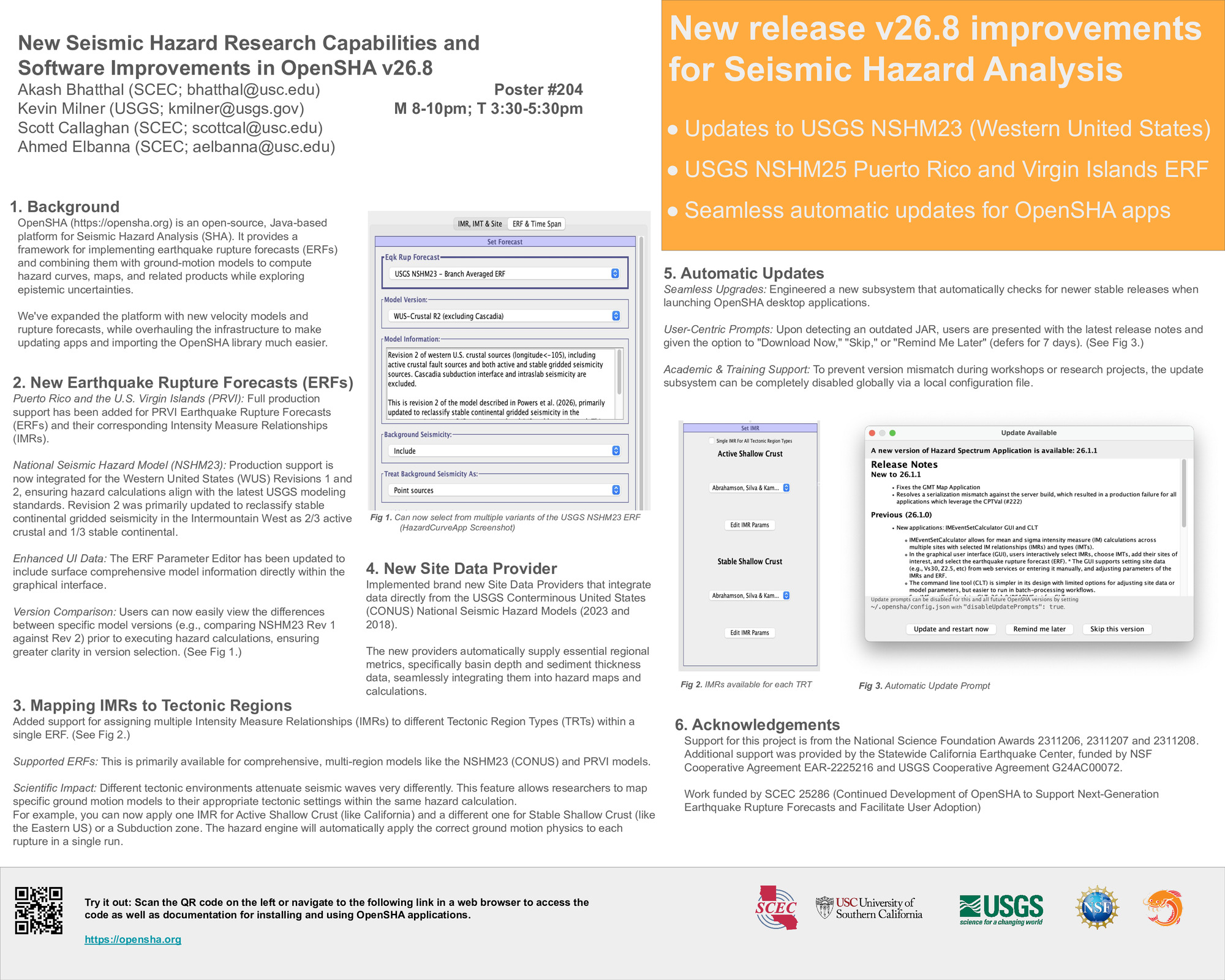 |
RC |
New Seismic Hazard Research Capabilities and Software Improvements in OpenSHA v26.8
Akash Bhatthal, Kevin Milner, Scott Callaghan, Ahmed Elbanna OpenSHA is an open-source, SCEC- and USGS-developed tool for performing seismic hazard analysis. Over the past year, OpenSHA has continued to advance its seismic hazard analysis capabilities, culminating in the release of version 26.8 which includes... more |
25286
|
|
Group A Poster 127 |
Geology |
Order-Statistical Corrections for Inbuilt Age Effects at Paleoseismic Sites
Glenn Biasi, Katherine Scharer, Devin McPhillips We investigate inbuilt age effects in charcoal used to constrain paleoseismic earthquake dates. On the San Andreas fault and most California faults, most estimated earthquake dates are derived from radiocarbon ages from charcoal fragments in... more Themes: Advancing Community Earth Models for Hazard Analyses |
|
|
Group B Poster 136 |
Seismology |
Eikonal-Based Adjoint-State Inversion for the Structure of the Los Angeles Basin
Eli Bird, Ettore Biondi, Robert Clayton, Zhongwen Zhan Due in part to computational limitations and variations in data quality, many models of seismic structure in Southern California are limited to a small subset of the available data. Typically, broader scale inversions focus on relatively sparsely-... more Themes: Advancing Community Earth Models for Hazard Analyses |
|
Group B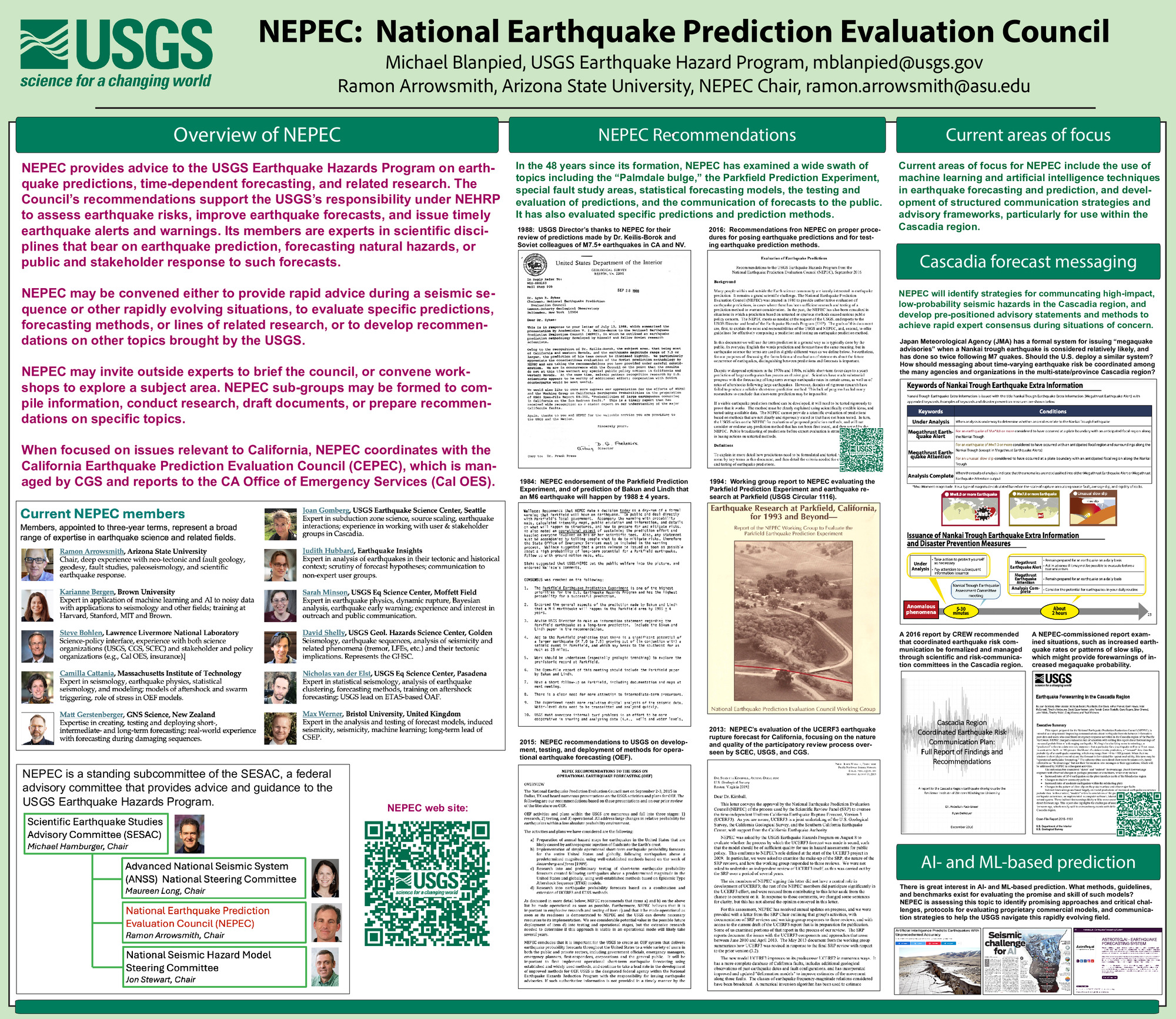 |
EFP |
NEPEC: the National Earthquake Prediction Evaluation Council
Michael Blanpied, Ramon Arrowsmith The National Earthquake Prediction Evaluation Council (NEPEC) provides advice to the USGS Earthquake Hazards Program on earthquake predictions, time-dependent forecasting, and related research. The Council’s recommendations support the USGS’s... more Themes: Earthquake Scenarios for Hazard and Risk Assessment | Earthquake Cycle Simulations & Forecasting | Engaging Communities in Earthquake Preparedness |
|
|
Group A Poster 031 |
FARM |
Comparing Dynamic Rupture Behavior of the Southern San Andreas Fault over Multiple Earthquake Cycles between CFM5.3 and CFM7 with a 3D Fully Dynamic Earthquake Simulator
Hasti Bordbar, Benchun Duan Understanding how three-dimensional fault geometry and tectonic loading interact to control earthquake rupture propagation is critical for seismic hazard assessment. We use EQdyna, a 3D fully dynamic earthquake simulator, to investigate multicycle... more Themes: Earthquake Scenarios for Hazard and Risk Assessment | Earthquake Cycle Simulations & Forecasting |
|
Group A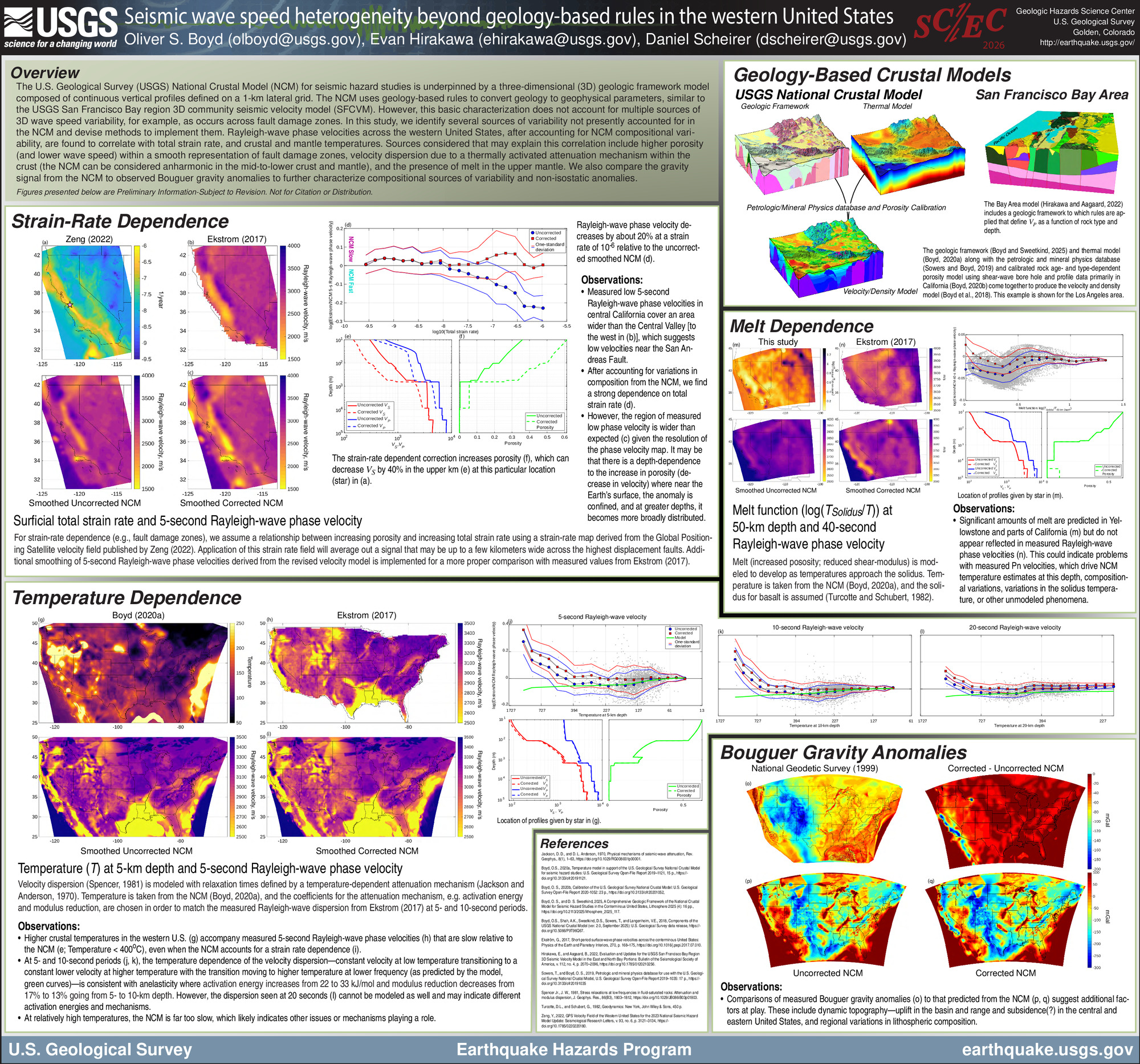 |
CEM |
Seismic wave speed variability beyond geology-based rules in the western United States
Oliver Boyd, Evan Hirakawa, Daniel Scheirer The U.S. Geological Survey (USGS) National Crustal Model (NCM) for seismic hazard studies is underpinned by a three-dimensional (3D) geologic framework model composed of continuous vertical profiles defined on a 1-km lateral grid. The NCM uses... more Themes: Advancing Community Earth Models for Hazard Analyses | Physics-Based Ground Motion Simulations & Validation |
|
Group A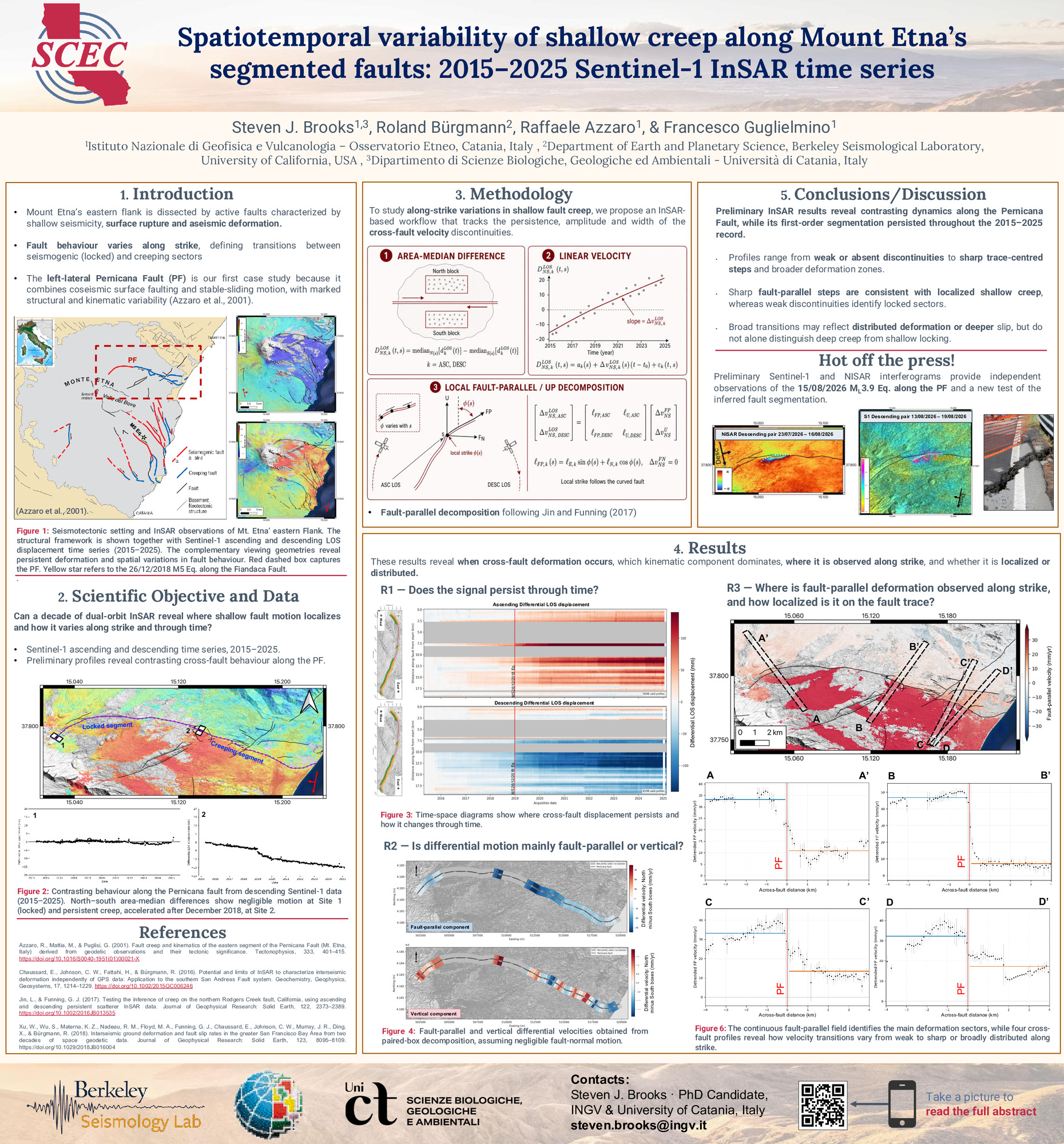 |
Geodesy |
Spatiotemporal variability of shallow creep along Mount Etna’s segmented faults: 2015–2025 Sentinel-1 InSAR time series
Steven Brooks, Roland Bürgmann, Raffaele Azzaro, Francesco Guglielmino Segmented fault systems can accommodate slip through adjacent creeping and mostly locked sections, but the persistence of these patterns through time and their response to earthquake sequences remain poorly resolved. Mount Etna’s eastern flank,... more Themes: Earthquake Scenarios for Hazard and Risk Assessment | Earthquake Cycle Simulations & Forecasting | Rapid Post-Earthquake Investigations & Communications |
|
|
Group B Poster 008 |
FARM |
Anisotropic roughness evolution of triaxially fractured granite
Eric Burdette, N. Beeler, Brian Kilgore, David Lockner To investigate the evolution of fault-surface topography we fractured intact 2.75-inch-diameter cylinders of Westerly granite were fractured in triaxial compression at 50 MPa confining pressure and room temperature. The generated surface heights... more Themes: Advancing Community Earth Models for Hazard Analyses |
|
|
Group B Poster 102 |
Geology |
New UAS Sensor Payload Portfolio for Near-Surface Geophysics at the NSF National Geophysical Facility
Matt Burgess, Erika Schreiber, Chad Pyatt, Akram Mostafanejad, Chris Crosby, Hayley Bricker, Beth Pratt-Sitaula The NSF National Geophysical Facility (NGF), operated by EarthScope Consortium, provides NDAA-compliant small Uncrewed Aerial Systems (UAS), advanced sensor payloads, and expert operational support to enable community near-surface geophysical... more Themes: Advancing Community Earth Models for Hazard Analyses | Rapid Post-Earthquake Investigations & Communications |
|
|
Talk |
Geodesy |
Aseismology - Learning from slow fault slip in California
Roland Bürgmann Aseismic slip at sub-seismogenic speeds can substantially moderate the earthquake potential and thus earthquake hazard of lithospheric faults. Field measurements of surface creep, space-geodetic observations, and the distribution of repeating and... more Themes: Earthquake Cycle Simulations & Forecasting |
25123
|
Group B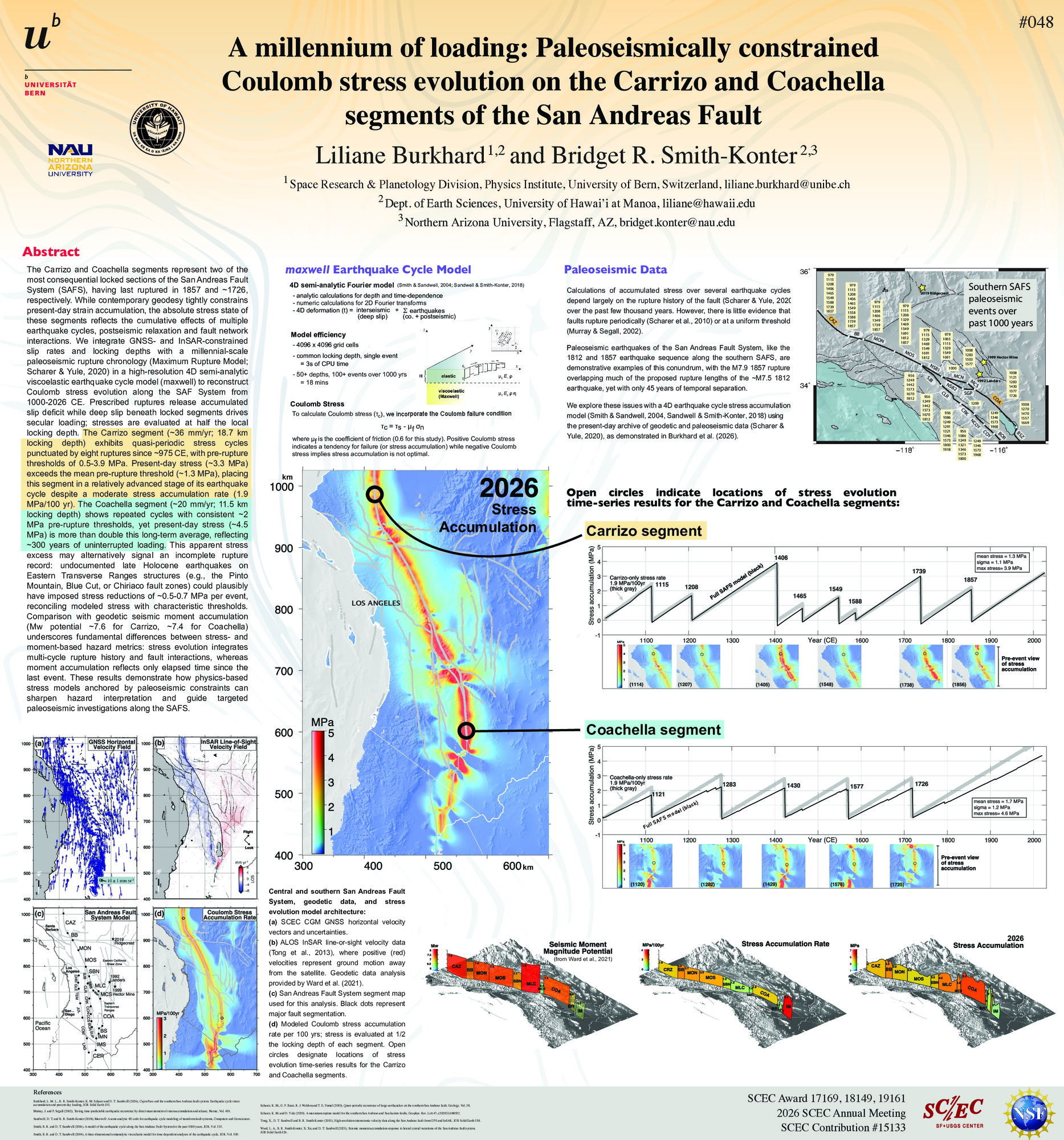 |
SDOT |
A millennium of loading: Paleoseismically constrained Coulomb stress evolution on the Carrizo and Coachella segments of the San Andreas Fault
Liliane Burkhard, Bridget Smith-Konter The Carrizo and Coachella segments represent two of the most consequential locked sections of the San Andreas Fault System (SAFS), having last ruptured in 1857 and ~1726, respectively. While contemporary geodesy tightly constrains present-day strain... more Themes: Earthquake Scenarios for Hazard and Risk Assessment | Earthquake Cycle Simulations & Forecasting |
17169, 18149, 19161
|
Group B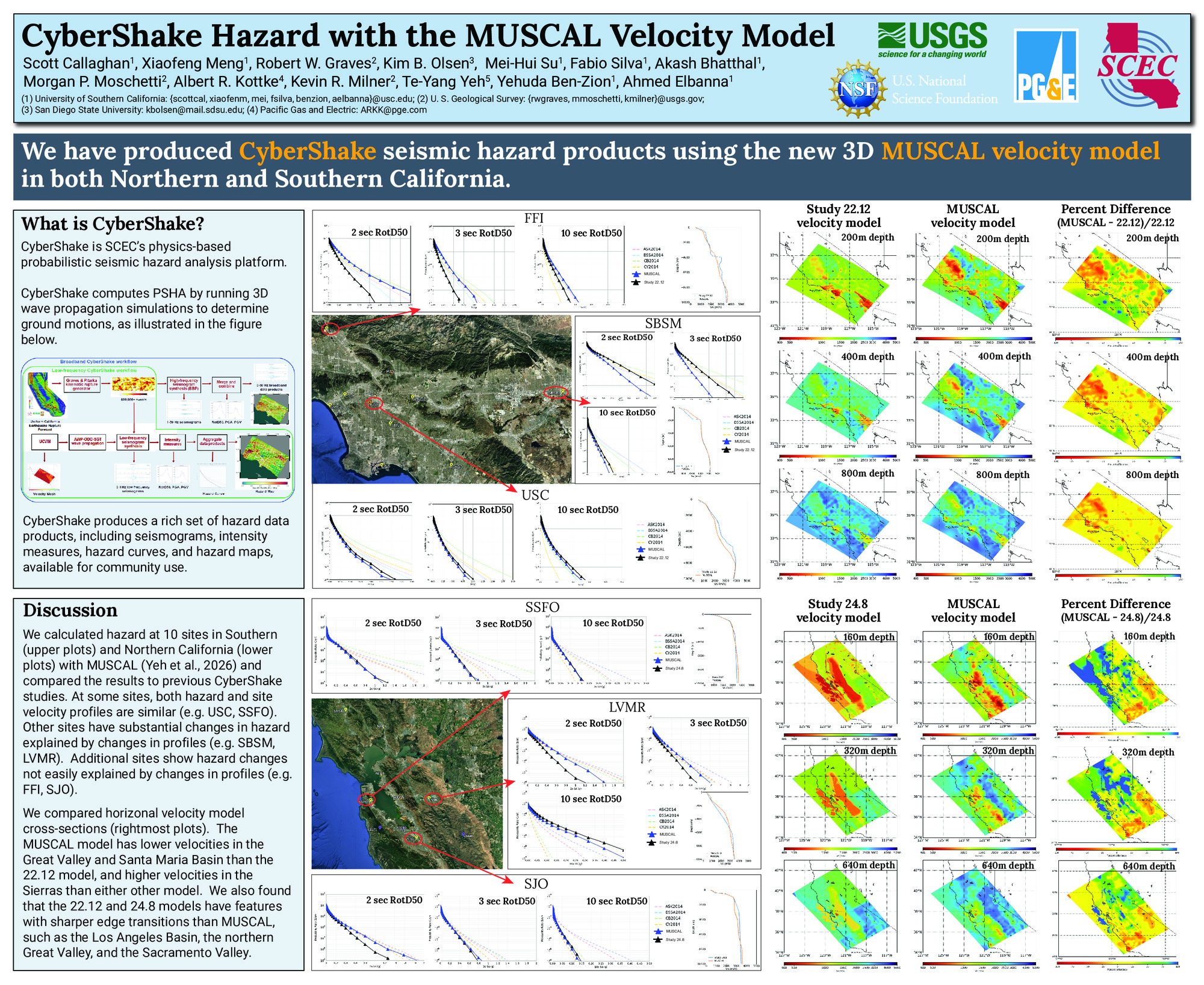 |
GM |
CyberShake hazard with the MUSCAL velocity model
Scott Callaghan, Xiaofeng Meng, Robert Graves, Kim Olsen, Mei-Hui Su, Fabio Silva, Akash Bhatthal, Morgan Moschetti, Albert Kottke, Kevin Milner, Te-Yang Yeh, Yehuda Ben-Zion, Ahmed Elbanna The SCEC CyberShake platform implements physics-based probabilistic seismic hazard analysis in California. CyberShake performs 3D wave propagation simulations using AWP-ODC through velocity meshes generated with UCVM to generate strain Green... more Themes: Physics-Based Ground Motion Simulations & Validation | Utilization of Ground Motion Simulations & Records |
|
|
Talk Tue0800 |
GM |
SCEC’s Physics-Based Seismic Hazard Modeling Platforms
Scott Callaghan Seismic hazard analysis is a key tool for strengthening societal resilience to future damaging earthquakes, and SCEC has long recognized the importance of improving seismic hazard models. This presentation will highlight SCEC's physics-based... more Themes: Physics-Based Ground Motion Simulations & Validation | Utilization of Ground Motion Simulations & Records |
|
Group B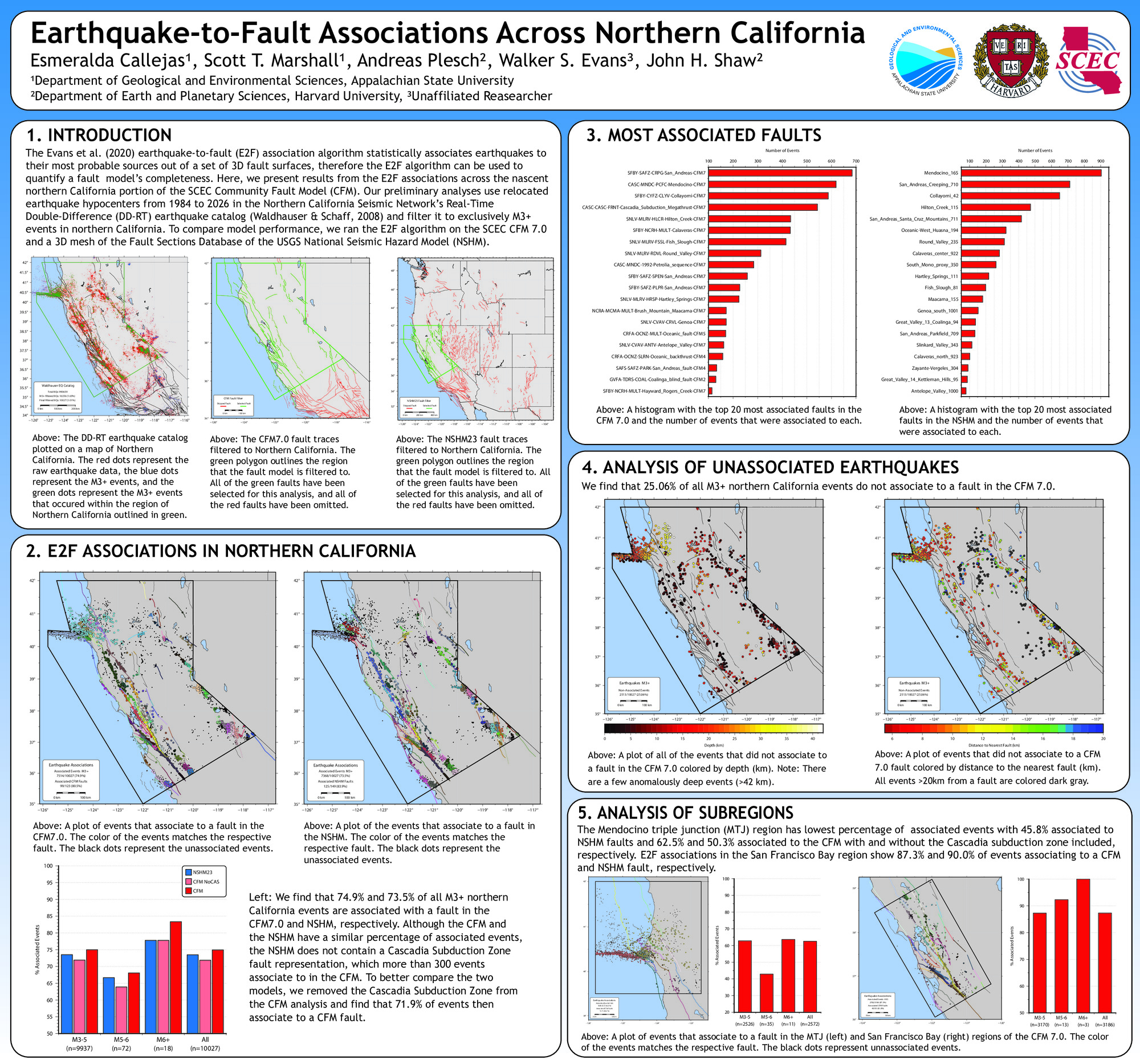 |
CEM |
Earthquake-to-fault associations across northern California
Esmeralda Callejas, Scott Marshall, Andreas Plesch, Walker Evans, John Shaw The Evans et al. (2020) earthquake-to-fault (E2F) association algorithm statistically associates earthquakes to their most probable sources out of a set of 3D fault surfaces. Importantly, the E2F algorithm also assigns a probability to whether... more Themes: Advancing Community Earth Models for Hazard Analyses |
26087
|
|
Group A Poster 095 |
Geology |
Late Quaternary activity of the Waterman Canyon Fault, Devil Canyon, San Bernardino Mountains
Chad Carlson, Scott Lindvall, Andre Mere, Chelsea Blanton, Michael DeFrisco, Thomas Rockwell, Kathleen Rodrigues, Brian Swanson, Kristina Calderon, Benjamin Anderson The Waterman Canyon fault (WCF) is a westerly striking Quaternary active fault in the San Bernardino Mountains (SBM) that appears to splay from the San Andreas fault (SAF) about 10 km ESE of its junction with the San Jacinto fault. Its close... more Themes: Advancing Community Earth Models for Hazard Analyses |
|
Group A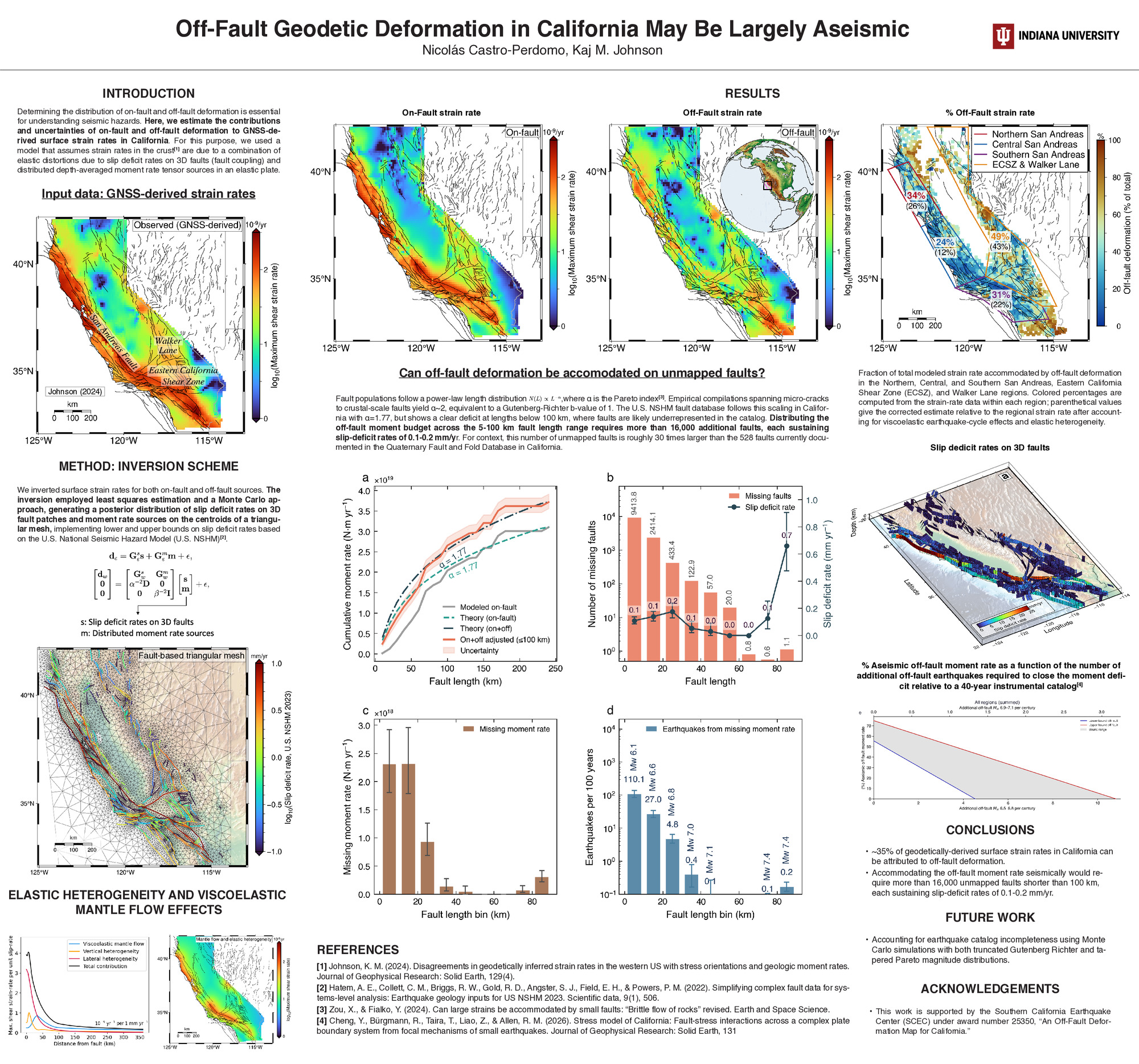 |
Geodesy |
Off-Fault Geodetic Deformation in California May Be Largely Aseismic
Nicolas Castro-Perdomo, Kaj Johnson Geodetic strain rates play a growing role in seismic hazard models, which often assume that most interseismic deformation is ultimately accommodated by seismic slip on faults. A considerable portion of this deformation, however, takes place away... more |
25350
|
|
Group B Poster 238 |
GM |
East Anatolian Fault Shielding Effect on Ground Shaking in Eastern Türkiye
Rufus Catchings The 6 February 2023 Mw 7.8 and Mw 7.6 Kahramanmaraş earthquake sequence in eastern Türkiye was responsible for over 60,000 fatalities and $160 billion in damage in Türkiye and Syria (Milat Internet Archive, 2023; last accessed September 22, 2025),... more Themes: Rapid Post-Earthquake Investigations & Communications |
|
|
Group B Poster 040 |
FARM |
Transient Strain and Electrical Conductivity due to Fault Formation across Laboratory Stepovers
Sara Beth Cebry, Tamara Jeppson, David Lockner, Eric Burdette Natural faults contain discontinuities which may have implications for earthquake hazard assessment and fluid flow. To study the effect of stepover geometry on fault activation, we prepared cylindrical Berea sandstone samples with cemented pre-... more Themes: Earthquake Scenarios for Hazard and Risk Assessment | Earthquake Cycle Simulations & Forecasting |
|
|
Group B Poster 006 |
FARM |
Lithology and Stiffness Controls on Coseismic Fault Weakening and Re-Strengthening in Stick-Slip Friction Experiments
Xiaofeng Chen Earthquake cycles are governed by the accumulation and release of tectonic stress. Stress accumulates on locked faults during interseismic periods and is released rapidly during earthquakes. Consequently, most studies have focused on coseismic... more Themes: Earthquake Cycle Simulations & Forecasting |
25063, 24113
|
|
Group B Poster 100 |
Geology |
Integrated Mapping and Physics-Engine-Based Fragility Modeling of Precariously Balanced Rocks
Zhiang Chen, Ramon Arrowsmith, Christopher Madugo, Albert Kottke Precariously balanced rocks (PBRs) can constrain the upper bounds of earthquake ground motions over long timescales, but their use in seismic hazard assessment is limited by two major challenges: (i) scalable extraction of rock and contact geometry... more Themes: Advancing Community Earth Models for Hazard Analyses | Earthquake Scenarios for Hazard and Risk Assessment |
|
|
Group B Poster 156 |
EFP |
Unrest at Campi Flegrei: Geothermal or Magmatic? Insights from Joint GNSS–InSAR Inversion and Seismicity Analysis
Jinhui Cheng, Zhen Li, Mateo Acosta, Kyungjae Im, Brice Lecampion, Jean-Philippe Avouac Campi Flegrei, a restless caldera near Naples, Italy, has experienced significant ground uplift, elevated seismicity, and intense gas emissions over the past two decades. The physical source driving the observed deformation and seismicity remains... more Themes: Earthquake Cycle Simulations & Forecasting |
|
Group A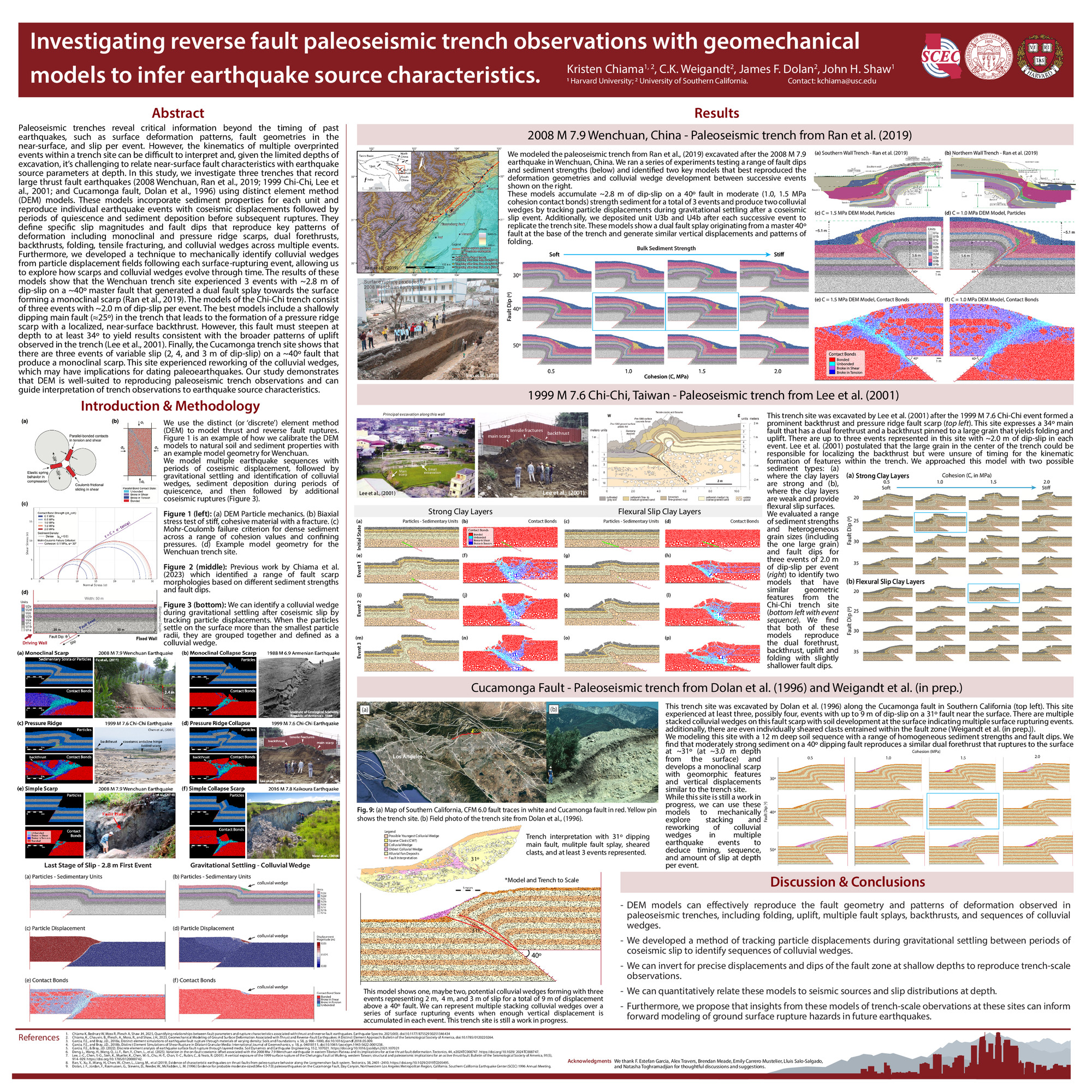 |
FARM |
Investigating reverse fault paleoseismic trench observations with geomechanical models to infer earthquake source characteristics
Kristen Chiama, Caje Kindred Weigandt, James Dolan, John Shaw Paleoseismic trenches reveal critical information beyond the timing of past earthquakes, such as surface deformation patterns, fault geometries in the near-surface, and slip per event. However, the kinematics of multiple overprinted events within a... more Themes: Earthquake Scenarios for Hazard and Risk Assessment |
22013
|
|
Group B Poster 206 |
RC |
Quakeworx: A Community Science Gateway for Earthquake Research, Education, and Cybertraining
Amit Chourasia, Choonhan Youn, Fabio Silva, Bar Oryan, Chunhui Zhao, Jeena Yun, Napat Tainpakdipat, Fabian Kutschera, Akash Bhatthal, Evan Marschall, Francesco Serafini, Benjamin Winjum, Jerome Ronquillo, Philip Maechling, Dave May, Ahmed Elbanna, Alice-Agnes Gabriel, Yehuda Ben-Zion Computational earthquake science increasingly relies on sophisticated simulation software, high-performance computing (HPC), and large research datasets, yet these resources often require substantial computational expertise. Quakeworx addresses this... more Themes: Earthquake Scenarios for Hazard and Risk Assessment | Physics-Based Ground Motion Simulations & Validation | Earthquake Cycle Simulations & Forecasting |
|
|
Group B Poster 208 |
RC |
A GPU-accelerated non-periodic spectral boundary integral method for three-dimensional earthquake-cycle simulations
Federico Ciardo, Anubhav Roy, Pierre Romanet Spectral boundary integral equation methods efficiently simulate fault slip, but their Fourier representation introduces artificial periodic replicas of the modeled fault. Cochard and Rice (1997) developed a theoretical formulation that eliminates... more Themes: Physics-Based Ground Motion Simulations & Validation | Earthquake Cycle Simulations & Forecasting |
|
|
Group A Poster 213 |
EFP |
Toward Ground Motion Forecasting
Tim Clements, Elizabeth Cochran, Sarah Minson, Nicholas van der Elst, Clara Yoon, Annemarie Baltay, Morgan Page, Max Schneider Typically, earthquake forecasts project the expected rate or number of earthquakes in the hours to weeks following a large earthquake. While grounded in the statistics and physics of seismogenesis, earthquake forecasts do not account for local... more Themes: Utilization of Ground Motion Simulations & Records | Earthquake Cycle Simulations & Forecasting | Rapid Post-Earthquake Investigations & Communications |
|
|
Group B Poster 110 |
Seismology |
APPLES-to-APPLES: Optimizing and benchmarking a ground-motion algorithm for ShakeAlert
Elizabeth Cochran, Jessie Saunders, Julian Bunn, Colin O'Rourke, Sarah Minson, Annemarie Baltay, Clara Yoon, Tim Clements Earthquake early warning (EEW) relies on rapid, accurate ground motion predictions to provide warning of potentially damaging shaking. The U.S. ShakeAlert system currently implements algorithms that characterize an earthquake’s source (location,... more Themes: Rapid Post-Earthquake Investigations & Communications |
|
|
Group A Poster 181 |
Seismology |
Rummaging for repeaters: Building a California statewide repeating earthquake catalog
Norma Contreras, Gareth Funning California contains numerous faults that exhibit aseismic slip (creep). In contrast to locked faults, which accumulate stress and can rupture in large, damaging earthquakes, creeping faults display velocity-strengthening behavior. As a result, they... more Themes: Advancing Community Earth Models for Hazard Analyses |
|
|
Group B Poster 154 |
EFP |
Reducing the NSHM23 California Rupture Set for Earthquake Risk Applications and Adapting Time-Dependent Recurrence Models
Heather Crume, Jessica Velasquez, Jochen Woessner, Chris Milliner The 2023 U.S. National Seismic Hazard Model (NSHM23) introduces a substantially updated California crustal fault model, including revised slip rates and expanded multi-fault rupture connectivity. While these updates improve physical realism, the... more Themes: Earthquake Scenarios for Hazard and Risk Assessment | Earthquake Cycle Simulations & Forecasting |
|
|
Group A Poster 207 |
EFP |
A Moment-bounded Epidemic type aftershock sequence model (ETAS)
Kelian Dascher-Cousineau, Rishav Mallick We present a moment-bounded spatiotemporal epidemic-type aftershock sequence (ETAS) model. Tectonic loading replenishes the available moment; earthquakes locally deplete it. The evolving and spatially variable moment budget constrains the maximum... more Themes: Earthquake Cycle Simulations & Forecasting |
|
|
Group A Poster 093 |
Geology |
Luminescence Age Constraints and Slip Rate Estimates for the Mt. Rose Fault Near Reno, Nevada
Carter Dills, Daniel Trugman, Rich Koehler, Kathleen Rodrigues, Steven Wesnousky We report new chronological constraints on two alluvial fan surfaces offset by the Mt. Rose Fault, a range-bounding normal fault located near Reno, Nevada, derived from infrared stimulated luminescence (IRSL) dating of samples collected from... more Themes: Advancing Community Earth Models for Hazard Analyses |
|
|
Group A Poster 129 |
Geology |
Cryptic evolution of fault rocks along the shallow southern San Andreas fault system? Inherited material, shallow burial, and neoformed phases
Alexandra DiMonte, Lydia Bailey, Alexis Ault, Dennis Newell, Audrey Warren, Stephen Cox, Sidney Hemming, Greg Hirth Shallow slip on the southern San Andreas fault (SSAF) system is accommodated in clay-rich gouge, but how clay was incorporated into different faults varies with lithology. It may be inherited from the material the fault cuts or neoformed. We... more |
23081
|
|
Group B Poster 116 |
Seismology |
Towards Fourier Neural Operators for Source and Structural Inversion of the San Francisco Bay Area
Claire Doody, Jiun-Ting Lin, Qingkai Kong, Arthur Rodgers, Luis Vazquez, Caifeng Zou, Youngsoo Choi, Zachary Ross, Kamyar Azizzadenesheli, Robert Clayton Fourier Neural Operators (FNOs) are machine learning methods that approximate solution operators for partial differential equations, enabling efficient calculations of wave propagation. These methods have substantially reduced the computational... more Themes: Advancing Community Earth Models for Hazard Analyses | Physics-Based Ground Motion Simulations & Validation |
|
The Statewide California Earthquake Center is committed to providing a safe, productive, and welcoming environment for all participants. We take pride in fostering a diverse and inclusive SCEC community, and therefore expect all participants to abide by the SCEC Activities Code of Conduct.


