
Group A, Poster #121, Earthquake Geology
Understanding Natural Recurrence of Earthquakes and Slip over Time (UNREST) Technical Activity Group
Michael E. Oskin, Sinan O. Akciz, Kim D. Blisniuk, Sally F. McGill, Thomas K. Rockwell, Alba M. Rodriguez Padilla, Ramon Arrowsmith, Timothy Dawson, Lisa Grant Ludwig, Genya Ishigaki, Ian Pierce, Gordon G. Seitz, Erik Perkins, Sophia Esquenet, & Brian Ducharme





Poster Image:
Poster Presentation
2026 SCEC Annual Meeting, Poster #121, SCEC Contribution #15347 VIEW PDF
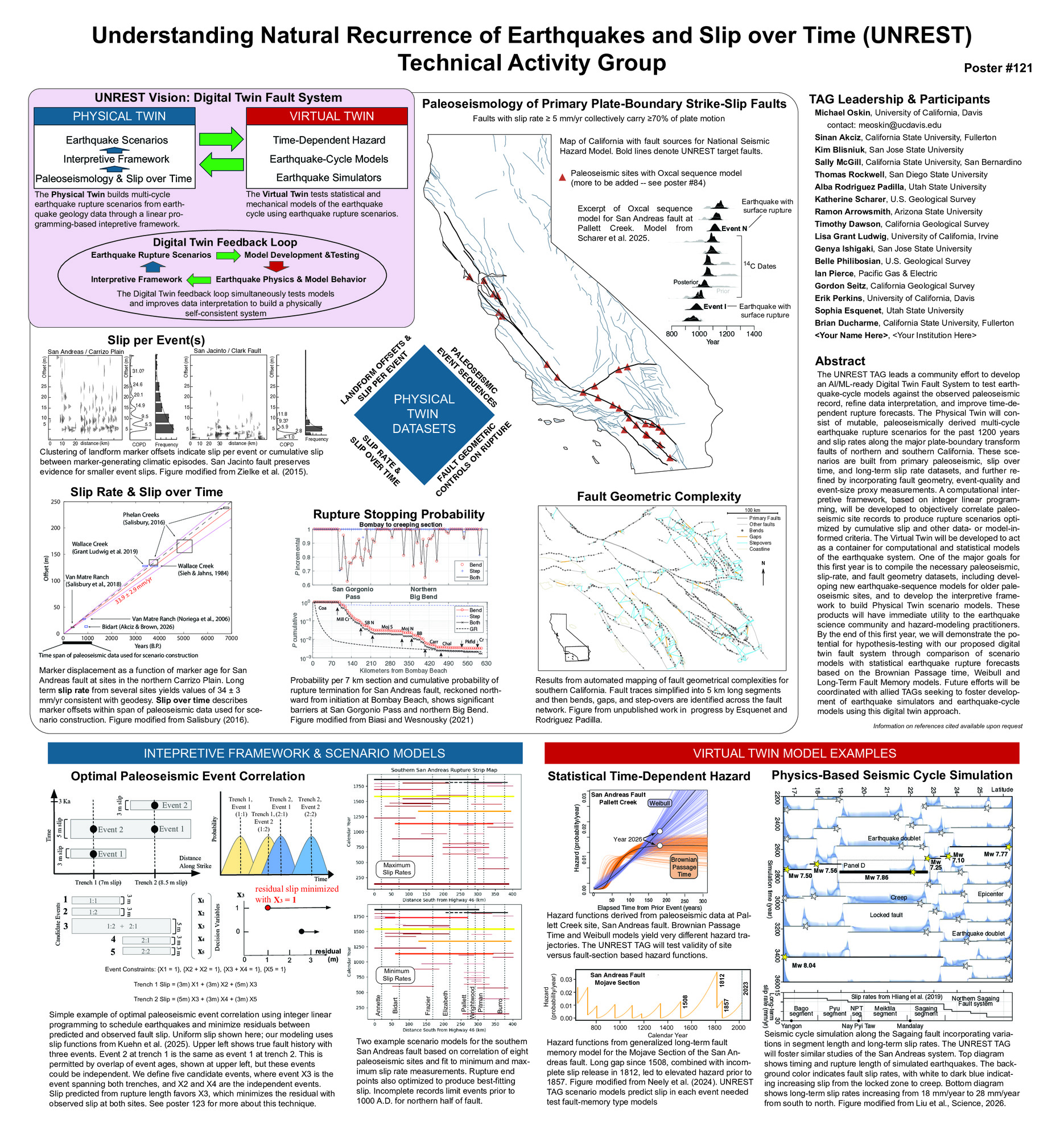
The UNREST TAG leads a community effort to develop an AI/ML-ready Digital Twin Fault System to test earthquake-cycle models against the observed paleoseismic record, refine data interpretation, and improve time-dependent rupture forecasts. The Physical Twin will consist of mutable, paleoseismically derived multi-cycle earthquake rupture scenarios for the past 1200 years and slip rates along the major plate-boundary transform faults of northern and southern California. These scenarios are built from primary paleoseismic, slip over time, and long-term slip rate datasets, and further refined by incorporating fault geometry, event-quality and event-size proxy measurements. A computational interpretive framework, based on integer linear programming, will be developed to objectively correlate paleoseismic site records to produce rupture scenarios optimized by cumulative slip and other data- or model-informed criteria. The Virtual Twin will be developed to act as a container for computational and statistical models of the earthquake system. One of the major goals for this first year is to compile the necessary paleoseismic, slip-rate, and fault geometry datasets, including developing new earthquake-sequence models for older paleoseismic sites, and to develop the interpretive framework to build Physical Twin scenario models. These products will have immediate utility to the earthquake science community and hazard-modeling practitioners. By the end of this first year, we will demonstrate the potential for hypothesis-testing with our proposed digital twin fault system through comparison of scenario models with statistical earthquake rupture forecasts based on the Brownian Passage time, Weibull and Long-Term Fault Memory models. Future efforts will be coordinated with allied TAGs seeking to foster development of earthquake simulators and earthquake-cycle models using this digital twin approach.
Citation: Oskin, M. E., Akciz, S. O., Blisniuk, K. D., McGill, S. F., Rockwell, T. K., Rodriguez Padilla, A. M., Arrowsmith, R., Dawson, T., Grant Ludwig, L., Ishigaki, G., Pierce, I., Seitz, G. G., Perkins, E., Esquenet, S., & Ducharme, B. (2026, 08). Understanding Natural Recurrence of Earthquakes and Slip over Time (UNREST) Technical Activity Group. Poster Presentation at 2026 SCEC Annual Meeting.
SCEC Award: 26076
Relevant SCEC Themes:
Advancing Community Earth Models for Hazard Analyses
Earthquake Scenarios for Hazard and Risk Assessment
Earthquake Cycle Simulations & Forecasting
MORE POSTERS BY THE AUTHORS
|
|
|
|
|


