

| AGENDA | POSTERS | PARTICIPANTS | ABSTRACTS | TRAVEL | FAQ |
Meeting Abstracts
The Statewide California Earthquake Center (SCEC) collaborates with academic, government, industry, and other organizations to advance earthquake science, community resilience, and education by: (1) Gathering and analyzing data from field observations and laboratory experiments. (2) Developing system-level models and simulations of earthquake processes to synthesize knowledge as a physics-based understanding of seismic hazard. (3) Communicating that understanding to expand knowledge and reduce earthquake risk.
Participants are invited to present recent work aligned with SCEC priorities during the poster sessions.
| SCEC ID | Category | Title and Authors | SCEC Award |
|---|---|---|---|
|
Group A Poster 097 |
Geology |
Assessing evidence for late Quaternary right-lateral slip along the Mission-Mill Creek fault in the Eastern San Bernardino Mountains, Southern California
Miranda Owen, Sally McGill, Burakhan Gedik Published fault slip rates for the Mission-Mill Creek strand of the San Andreas fault in Southern California range from 0 to 30 mm/yr, obscuring our understanding of the fault activity, slip transfer, and earthquake hazards in this complex tectonic... more Themes: Earthquake Scenarios for Hazard and Risk Assessment |
|
|
Group B Poster 012 |
FARM |
Periodic and chaotic aseismic and seismic slip sequences on rate-state faults in three dimensions with two loading approaches
So Ozawa, Robert Viesca Faults can slip in both seismic and aseismic ways. In the framework of rate-state friction, velocity-weakening faults of a comparable size to the nucleation size produce slow slip events (Liu and Rice, 2007; Barbot 2019). This is a classic... more Themes: Earthquake Cycle Simulations & Forecasting |
|
|
Group B Poster 150 |
EFP |
A Bayesian Framework for Inferring Probabilistic Date of Last Event Between Sites with Paleoseismic Data
Morgan Page Modern seismic hazard models such as the Uniform California Earthquake Rupture Forecast, version 3 (UCERF3) and the 2023 National Seismic Hazard Model (NSHM23) represent fault-based earthquake sources on complex, interconnected fault networks. Some... more Themes: Advancing Community Earth Models for Hazard Analyses | Earthquake Cycle Simulations & Forecasting |
|
|
Group A Poster 191 |
Seismology |
Predictive Distributions as a Data-Driven Indicator for Phase-Pick Confidence
Yongsoo Park, Nathan Stevens, Brent Delbridge Reliable uncertainty estimates are essential for using neural-network phase pickers in automated seismic monitoring and catalog construction. Using the Pacific Northwest Seismic Network dataset, we show that the spread of predicted probability mass... more |
|
|
Group B Poster 122 |
Seismology |
Using a Ground-Motion Modeling Framework to Fit Stress Drops for the SCEC Community Stress Drop Validation TAG Synthetic Exercise
Grace Parker I fit spectral stress drop, linear site amplification, and kappa (the high frequency attenuation parameter), to synthetically generated earthquake ground motion Fourier amplitude spectra (FAS) as part of the SCEC Community Stress Drop Validation... more Themes: Utilization of Ground Motion Simulations & Records |
|
Group A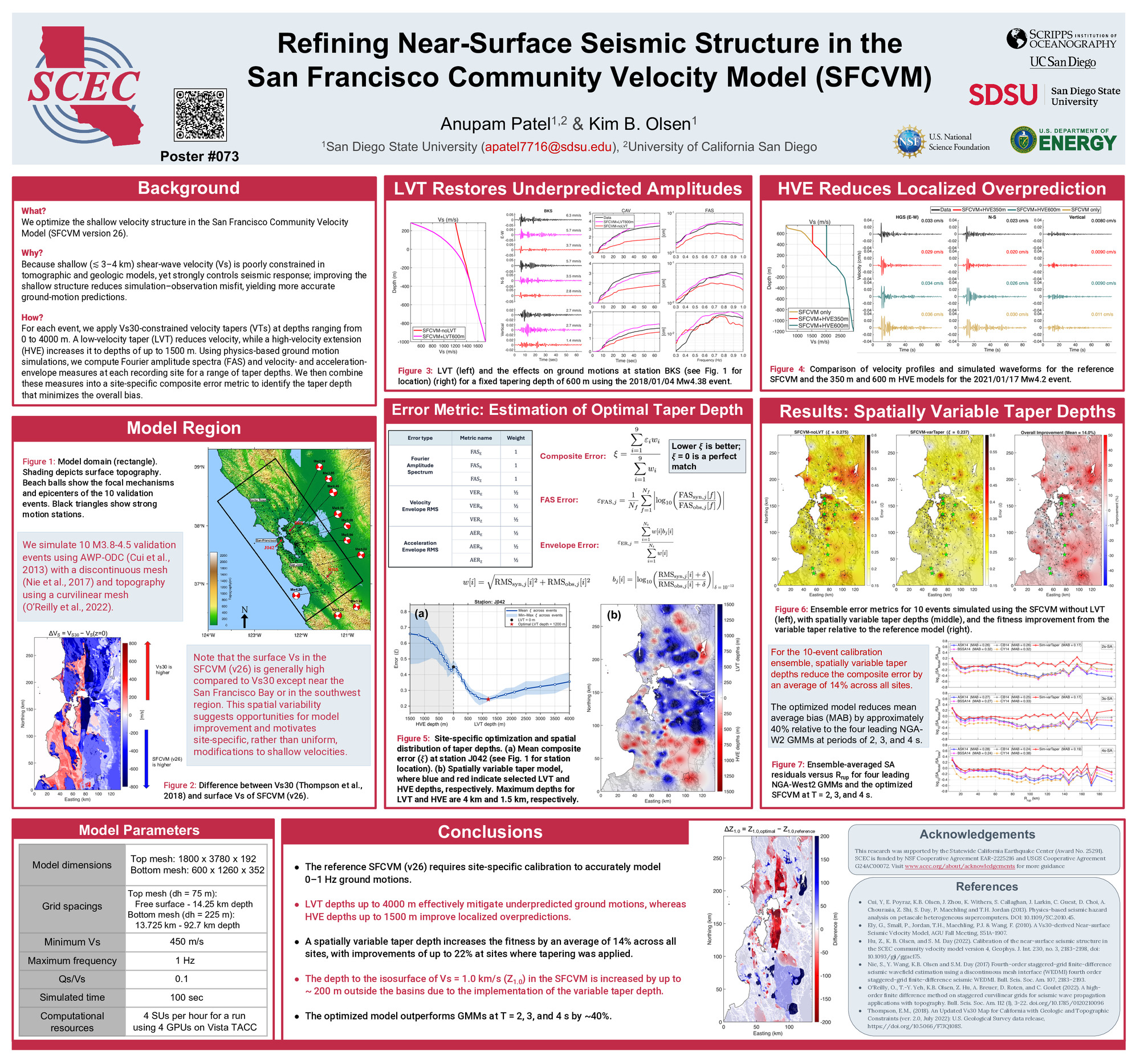 |
CEM |
Refining Near-Surface Seismic Structure in the San Francisco Community Velocity Model (SFCVM)
Anupam Patel, Kim Olsen Accurate 3-D physics-based ground-motion prediction in the San Francisco Bay Area requires a well-calibrated near-surface velocity structure. Here, we refine the upper few kilometers of the San Francisco Community Velocity Model (SFCVM version 26)... more Themes: Advancing Community Earth Models for Hazard Analyses | Physics-Based Ground Motion Simulations & Validation |
25291
|
|
Group A Poster 169 |
Seismology |
Systematic measurements of rupture directivity for M3+ earthquakes in California
Anne Patton, Daniel Trugman Rupture directivity is an important but poorly characterized earthquake source property that can directly affect the azimuthal distribution of ground motions and, consequently, earthquake hazard. Directivity has been measured for many moderate-to-... more Themes: Utilization of Ground Motion Simulations & Records | Earthquake Cycle Simulations & Forecasting |
23116
|
|
Talk Tue0800 |
GM |
SCEC Ground Motion Tools Supporting Engineering Applications
Edric Pauk SCEC has developed a suite of community products that connect earthquake science and ground motion simulations with engineering and risk analyses. This presentation highlights four complementary tools and their roles in engineering applications: (1... more Themes: Physics-Based Ground Motion Simulations & Validation | Utilization of Ground Motion Simulations & Records |
|
|
Talk Tue1400 |
CCB |
Closing the Earthquake Science to Public Action Gap
Lori Peek Over the decades, scientists and engineers have generated profoundly important insights regarding earthquake risk, impacts, and recovery. Yet, in many cases, available evidence is not being used or acted upon by decisionmakers or members of the... more Themes: Engaging Communities in Earthquake Preparedness |
|
|
Group B Poster 034 |
FARM |
Machine Learning Enhanced Earthquakes Reveal Stress Changes in Icelandic Geothermal Fields
Colin Pennington, Egill Guðnason, Þorbjörg Ágústsdóttir, Anette Mortensen , Rögnvaldur Magnússon Krafla and Þeistareykir geothermal fields in northeast Iceland are respectively one of the oldest and one of the newest geothermal operations in Iceland. Since 2006, continuous monitoring by Iceland GeoSurvey (ÍSOR) for Landsvirkjun has produced a... more |
|
|
Group B Poster 070 |
Geodesy |
Binary Probabilistic Inference of Megathrust Segmentation in the Presence of Slow Slip Events: Insights from the Mexico Subduction Zone
Axel Periollat, Gareth Funning, Roland Bürgmann Subduction megathrusts are frictionally heterogeneous, with locked patches – the sources of major earthquakes – embedded within broader stably-sliding and transitional domains. Identifying compact locked areas is challenging because GNSS velocities... more Themes: Earthquake Scenarios for Hazard and Risk Assessment | Earthquake Cycle Simulations & Forecasting |
|
Group A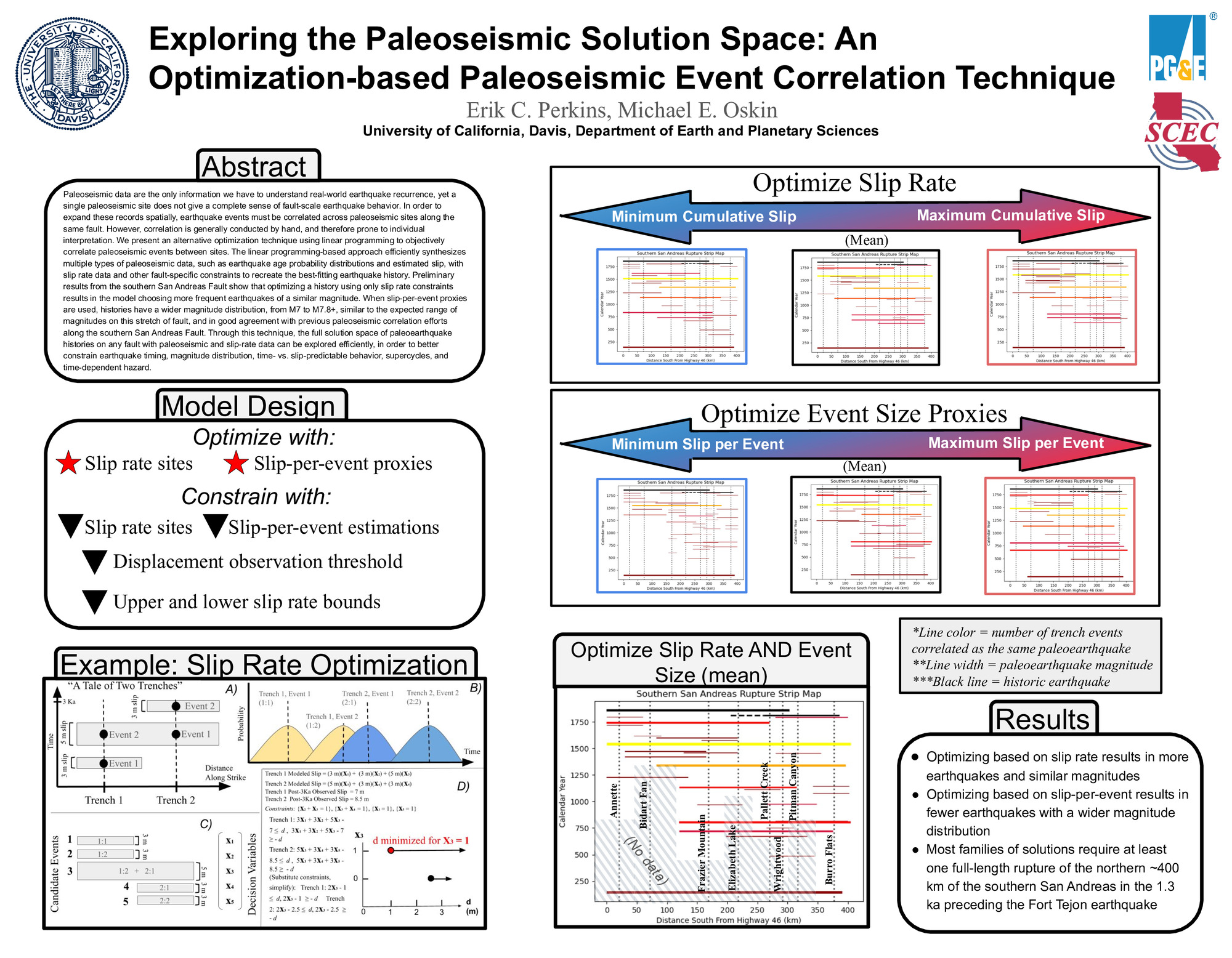 |
Geology |
Exploring the Paleoseismic Solution Space: An Optimization-based Paleoseismic Event Correlation Technique
Erik Perkins Paleoseismic data are the only information we have to understand real-world earthquake recurrence, yet a single paleoseismic site does not give a complete sense of fault-scale earthquake behavior. In order to expand these records spatially,... more Themes: Earthquake Scenarios for Hazard and Risk Assessment |
|
|
Group A Poster 105 |
Geology |
Do earthquakes rupture through the creeping section of the San Andreas Fault? Evidence from geology
Belle Philibosian, Jessie Vermeer, Evelyn Usher, Charles Trexler, Travis Alongi, Austin Elliott, Morena Hammer, Catherine Hanagan, Stephen DeLong The 150-km-long central creeping section of the San Andreas Fault moves gradually at nearly the long-term fault slip rate (~35 mm/yr) and has no historical seismicity greater than M6 except for the repeated ruptures at Parkfield in the southern... more Themes: Earthquake Cycle Simulations & Forecasting |
|
Group B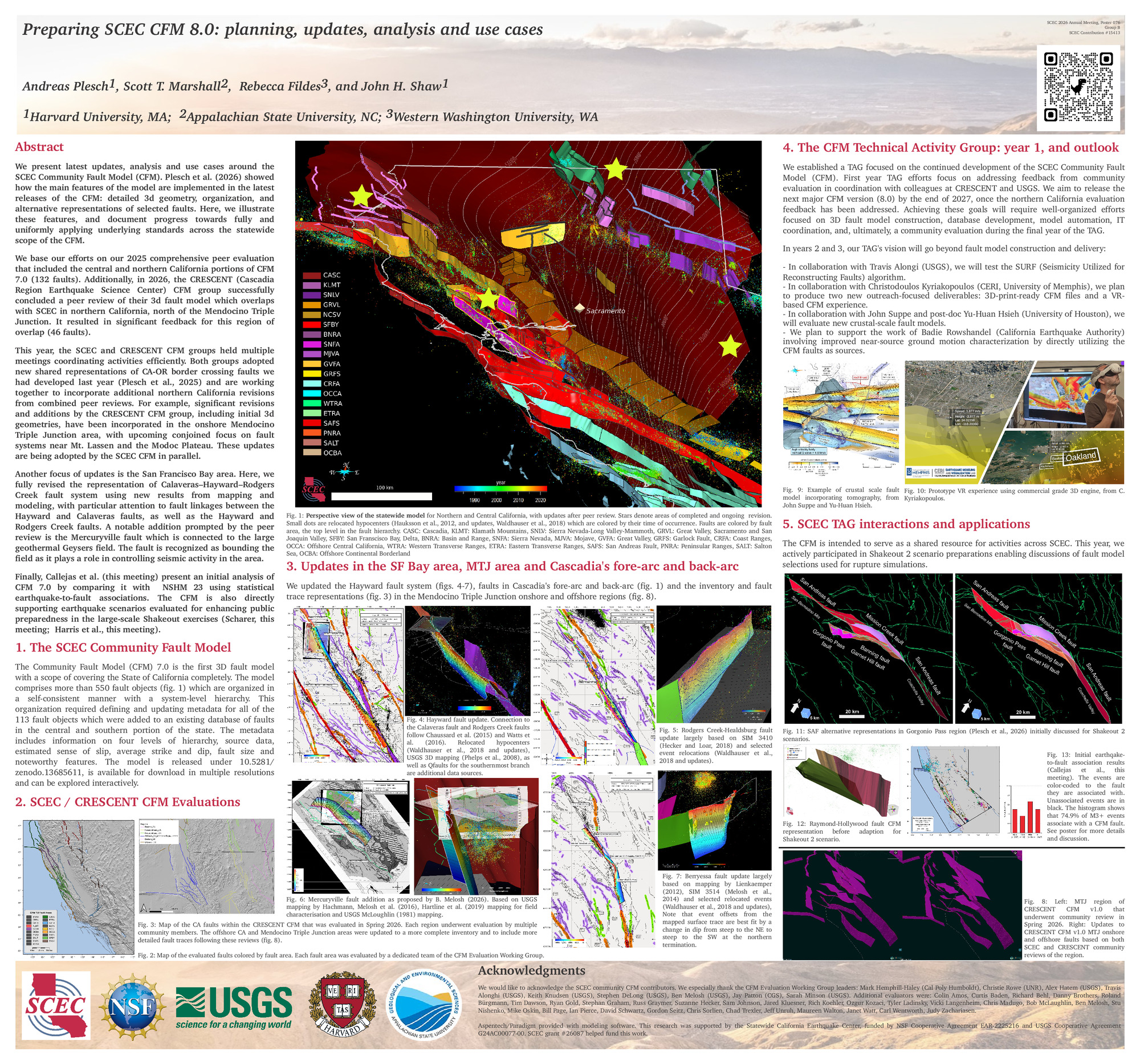 |
CEM |
Planning SCEC CFM 8.0 and the TAG: updates, analysis and use cases
Andreas Plesch, Scott Marshall, Rebecca Fildes, John Shaw We present latest updates, analysis and use cases around the SCEC Community Fault Model (CFM). Plesch et al. (2026) showed how the main features of the model are implemented in the latest releases of the CFM: detailed 3d geometry, organization, and... more Themes: Advancing Community Earth Models for Hazard Analyses |
26087
|
|
Group A Poster 117 |
Geology |
A Global Database of Strike-Slip Surface Ruptures
Nadine Reitman, Rich Briggs Every surface-rupturing earthquake provides a unique opportunity to refine understanding of earthquake behavior, how the crust breaks, and how earthquakes are related. These empirical earthquake data form the backbone of earthquake scaling... more Themes: Advancing Community Earth Models for Hazard Analyses | Rapid Post-Earthquake Investigations & Communications |
|
Group B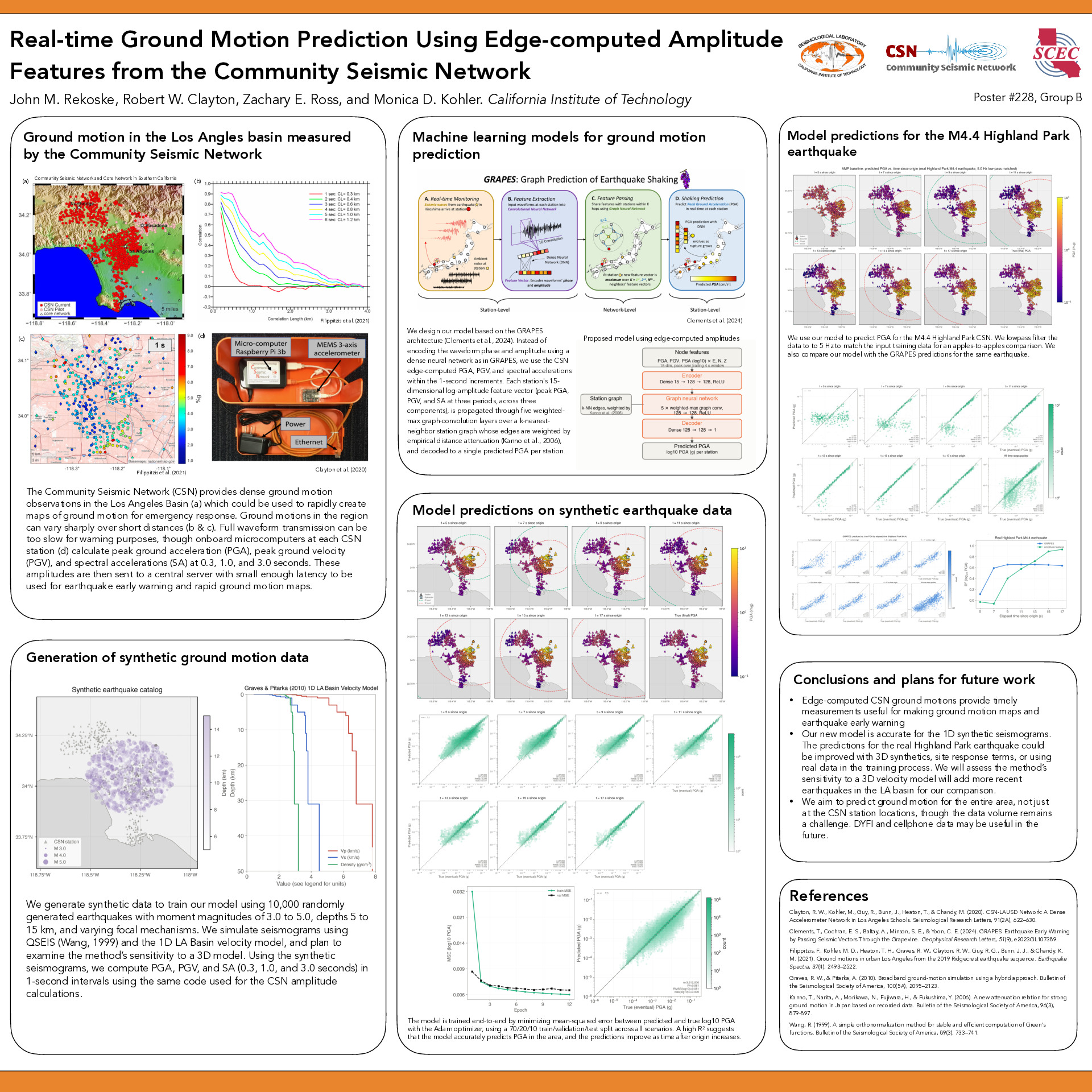 |
GM |
Real-time Ground Motion Prediction Using Edge-computed Amplitude Features from the Community Seismic Network
John Rekoske, Robert Clayton, Zachary Ross, Monica Kohler Ground motion in the urban Los Angeles basin can vary sharply over short distances, and capturing that variability in real time is essential for effective earthquake early warning and damage estimates. Transmitting full waveforms from a dense... more Themes: Utilization of Ground Motion Simulations & Records | Rapid Post-Earthquake Investigations & Communications |
|
Group B |
Seismology |
Covariance-Informed Identification of Repeating Earthquakes
Rosamiel Ries, Gregory Beroza, William Ellsworth Quantifying the degree of source overlap between potential repeating earthquake pairs has been identified as important test for the identification of the repeating earthquakes. Assessment is commonly based on their separation, reported uncertainty,... more |
|
Group B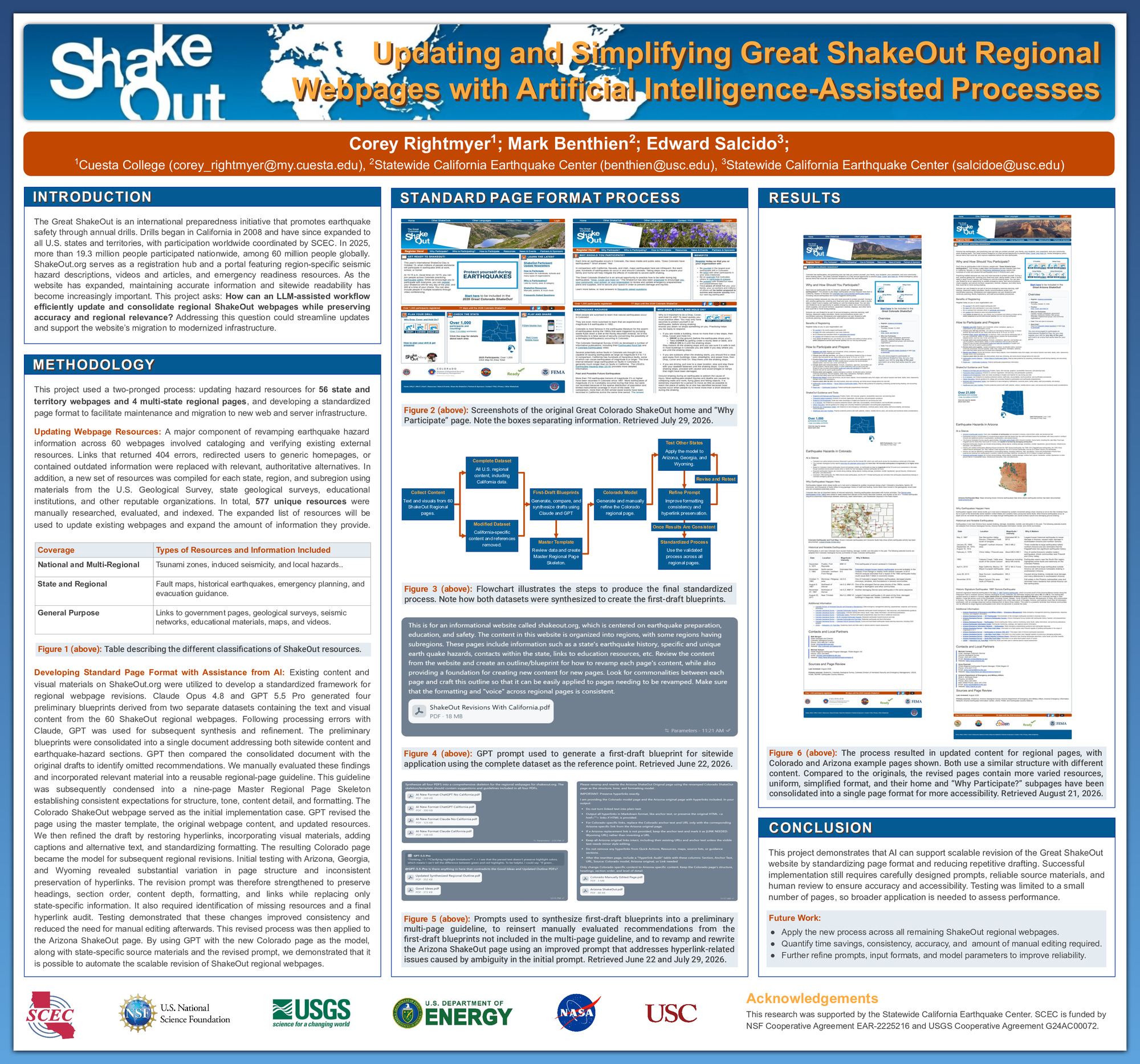 |
CCB |
Updating and Simplifying Great ShakeOut Regional Webpages with Artificial Intelligence-Assisted Processes
Corey Rightmyer, Mark Benthien, Edward Salcido Great ShakeOut Earthquake Drills began in California in 2008 and have expanded to all U.S. states and territories, with participation worldwide coordinated by SCEC. In 2025, more than 19.3 million people participated nationwide, among more than 60... more Themes: Earthquake Scenarios for Hazard and Risk Assessment | Engaging Communities in Earthquake Preparedness |
|
|
Group A Poster 053 |
Geodesy |
Investigating the complex multi-segment rupture of the 2025 M 6.0 Afghanistan earthquake from Sentinel-1 InSAR data
Karlee Rivera The M 6.0 2025 Afghanistan earthquake occurred in northeastern Afghanistan within the southern region of the Pamir-Hindu Kush. Afghanistan has a limited local seismic network and restricted field access, so remote sensing, particularly InSAR, is the... more Themes: Rapid Post-Earthquake Investigations & Communications |
|
Group A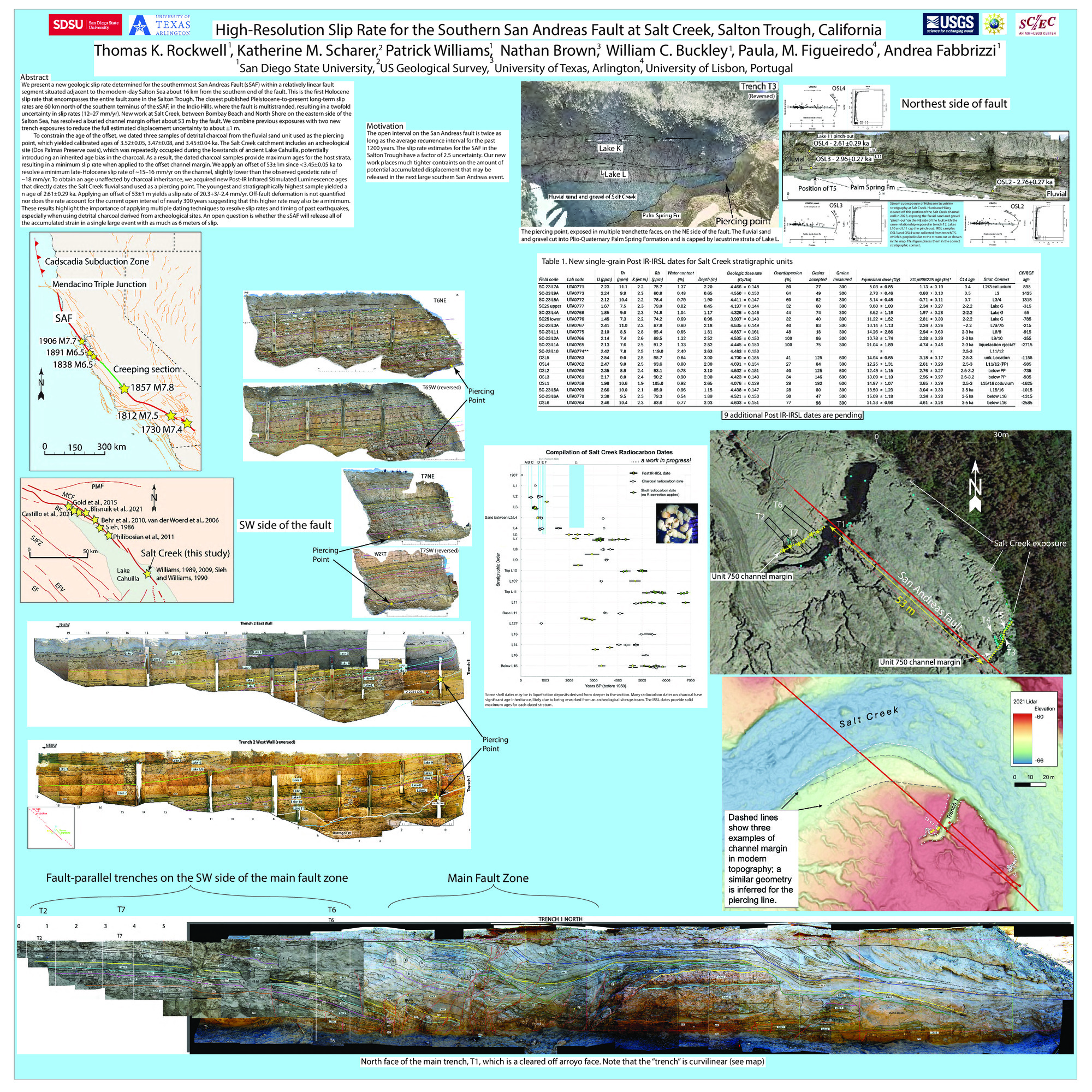 |
Geology |
High Resolution Holocene Slip Rate for the Southern San Andreas Fault at Salt Creek, Salton Trough, California
Thomas Rockwell, Katherine Scharer, Nathan Brown, William Buckley, Paula Figueiredo, Andrea Fabbrizzi, Patrick Williams We present a new geologic slip rate determined for the southernmost San Andreas Fault (sSAF) within a relatively linear fault segment situated adjacent to the modern-day Salton Sea about 16 km from the southern end of the fault. This is the first... more Themes: Advancing Community Earth Models for Hazard Analyses |
26076
|
|
Group A Poster 071 |
CEM |
Full Waveform Inversion Tomography of the San Francisco Bay Area
Arthur Rodgers, Claire Doody, Jiun-Ting Lin, Qingkai Kong We present a new three-dimensional seismic-wave-speed model for the San Francisco Bay Area (SFBA) inferred from full waveform inversion of local earthquake data. The 160 km by 160 km model domain covers San Francisco, San Jose, Oakland, the East... more Themes: Advancing Community Earth Models for Hazard Analyses | Physics-Based Ground Motion Simulations & Validation | Utilization of Ground Motion Simulations & Records |
|
|
Talk Mon1000 |
FARM |
From Seconds to Millennia: Fault Mechanics Across the Earthquake Cycle
Alba Rodriguez Padilla Surface ruptures are the foundation of the Quaternary record, illuminating coseismic processes in exceptional detail and ultimately encoding the recurrence of large earthquakes across a fault system. This talk journeys through observations from... more Themes: Earthquake Cycle Simulations & Forecasting | Rapid Post-Earthquake Investigations & Communications |
|
|
Group B Poster 056 |
SDOT |
A Preliminary 3D Mechanical Model of Central California Fault Slip Rates
Francisco Roland-Sagui, Scott Marshall Central California contains a complex network of strike-slip and reverse faults that pose significant seismic hazard to local populations and their infrastructure. Compared to other regions in California, many of these faults are poorly studied and... more Themes: Advancing Community Earth Models for Hazard Analyses | Earthquake Cycle Simulations & Forecasting |
|
|
Group A Poster 145 |
Seismology |
A Machine-Learning-Enhanced Catalog of California Statewide Seismicity over Two Decades
Bo Rong, Weiqiang Zhu, Ian McBrearty, Gregory Beroza Microseismicity provides important insights into fault geometries at seismogenic depths, and its spatiotemporal characteristics can provide constraints on the mechanics of earthquake nucleation and rupture. The detection of small earthquakes, though... more Themes: Earthquake Scenarios for Hazard and Risk Assessment |
|
Group B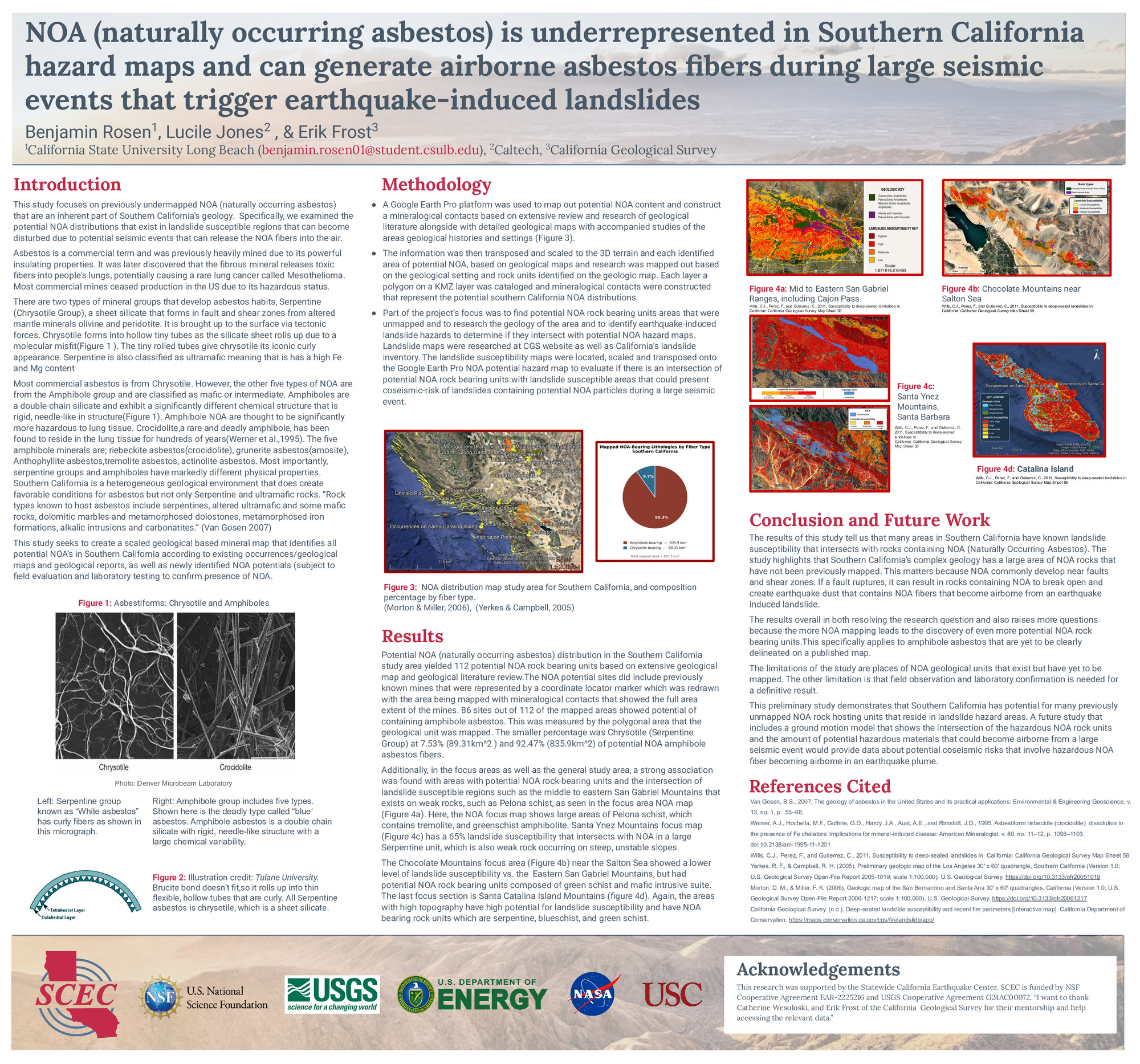 |
Geology |
NOA (naturally occurring asbestos) is underrepresented in Southern California hazard maps and can generate airborne asbestos fibers during large seismic events that trigger earthquake-induced landslides
Benjamin Rosen, Lucile Jones, Erik Frost, Catherine Wesoloski, Brenda Callen NOA (Naturally Occurring Asbestos) is prominent in the Southern California landscape, and
documented occurrences are known in 10 counties, which are Imperial, San Diego, Riverside, Orange, San Bernardino, Los Angeles, Ventura, Santa Barbara, and... more Themes: Earthquake Scenarios for Hazard and Risk Assessment |
|
|
Group B Poster 158 |
EFP |
Towards geothermally induced earthquake forecasting using California’s open data
Meggy Rossbach, Zhengfa Bi, Nori Nakata, Emily Brodsky Energy production from geothermal fields is a growing field in the energy sector. Increase in production often comes along with increased induced seismicity, where operations are regulated by the retro-active traffic light system. While induced... more Themes: Earthquake Cycle Simulations & Forecasting |
|
Group B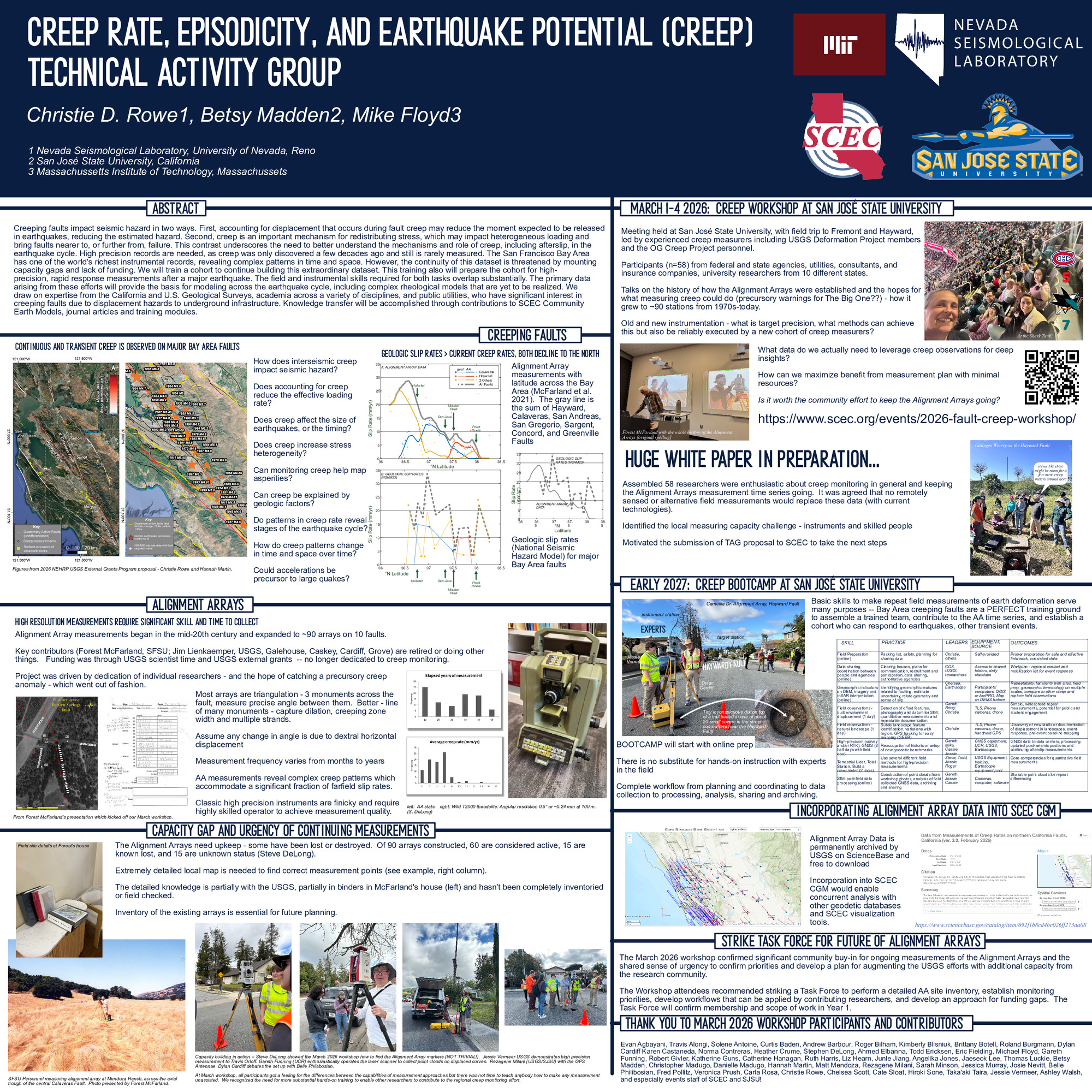 |
Geology |
CREEP: Creep Rate, Episodicity, and Earthquake Potential - Technical Activity Group
Christie Rowe, Elizabeth Madden, Michael Floyd Creeping faults impact seismic hazard in two ways. First, accounting for displacement that occurs during fault creep may reduce the moment expected to be released in earthquakes, reducing the estimated hazard. Second, creep is an important mechanism... more Themes: Advancing Community Earth Models for Hazard Analyses | Rapid Post-Earthquake Investigations & Communications |
26066
|
Group A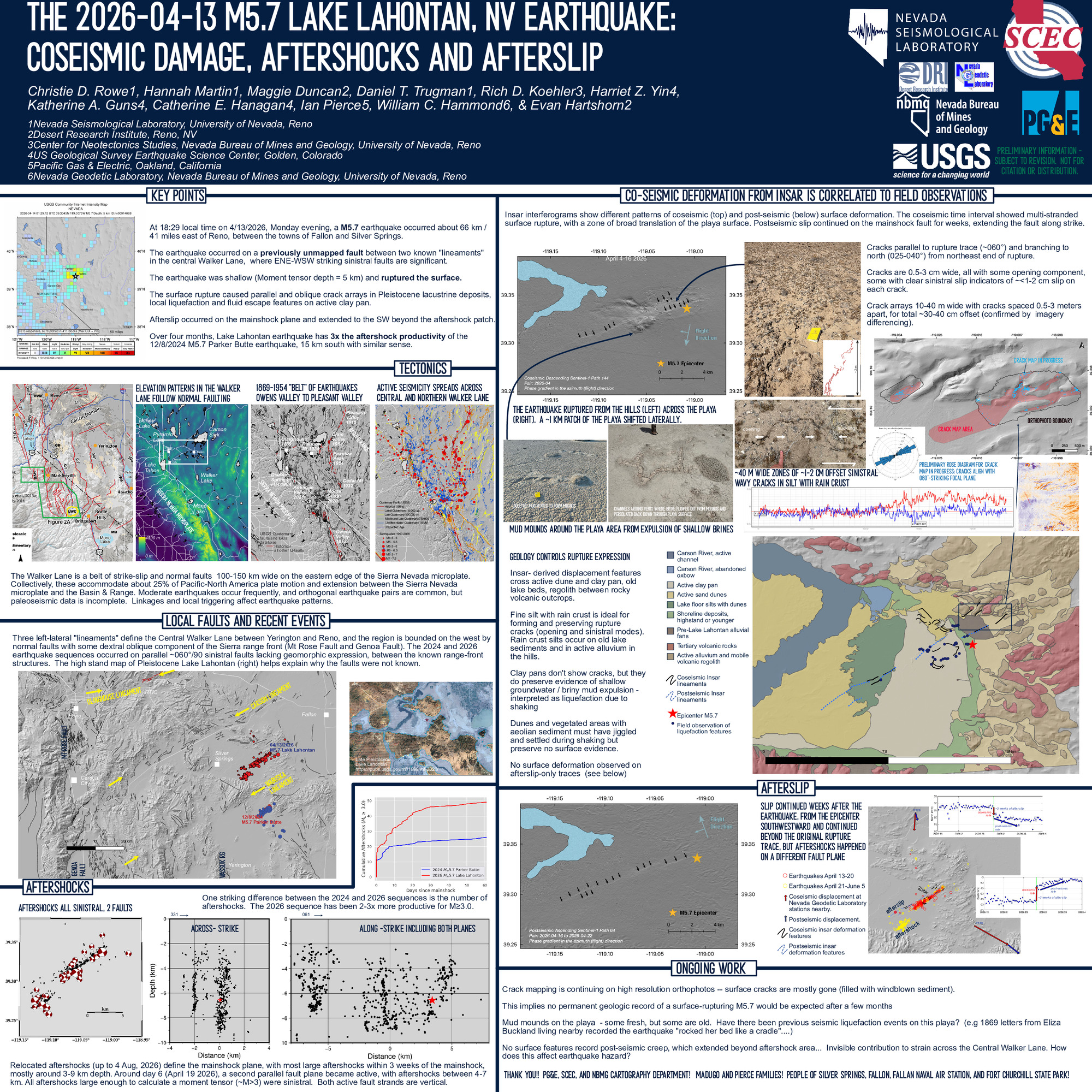 |
Geology |
The 2026-04-13 M5.7 Lake Lahontan, NV Earthquake: coseismic damage, aftershocks and afterslip
Christie Rowe, Hannah Martin, Maggie Duncan, Daniel Trugman, Rich Koehler, Harriet Yin, Katherine Guns, Catherine Hanagan, Ian Pierce, William Hammond, Evan Hartshorn The Lake Lahontan M5.7 earthquake occurred on April 13, 2026, in the Dead Camel Mountains between Fallon and Silver Springs, NV. Historic adobe buildings were damaged, but otherwise shaking caused only minor, mostly non-structural damage. The... more Themes: Rapid Post-Earthquake Investigations & Communications |
|
Group A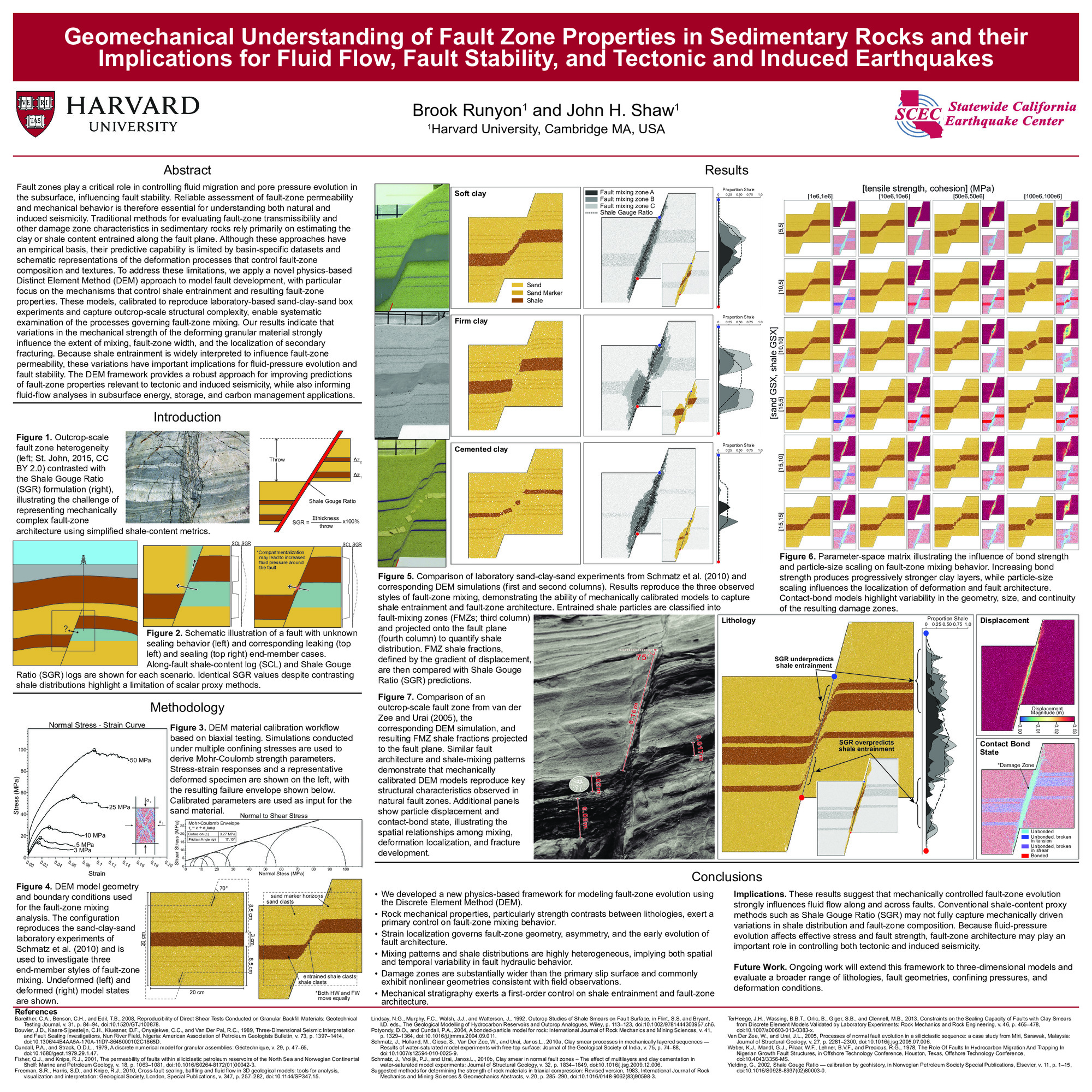 |
FARM |
Geomechanical Understanding of Fault Zone Properties in Sedimentary Rocks and their Implications for Fluid Flow, Fault Stability, and Tectonic and Induced Earthquakes
Brook Runyon, John Shaw Fault zones play a critical role in controlling fluid migration and pore pressure evolution in the subsurface, influencing fault stability. Reliable assessment of fault-zone permeability and mechanical behavior is therefore essential for... more Themes: Physics-Based Ground Motion Simulations & Validation |
|
|
Group B Poster 108 |
Geology |
Assessing potential multi-segment large-magnitude paleo-earthquakes on the Compton blind thrust fault beneath metropolitan Los Angeles
Matthew Salinas, Lorraine Leon, Chris Anthonissen, James Dolan, John Shaw, Thomas Pratt The Compton thrust is a 40-km-long blind thrust fault extending beneath the western part of the Los Angeles metropolitan region. An earlier paleoseismological study by Leon et al. (2009) utilized seismic reflection profiles and a transect of... more |
|
|
Group B Poster 132 |
Seismology |
ELVIS: Mapping Las Vegas Valley Basin Resonance utilizing HVSR methods
Delton Samuel, Heather Ford, Joseph Byrnes, Rufus Catchings The population of the Las Vegas Valley Basin (LVVB) in Nevada exceeds 1.7 million people and is exposed to significant seismic hazards within the LVVB, where its shallow subsurface is known to be composed of 1 to 5 km of clastic fill. The... more Themes: Advancing Community Earth Models for Hazard Analyses |
|
|
Group A Poster 107 |
Geology |
Structural and Geochemical Characterization of the Elsinore Fault in the Coyote Mountains, Southern California
Victor Sanchez, Rafael Almeida, Thomas Rockwell, William Griffith Fault damage zones record cumulative deformation produced by fault growth and repeated earthquake rupture. We investigate how lithology, structural position, and fluid–rock interaction influence damage across a 50-m transect through the main strand... more |
|
Group B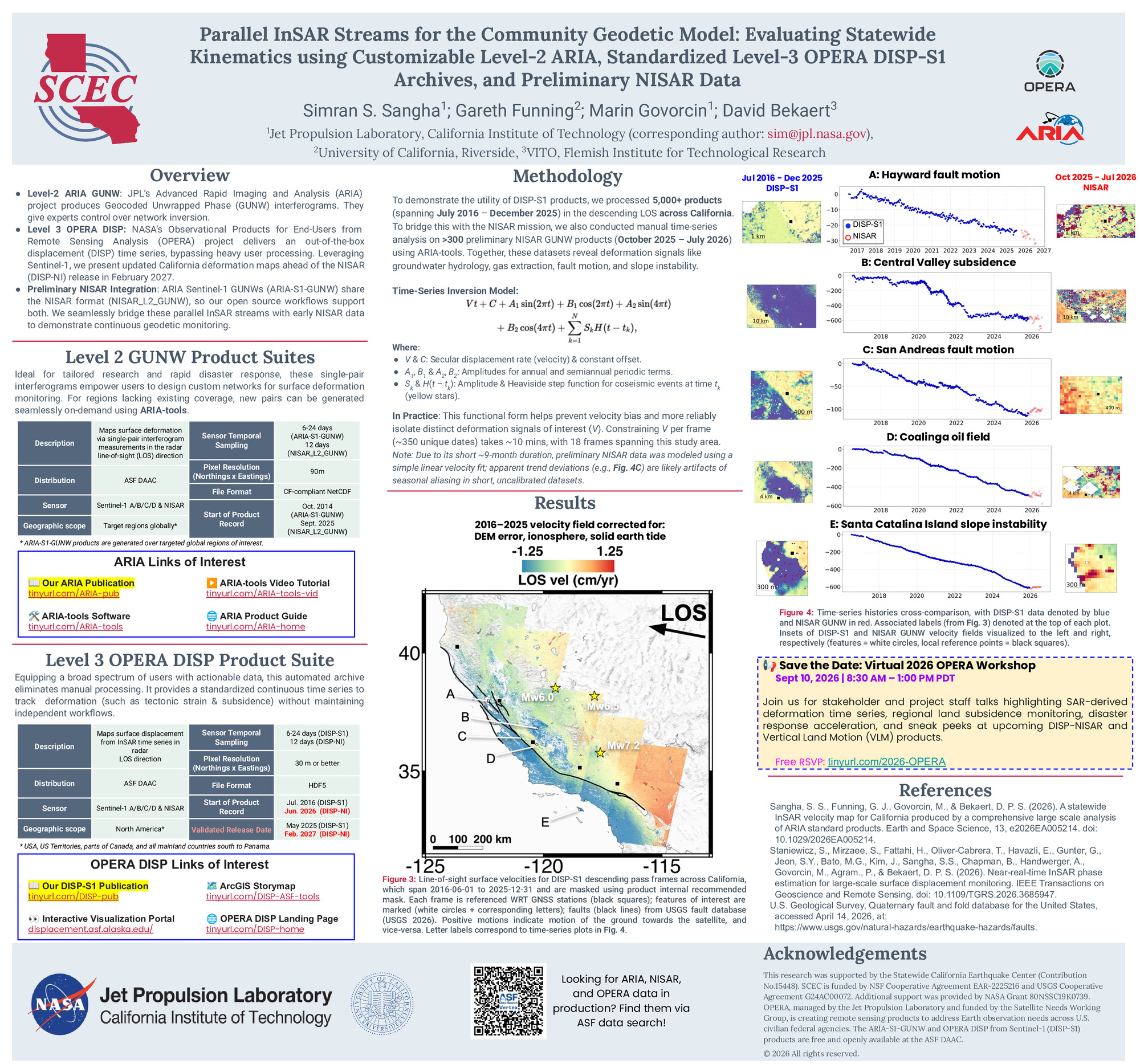 |
Geodesy |
Parallel InSAR Streams for the Community Geodetic Model: Evaluating Statewide Kinematics using Customizable Level-2 ARIA, Standardized Level-3 OPERA DISP-S1 Archives, and Preliminary NISAR Data
Simran Sangha, Gareth Funning, Marin Govorcin, David Bekaert Over the past several years, our efforts have focused on expanding and refining InSAR time-series analysis to support the Statewide California Earthquake Center (SCEC) Community Geodetic Model (CGM). Here, we present a high-resolution (90-meter)... more Themes: Advancing Community Earth Models for Hazard Analyses |
25141, 24081
|
Group A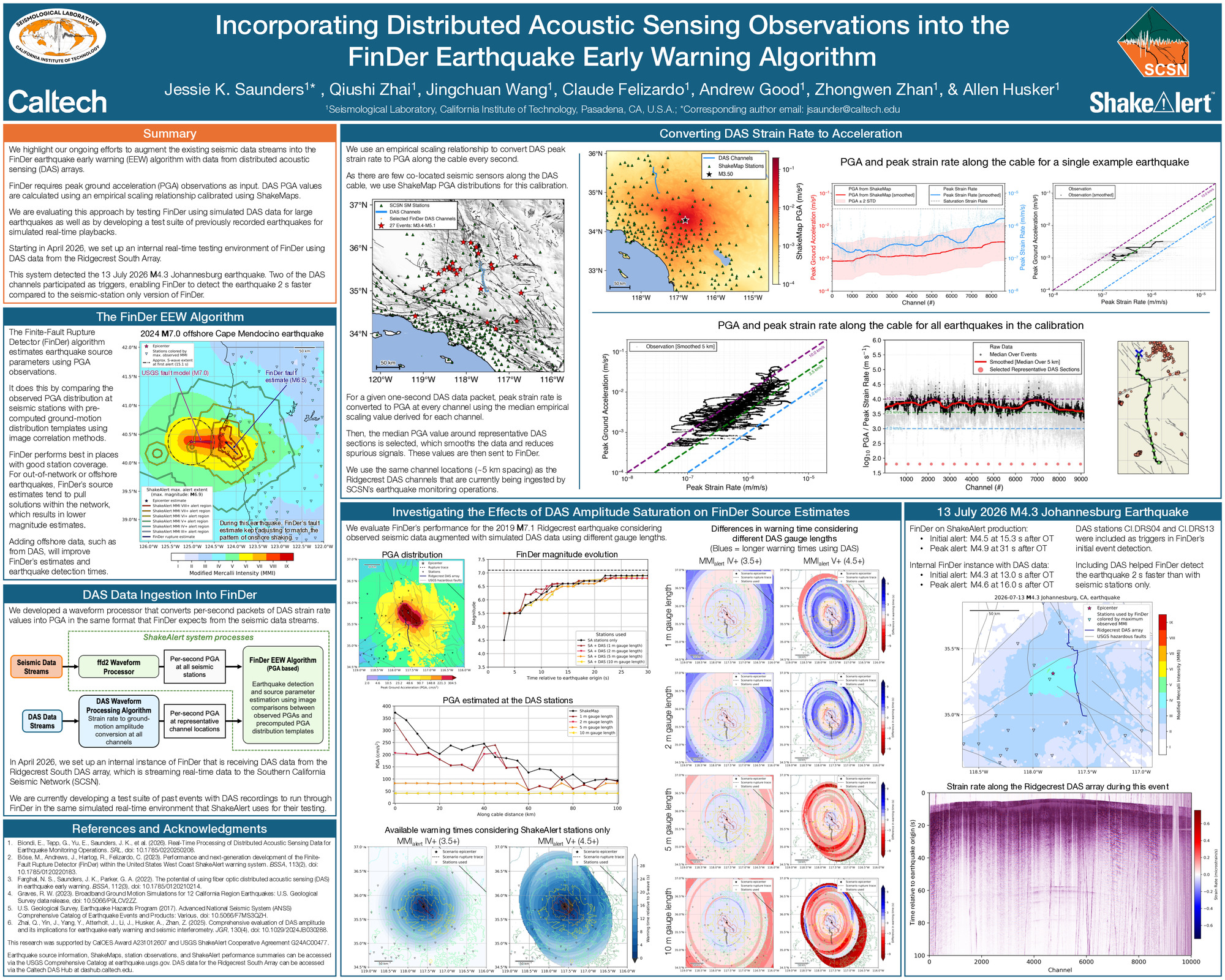 |
Seismology |
Incorporating distributed acoustic sensing observations into the FinDer earthquake early warning algorithm
Jessie Saunders, Qiushi Zhai, Jingchuan Wang, Claude Felizardo, Andrew Good, Zhongwen Zhan, Allen Husker The Finite-Fault Rupture Detector (FinDer) earthquake early warning (EEW) algorithm rapidly estimates earthquake source parameters by matching pre-computed ground-motion templates with the observed peak ground acceleration (PGA) distribution.... more |
|
|
Group B Poster 024 |
FARM |
The friction of natural fault rocks
Heather Savage, Demian Saffer Laboratory friction experiments have advanced our understanding of fault behavior for several decades, however the majority of friction experiments have been conducted on mono-mineralic standards and synthetic mixtures. Natural fault gouges tend to... more Themes: Advancing Community Earth Models for Hazard Analyses |
|
|
Talk Mon0800 |
ASI |
Building the scientific foundations of the ShakeOut Scenario 2.0
Katherine Scharer Earthquake scenarios aim to provide an example of the damages a catastrophic earthquake can create for a community and highlight the preparedness planning and mitigation that could reduce those risks. The earthquakes used in such efforts, whether... more Themes: Earthquake Scenarios for Hazard and Risk Assessment | Utilization of Ground Motion Simulations & Records | Engaging Communities in Earthquake Preparedness |
26067
|
Group A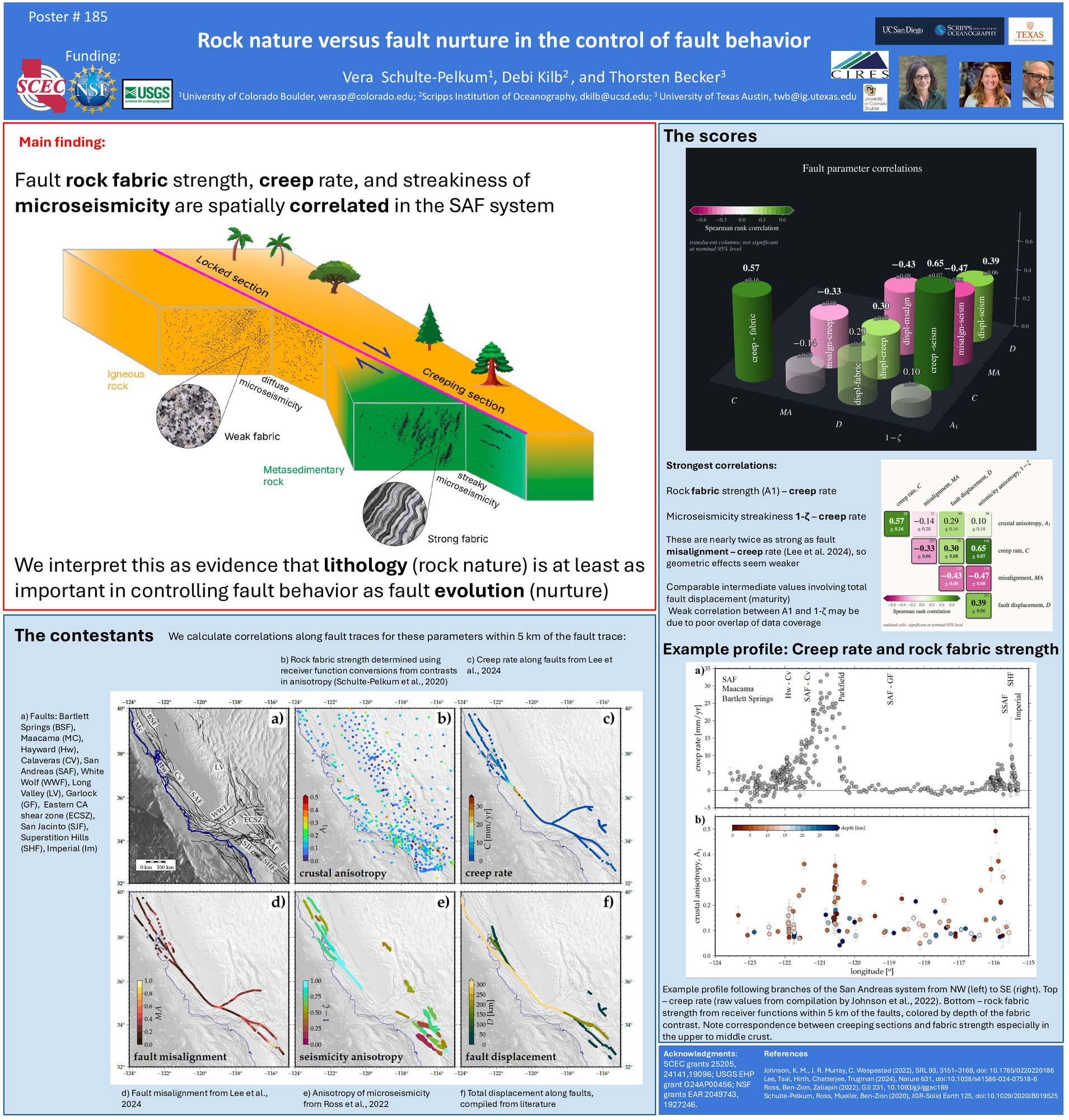 |
Seismology |
Rock nature versus fault nurture in the control of fault behavior
Vera Schulte-Pelkum, Thorsten Becker, Debi Kilb Earthquakes at continental transform margins reflect the interplay between strain localization and geological memory effects such as juxtaposed lithologies and inherited fabric. The San Andreas plate boundary fault system encompasses a range of... more Themes: Advancing Community Earth Models for Hazard Analyses |
25205, 24141, 22073, 21098
|
|
Group B Poster 234 |
GM |
Shear Wave Velocity Profile Informed Basin Depth Extrapolation Model For z1.0 Estimation
Rashid Shams, Chukwuebuka Nweke, Tristan Buckreis, Scott Brandenberg, Jonathan Stewart Ground motion models (GMMs) incorporate sedimentary basin effects using basin depth parameters (zx), which represents the depth to specific shear wave velocity (VS) isosurfaces (typically where x = 1.0 km/s or 2.5 km/s). Basin depths are often... more Themes: Earthquake Scenarios for Hazard and Risk Assessment |
|
|
Group B Poster 130 |
Seismology |
H/V Ratios in Northern California and the Livermore Basin
Brierton Sharp, Fan-Chi Lin, Taka'aki Taira, Arthur Rodgers Despite the numerous active faults surrounding the Livermore Basin in northern California, its shallow velocity structure remains poorly constrained. To improve subsurface characterization and support seismic-hazard assessment, we deployed 197... more Themes: Advancing Community Earth Models for Hazard Analyses | Engaging Communities in Earthquake Preparedness |
|
|
Group B Poster 002 |
FARM |
Cessation of nearby low-frequency earthquake activity following the December 2024 Mw 7.0 Mendocino earthquake: the likely role of pore pressure reductions
David Shelly, Kathryn Materna Earthquakes affect surrounding fault systems through multiple mechanisms. Here, we examine a rare cessation of activity in 27 families of low-frequency earthquakes (LFEs) that likely reflect fault creep at the southern edge of Cascadia subduction,... more Themes: Advancing Community Earth Models for Hazard Analyses | Earthquake Cycle Simulations & Forecasting |
|
|
Group A Poster 085 |
CEM |
GNSS/InSAR Integration for 3-D Deformation Time Series in Southern California
Zheng-Kang Shen, Zhen Liu We have developed a method to integrate GNSS and InSAR observations to produce a three-dimensional (3-D) surface velocity field of the Earth [Shen and Liu, 2020, 2025]. The method consists of the following key components: (a) an optimal... more Themes: Advancing Community Earth Models for Hazard Analyses |
26092
|
|
Group A Poster 015 |
FARM |
Conditions for runaway ruptures during reservoir operations: magnitude–frequency distribution implications and application to Groningen
Qian Shi, Alexis Sáez, Linxuan Li, Kyungjae Im, Stephen Bourne, Jan van Elk, Jean-Philippe Avouac We present a theoretical analysis of an induced seismic rupture propagating from a gas reservoir into the underburden. We use linear elastic fracture mechanics (LEFM) to determine the conditions for self-arrested or runaway ruptures. We derive a... more Themes: Earthquake Scenarios for Hazard and Risk Assessment | Engaging Communities in Earthquake Preparedness |
|
|
Group B Poster 016 |
FARM |
A Tale of Two Heterogeneities: How Lithology and Geometry Set the Earthquake Clock
Srisharan Shreedharan, Alejandro Aguilar, Alba Rodriguez Padilla, Chas Bolton, Kelian Dascher-Cousineau Paleoseismic records reveal a spectrum of earthquake recurrence patterns, but the mechanisms that set rupture timing are hard to isolate from limited field data. Using complementary meter-scale laboratory experiments and rate-and-state numerical... more Themes: Earthquake Scenarios for Hazard and Risk Assessment | Earthquake Cycle Simulations & Forecasting |
|
|
Group A Poster 183 |
Seismology |
Characterizing the Occurrence of Linear Seismicity Streaks Along the San Andreas Fault
Rajani Shrestha, Roland Bürgmann, Zachary Ross Linear streaks of micro-seismicity are often interpreted as common features of creeping faults. These streaks have been previously observed along different sections of the San Andreas fault and elsewhere. However, previous studies have only looked... more Themes: Advancing Community Earth Models for Hazard Analyses |
|
Group B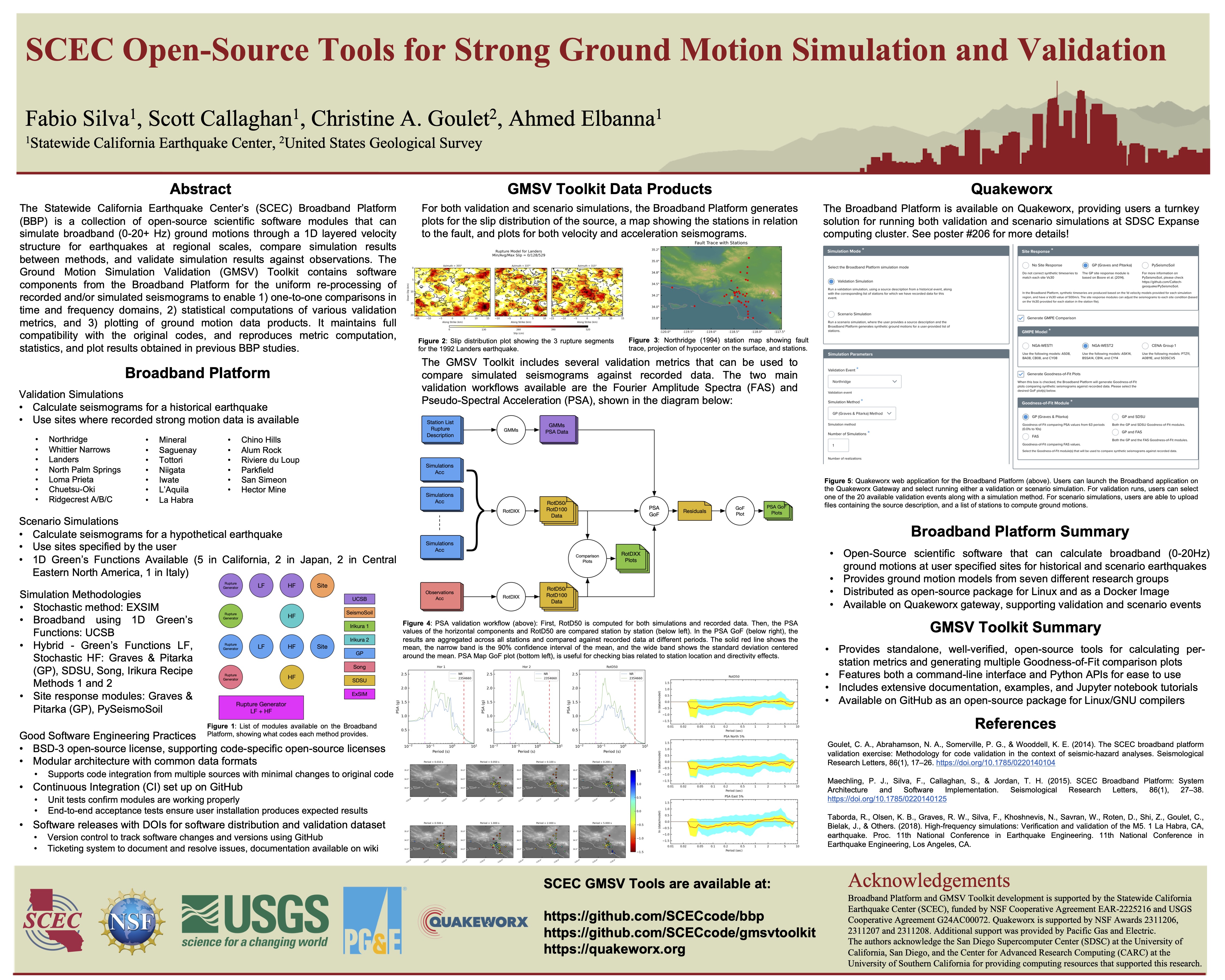 |
GM |
SCEC Open-Source Tools for Ground Motion Simulation and Validation
Fabio Silva, Scott Callaghan, Christine Goulet, Ahmed Elbanna The Statewide California Earthquake Center’s (SCEC) Broadband Platform (BBP) is a collection of open-source scientific software modules that can simulate broadband (0-20+ Hz) ground motions through a 1D layered velocity structure for earthquakes at... more Themes: Earthquake Scenarios for Hazard and Risk Assessment | Physics-Based Ground Motion Simulations & Validation |
22091
|
|
Group B Poster 010 |
FARM |
Free-surface controls on the stability of shallow rate-and-state faults
Ari Silver, Federico Ciardo Slow slip events are increasingly recognized at shallow depths, yet the mechanical conditions that permit their nucleation remain uncertain. Most existing stability criteria are derived for faults embedded in unbounded elastic media and therefore... more |
|
|
Group B Poster 112 |
Seismology |
Earthquake Early Warning Testing: Using New Synthetics
Deborah Smith, Robert Graves, Jeff McGuire The West Coast ShakeAlert Earthquake Early warning system has been sending public alerts since October 17, 2019, and has been successfully generating real-time earthquake messages. In order to assess continuing algorithm development and proposed... more Themes: Earthquake Scenarios for Hazard and Risk Assessment | Physics-Based Ground Motion Simulations & Validation |
|
|
Group A Poster 189 |
Seismology |
Observations of Seismicity in the Rock Valley Fault Zone, Southern NNSS, from deep core-hole DAS and Geophone Data
Ken Smith, Jacob Gochenour, A. Christian Stanciu, Colin Pennington, Reagan Turley, Maia Zhang, Abigail Travers, Michelle Scalise The Rock Valley Direct Comparison (RV/DC) experiment, Phase III of the Source Physics Experiment (SPE), will detonate a conventional explosive near the hypocenter of the unusually shallow 1993 Mw 3.8 Rock Valley earthquake (~2 km depth) at the... more Themes: Advancing Community Earth Models for Hazard Analyses |
|
|
Group A Poster 043 |
FARM |
Influence of fault zone overstrengthening on earthquake rupture across distributed fault networks: Insights from Ridgecrest, CA
Zachary Smith, Roland Bürgmann, Ruyu Yan, Franics Waligora, William Griffith, Josie Nevitt, Matthew Gleeson, Christine Jilly, Tamara Jeppson, Eric Burdette, Kathryn Materna, Matthew Idzakovich The evolution of fault zones over multiple earthquake cycles can influence slip across distributed fault systems. Fault zones are typically thought to evolve toward tabular damage zones surrounding a low-cohesion fault core, characterized by... more Themes: Advancing Community Earth Models for Hazard Analyses | Earthquake Cycle Simulations & Forecasting |
23045
|
|
Group B Poster 162 |
CCB |
Representations of earthquake prediction, forecasting, and early warning in popular media
Samantha Stanley, Claire Wardle, Natasha Tiwari While many people come to understand natural hazards like earthquakes through popular media, these media often prioritize entertainment, action, and emotion over accurate or realistic depictions of earthquake monitoring and warning. This research... more Themes: Engaging Communities in Earthquake Preparedness |
|
The Statewide California Earthquake Center is committed to providing a safe, productive, and welcoming environment for all participants. We take pride in fostering a diverse and inclusive SCEC community, and therefore expect all participants to abide by the SCEC Activities Code of Conduct.


