Group A, Poster #091, Earthquake Geology
High Resolution Holocene Slip Rate for the Southern San Andreas Fault at Salt Creek, Salton Trough, California
Thomas K. Rockwell, Katherine M. Scharer, Nathan D. Brown, William C. Buckley, Paula M. Figueiredo, Andrea Fabbrizzi, & Patrick Williams



Poster Image:
Poster Presentation
2026 SCEC Annual Meeting, Poster #091, SCEC Contribution #15111 VIEW PDF
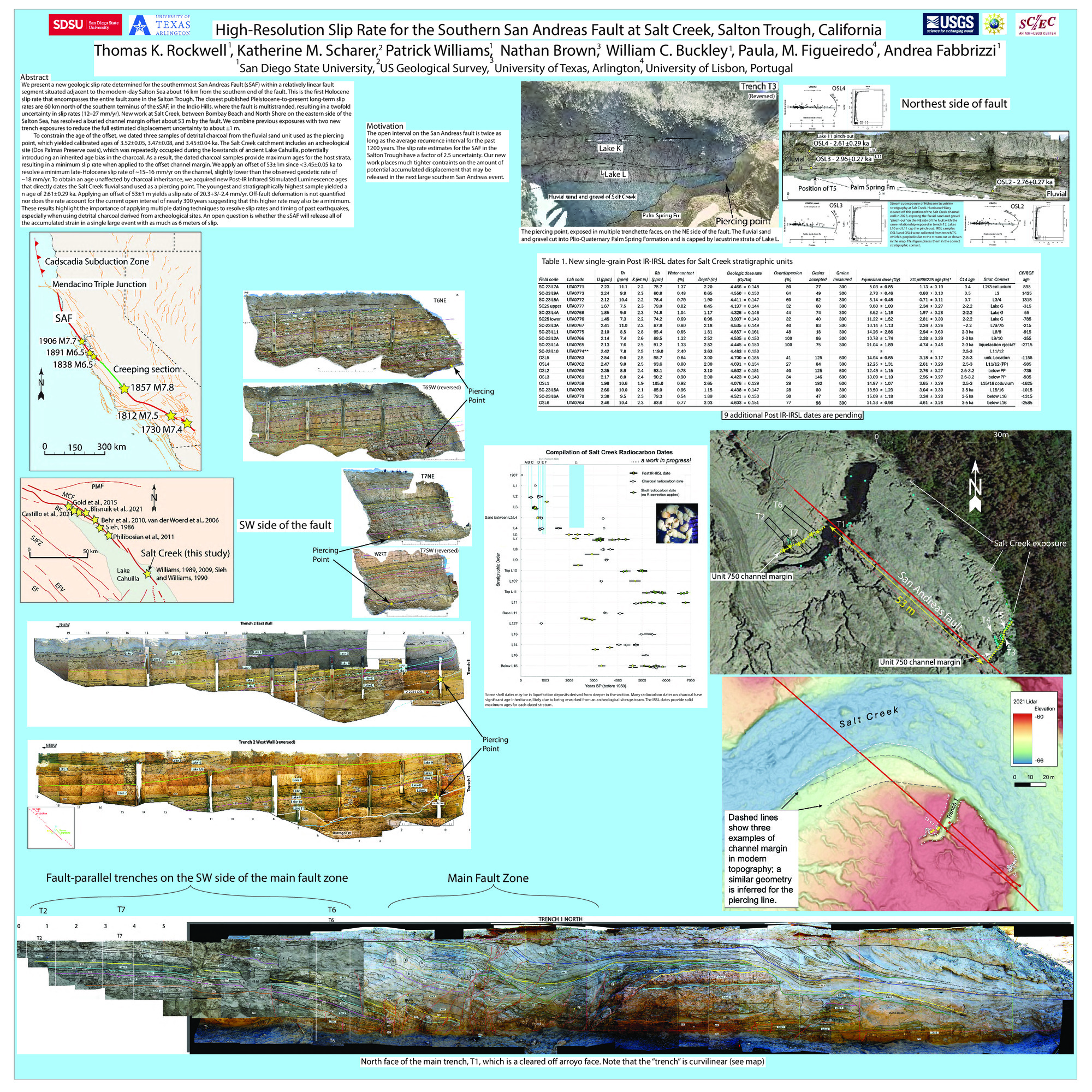
We present a new geologic slip rate determined for the southernmost San Andreas Fault (sSAF) within a relatively linear fault segment situated adjacent to the modern-day Salton Sea about 16 km from the southern end of the fault. This is the first Holocene slip rate that encompasses the entire fault zone in the Salton Trough. The closest published Pleistocene-to-present long-term slip rates are 60 km north of the southern terminus of the sSAF, in the Indio Hills, where the fault is multistranded, resulting in a twofold uncertainty in slip rates (12–27 mm/yr). New work at Salt Creek, between Bombay Beach and North Shore on the eastern side of the Salton Sea, has resolved a buried channel margin offset about 53 m by the fault. We combine previous exposures with two new trench exposures to reduce the full estimated displacement uncertainty to about ±1 m.
To constrain the age of the offset, we dated three samples of detrital charcoal from the fluvial sand unit used as the piercing point, which yielded calibrated ages of 3.52±0.05, 3.47±0.08, and 3.45±0.04 ka. The Salt Creek catchment includes an archeological site (Dos Palmas Preserve oasis), which was repeatedly occupied during the lowstands of ancient Lake Cahuilla, potentially introducing an inherited age bias in the charcoal. As a result, the dated charcoal samples provide maximum ages for the host strata, resulting in a minimum slip rate when applied to the offset channel margin. We apply an offset of 53±1m since <3.45±0.05 ka to resolve a minimum late-Holocene slip rate of ~15–16 mm/yr on the channel, slightly lower than the observed geodetic rate of ~18 mm/yr. To obtain an age unaffected by charcoal inheritance, we acquired new Post-IR Infrared Stimulated Luminescence ages that directly dates the Salt Creek fluvial sand used as a piercing point. The youngest and stratigraphically highest sample yielded an age of 2.61±0.29 ka. Applying an offset of 53±1 m yields a slip rate of 20.3+3/-2.4 mm/yr. Off-fault deformation is not quantified nor does the rate account for the current open interval of nearly 300 years suggesting that this higher rate may also be a minimum. These results highlight the importance of applying multiple dating techniques to resolve slip rates and timing of past earthquakes, especially when using detrital charcoal derived from archeological sites. An open question is whether the sSAF will release all of the accumulated strain in a single large event with as much as 6 meters of slip.
To constrain the age of the offset, we dated three samples of detrital charcoal from the fluvial sand unit used as the piercing point, which yielded calibrated ages of 3.52±0.05, 3.47±0.08, and 3.45±0.04 ka. The Salt Creek catchment includes an archeological site (Dos Palmas Preserve oasis), which was repeatedly occupied during the lowstands of ancient Lake Cahuilla, potentially introducing an inherited age bias in the charcoal. As a result, the dated charcoal samples provide maximum ages for the host strata, resulting in a minimum slip rate when applied to the offset channel margin. We apply an offset of 53±1m since <3.45±0.05 ka to resolve a minimum late-Holocene slip rate of ~15–16 mm/yr on the channel, slightly lower than the observed geodetic rate of ~18 mm/yr. To obtain an age unaffected by charcoal inheritance, we acquired new Post-IR Infrared Stimulated Luminescence ages that directly dates the Salt Creek fluvial sand used as a piercing point. The youngest and stratigraphically highest sample yielded an age of 2.61±0.29 ka. Applying an offset of 53±1 m yields a slip rate of 20.3+3/-2.4 mm/yr. Off-fault deformation is not quantified nor does the rate account for the current open interval of nearly 300 years suggesting that this higher rate may also be a minimum. These results highlight the importance of applying multiple dating techniques to resolve slip rates and timing of past earthquakes, especially when using detrital charcoal derived from archeological sites. An open question is whether the sSAF will release all of the accumulated strain in a single large event with as much as 6 meters of slip.
Citation: Rockwell, T. K., Scharer, K. M., Brown, N. D., Buckley, W. C., Figueiredo, P. M., Fabbrizzi, A., & Williams, P. (2026, 08). High Resolution Holocene Slip Rate for the Southern San Andreas Fault at Salt Creek, Salton Trough, California. Poster Presentation at 2026 SCEC Annual Meeting.
Keywords: San Andreas fault Holocene slip rate, Salt Creek
SCEC Award: 26076
Relevant SCEC Themes:
Advancing Community Earth Models for Hazard Analyses