Group A, Poster #073, Community Earth Models (CEM)
Refining Near-Surface Seismic Structure in the San Francisco Community Velocity Model (SFCVM)


Poster Image:
Poster Presentation
2026 SCEC Annual Meeting, Poster #073, SCEC Contribution #15453 VIEW PDF
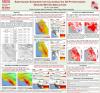
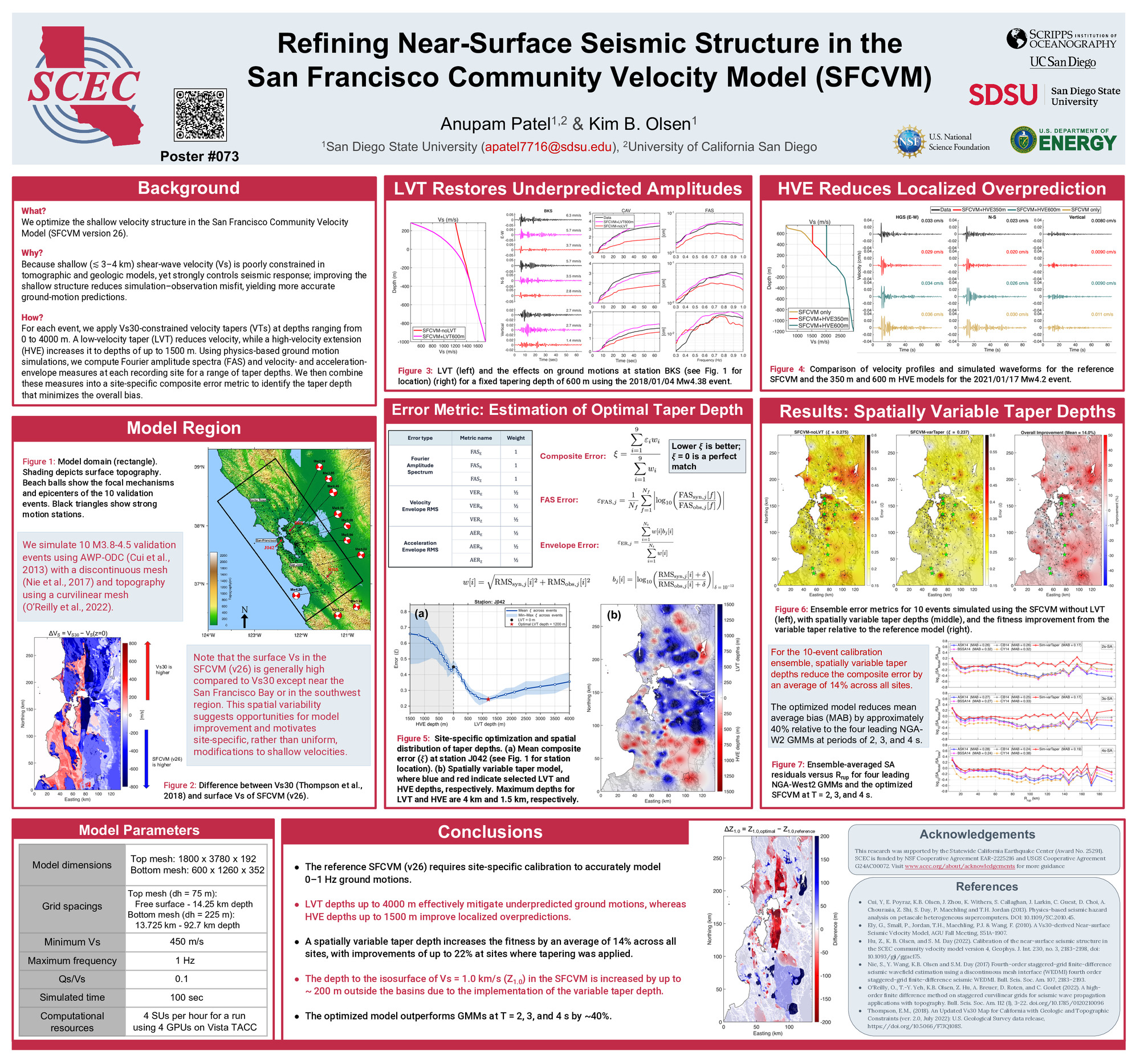
Accurate 3-D physics-based ground-motion prediction in the San Francisco Bay Area requires a well-calibrated near-surface velocity structure. Here, we refine the upper few kilometers of the San Francisco Community Velocity Model (SFCVM version 26) to improve ground-motion prediction efficacy across an ensemble of Mw 3.8–4.5 earthquakes. Model goodness-of-fit is quantified using a composite fitness metric that integrates the Smoothed Effective Amplitude Spectrum (SEAS) alongside velocity and acceleration waveform envelopes, establishing a unified joint constraint across spectral amplitude, phase arrival time, coda duration, and peak motion.
To resolve the regional model bias, we implement targeted velocity adjustments: at sites where the reference model systematically underpredicts ground motions for our small-event ensemble, we implement a Vs30-constrained spatially variable Low-Velocity Taper (LVT; Ely et al., 2010). At sites with overprediction for our set of events, we increase the low near-surface velocities down to 1200 m to suppress spurious high-amplitude reverberations. Optimizing spatially variable taper depths through systematic minimization of the bias improved the mean ensemble fitness by up to 14% (15% compared to that obtained by the SFCVM including a LVT with a constant thickness of 600 m), with individual event fitness improvements up to 20%.
The spatially variable taper deepens the Vs = 1.0 km/s isosurface (Z1.0) by up to ∼200 m outside the basins. Using the updated Z1.0 and Z2.5 isosurfaces enhances regional spectral acceleration predictions from four leading NGA-West2 Ground Motion Models (GMMs) by 16% on average (up to 22%) out to distances of ∼220 km relative to the uncalibrated SFCVM. Moreover, our 3-D physics-based simulations including the spatially variable velocity taper consistently outperform the GMMs at periods of T = 2, 3, and 4 sec, improving ensemble-averaged spectral acceleration predictions by 39% on average and up to 63% for individual GMMs. The optimized spatially-variable velocity taper provides a more accurate means of seismic hazard characterization in the Bay Area.
To resolve the regional model bias, we implement targeted velocity adjustments: at sites where the reference model systematically underpredicts ground motions for our small-event ensemble, we implement a Vs30-constrained spatially variable Low-Velocity Taper (LVT; Ely et al., 2010). At sites with overprediction for our set of events, we increase the low near-surface velocities down to 1200 m to suppress spurious high-amplitude reverberations. Optimizing spatially variable taper depths through systematic minimization of the bias improved the mean ensemble fitness by up to 14% (15% compared to that obtained by the SFCVM including a LVT with a constant thickness of 600 m), with individual event fitness improvements up to 20%.
The spatially variable taper deepens the Vs = 1.0 km/s isosurface (Z1.0) by up to ∼200 m outside the basins. Using the updated Z1.0 and Z2.5 isosurfaces enhances regional spectral acceleration predictions from four leading NGA-West2 Ground Motion Models (GMMs) by 16% on average (up to 22%) out to distances of ∼220 km relative to the uncalibrated SFCVM. Moreover, our 3-D physics-based simulations including the spatially variable velocity taper consistently outperform the GMMs at periods of T = 2, 3, and 4 sec, improving ensemble-averaged spectral acceleration predictions by 39% on average and up to 63% for individual GMMs. The optimized spatially-variable velocity taper provides a more accurate means of seismic hazard characterization in the Bay Area.
Citation: Patel, A., & Olsen, K. B. (2026, 08). Refining Near-Surface Seismic Structure in the San Francisco Community Velocity Model (SFCVM). Poster Presentation at 2026 SCEC Annual Meeting.
SCEC Award: 25291
Relevant SCEC Themes:
Advancing Community Earth Models for Hazard Analyses
Physics-Based Ground Motion Simulations & Validation