
Group A, Poster #045, Fault and Rupture Mechanics (FARM)
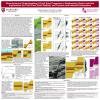
Investigating reverse fault paleoseismic trench observations with geomechanical models to infer earthquake source characteristics




Poster Image:
Poster Presentation
2026 SCEC Annual Meeting, Poster #045, SCEC Contribution #15304 VIEW PDF
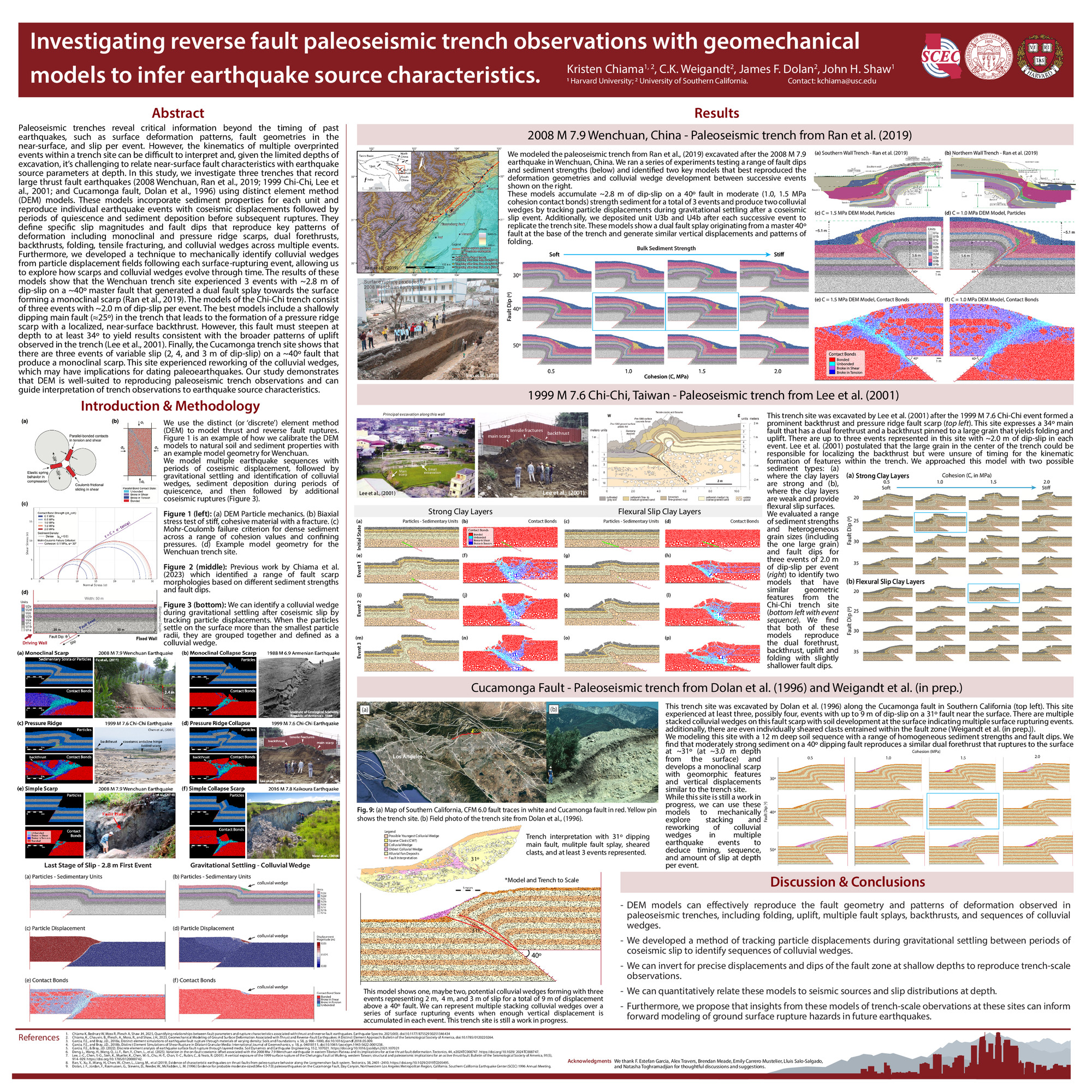
Paleoseismic trenches reveal critical information beyond the timing of past earthquakes, such as surface deformation patterns, fault geometries in the near-surface, and slip per event. However, the kinematics of multiple overprinted events within a trench site can be difficult to interpret and, given the limited depths of excavation, it’s challenging to relate near-surface fault characteristics with earthquake source parameters at depth. In this study, we investigate three trenches that record large thrust fault earthquakes (2008 Wenchuan, Ran et al., 2019; 1999 Chi-Chi, Lee et al., 2001; and Cucamonga fault, Dolan et al., 1997) using distinct element method (DEM) models. These models incorporate sediment properties for each unit and reproduce individual earthquake events with coseismic displacements followed by periods of quiescence and sediment deposition before subsequent ruptures. They define specific slip magnitudes and fault dips that reproduce key patterns of deformation including monoclinal and pressure ridge scarps, dual forethrusts, backthrusts, folding, tensile fracturing, and colluvial wedges across multiple events. Furthermore, we developed a technique to mechanically identify colluvial wedges from particle displacement fields following each surface-rupturing event, allowing us to explore how scarps and colluvial wedges evolve through time. The results of these models show that the Wenchuan trench site experienced 3 events with ~2.8 m of dip-slip on a ~40º master fault that generated a dual fault splay towards the surface forming a monoclinal scarp (Ran et al., 2019). The models of the Chi-Chi trench consist of three events with ~2.0 m of dip-slip per event. The best models include a shallowly dipping main fault (≈25º) in the trench that leads to the formation of a pressure ridge scarp with a localized, near-surface backthrust. However, this fault must steepen at depth to at least 34º to yield results consistent with the broader patterns of uplift observed in the trench (Lee et al., 2001). Finally, the Cucamonga trench site shows that there are three events of variable slip (2, 4, and 3 m of dip-slip) on a ~40º fault that produce a monoclinal scarp. This site experienced reworking of the colluvial wedges, which may have implications for dating paleoearthquakes. Our study demonstrates that DEM is well-suited to reproducing paleoseismic trench observations and can guide interpretation of trench observations to earthquake source characteristics.
Citation: Chiama, K., Kindred Weigandt, C. A., Dolan, J. F., & Shaw, J. H. (2026, 08). Investigating reverse fault paleoseismic trench observations with geomechanical models to infer earthquake source characteristics. Poster Presentation at 2026 SCEC Annual Meeting.
Keywords: Paleoseismic Trench, Reverse Fault, Geomechanical Models, Distinct Element Method (DEM)
SCEC Award: 22013
Relevant SCEC Themes:
Earthquake Scenarios for Hazard and Risk Assessment
MORE POSTERS BY THE AUTHORS
|
|
|
|
|
|


