
Group A, Poster #069, Tectonic Geodesy
Spatiotemporal variability of shallow creep along Mount Etna’s segmented faults: 2015–2025 Sentinel-1 InSAR time series


Poster Image:
Poster Presentation
2026 SCEC Annual Meeting, Poster #069, SCEC Contribution #15447 VIEW PDF
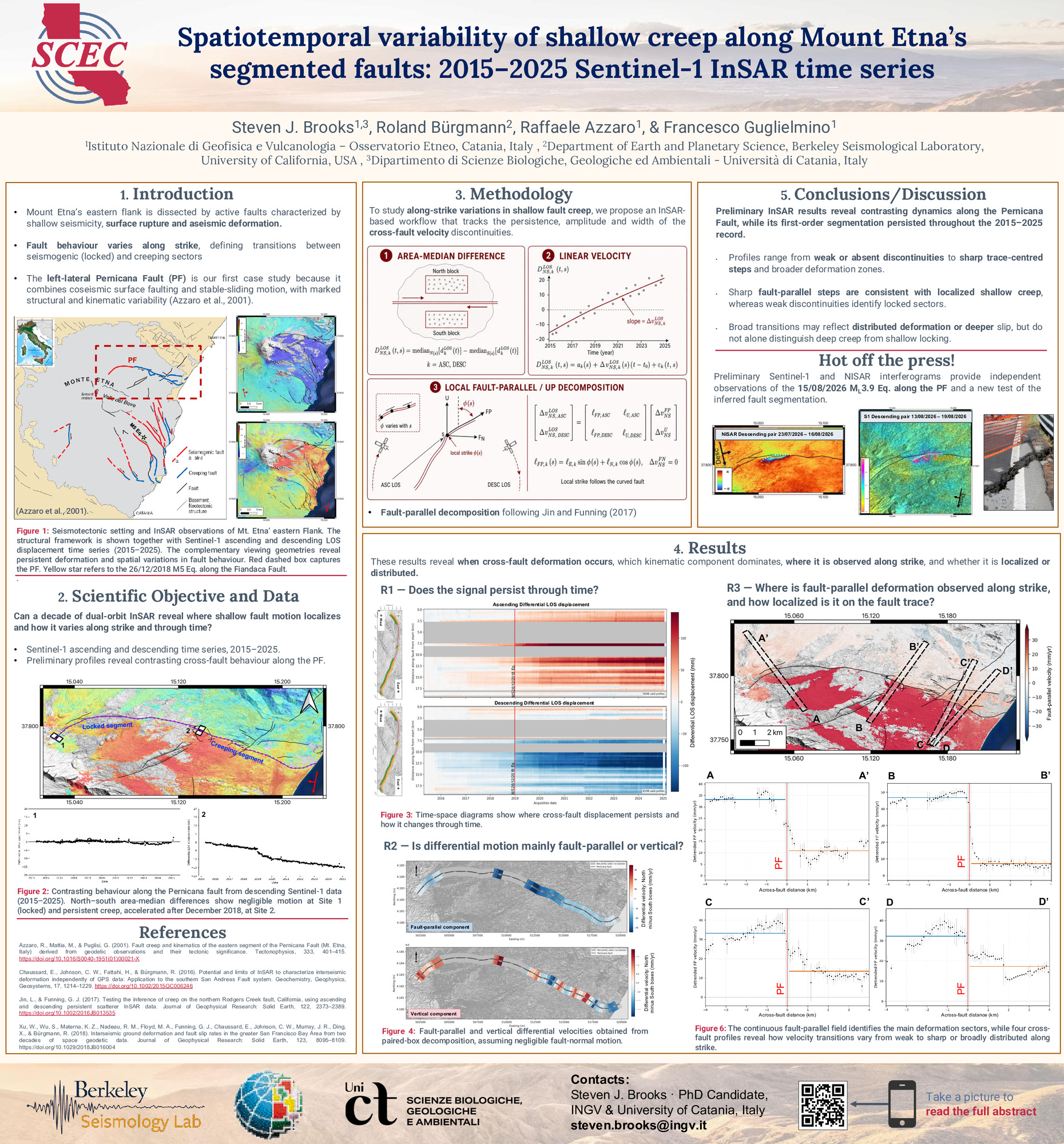
Segmented fault systems can accommodate slip through adjacent creeping and mostly locked sections, but the persistence of these patterns through time and their response to earthquake sequences remain poorly resolved. Mount Etna’s eastern flank, where rapidly deforming faults accommodate both aseismic creep and coseismic slip, provides an opportunity to track these contrasting behaviors over a decade. We analyze corrected ascending and descending Sentinel-1 DInSAR time series spanning 2015–2025 to test whether candidate creeping and locked sections persist across independent viewing geometries and periods of transient deformation.
At regularly spaced sites along each mapped fault, we difference median LOS displacement time series from paired areas straddling the trace. These differential time series are used to track localized cross-fault displacement along strike and through time while reducing the contribution of broad flank sliding shared by both sides. Separately, fault-normal profiles from ascending and descending LOS velocity fields test whether the same candidate sections correspond to persistent decade-scale velocity gradients in both viewing geometries.
The record includes the December 2018 intrusive and seismic sequence, which preceded the Mw 5.0 Fiandaca earthquake. Preliminary descending-track results show step-like changes in differential LOS displacement along previously identified creeping sections of the Pernicana fault, whereas adjacent sections exhibit weaker or more gradual changes. Transient signals also occur on other eastern-flank faults near the 2018 mainshock. We assess whether these signals are reproduced in the ascending-track observations, persist after the sequence, and coincide with long-term velocity gradients. Together, the temporal and spatial analyses refine the along-strike distribution of candidate creeping, transitional, and locked sections. Preliminary descending-track results suggest that this first-order spatial segmentation persisted through the 2015–2025 record, although individual creeping sections on several faults accelerated around the 2018 sequence. The sequence therefore appears to have locally modulated creep rates within an established segmentation rather than reorganizing the broader fault system. This decade-scale perspective provides an observational basis for investigating interactions between aseismic slip and adjacent seismogenic fault segments.
At regularly spaced sites along each mapped fault, we difference median LOS displacement time series from paired areas straddling the trace. These differential time series are used to track localized cross-fault displacement along strike and through time while reducing the contribution of broad flank sliding shared by both sides. Separately, fault-normal profiles from ascending and descending LOS velocity fields test whether the same candidate sections correspond to persistent decade-scale velocity gradients in both viewing geometries.
The record includes the December 2018 intrusive and seismic sequence, which preceded the Mw 5.0 Fiandaca earthquake. Preliminary descending-track results show step-like changes in differential LOS displacement along previously identified creeping sections of the Pernicana fault, whereas adjacent sections exhibit weaker or more gradual changes. Transient signals also occur on other eastern-flank faults near the 2018 mainshock. We assess whether these signals are reproduced in the ascending-track observations, persist after the sequence, and coincide with long-term velocity gradients. Together, the temporal and spatial analyses refine the along-strike distribution of candidate creeping, transitional, and locked sections. Preliminary descending-track results suggest that this first-order spatial segmentation persisted through the 2015–2025 record, although individual creeping sections on several faults accelerated around the 2018 sequence. The sequence therefore appears to have locally modulated creep rates within an established segmentation rather than reorganizing the broader fault system. This decade-scale perspective provides an observational basis for investigating interactions between aseismic slip and adjacent seismogenic fault segments.
Citation: Brooks, S. J., Bürgmann, R., Azzaro, R., & Guglielmino, F. (2026, 08). Spatiotemporal variability of shallow creep along Mount Etna’s segmented faults: 2015–2025 Sentinel-1 InSAR time series. Poster Presentation at 2026 SCEC Annual Meeting.
Keywords: InSAR, Fault behavior, Fault creep, Earthquake, Mt. Etna
Relevant SCEC Themes:
Earthquake Scenarios for Hazard and Risk Assessment
Earthquake Cycle Simulations & Forecasting
Rapid Post-Earthquake Investigations & Communications


