
Group B, Poster #020, Fault and Rupture Mechanics (FARM)
Thermal localization and rheological control on the steady-state width of 1D ductile shear zones


Poster Image:
Poster Presentation
2026 SCEC Annual Meeting, Poster #020, SCEC Contribution #15069 VIEW PDF
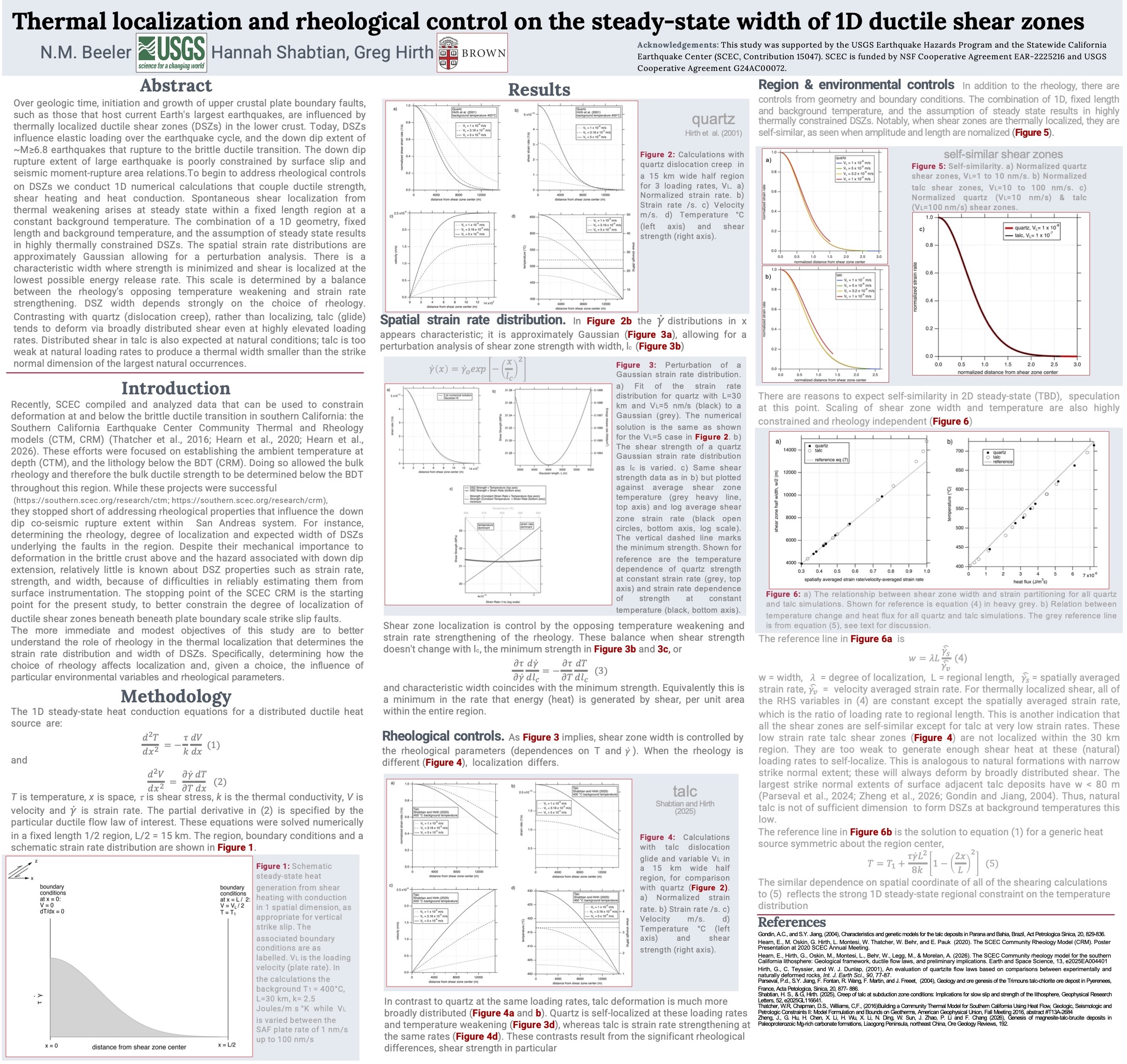
Over geologic time, initiation and growth of upper crustal plate boundary faults, such as those that host Earth's largest earthquakes today, are influenced by thermally localized ductile shear zones (DSZs) in the lower crust. Today DSZs influence elastic loading over the earthquake cycle, and the down dip extent of ~M≥6.8 earthquakes that rupture to the brittle ductile transition. Despite mechanical importance to tectonics and on-going crustal deformation, there is relatively little observational data on active DSZ properties due to their distant proximity to surface instrumentation. As in many previous 1 and 2D simulations, the 1D numerical calculations of this study couple ductile strength, shear heating and conduction, producing spontaneous shear localization from thermal weakening due to self-heating. These are at steady state within a fixed length region, L=30 km, at a background temperature of 400°C. The combination of a 1D geometry, fixed length and background temperature, and the assumption of steady state results in highly thermally constrained DSZs. When a DSZ is fully localized within the region: 1) it hosts a fixed fraction, 87%, of the deformation of the entire region; 2) temperature change within the region is proportional to shear heat production via a geometric constant and the thermal conductivity; and 3) the resulting strain rate distribution is self-similar, having the same shape independent of its width and amplitude. All three properties are rheology-independent. The form of the strain rate distribution is approximately Gaussian. For a Gaussian DSZ at steady state the velocity and temperature distributions, and the rate that thermal energy is generated from shearing are analytic, allowing for a perturbation analysis. The analysis yields a characteristic width where strength is minimized and shear is localized at the lowest possible energy release rate. This characteristic scale of localization is determined by a balance between the rheology's opposing temperature weakening and strain rate strengthening. Thus, despite being highly constrained by geometry and assumptions, DSZ width depends strongly on the choice of rheology. Contrasting with quartz (dislocation creep), rather than localizing, talc (glide) tends to deform via broadly distributed shear even at highly elevated loading rates. Distributed shear in talc is also expected at natural conditions; it is too weak to produce a thermal width smaller than the strike normal dimension of the largest natural occurrences.
Citation: Beeler, N. M., Shabtian, H., & Hirth, G. (2026, 08). Thermal localization and rheological control on the steady-state width of 1D ductile shear zones. Poster Presentation at 2026 SCEC Annual Meeting.
Keywords: crm, farm, rock mechanics, ductile shear zones


