
Group A, Poster #059, Tectonic Geodesy
Off-Fault Geodetic Deformation in California May Be Largely Aseismic


Poster Image:
Poster Presentation
2026 SCEC Annual Meeting, Poster #059, SCEC Contribution #15537 VIEW PDF
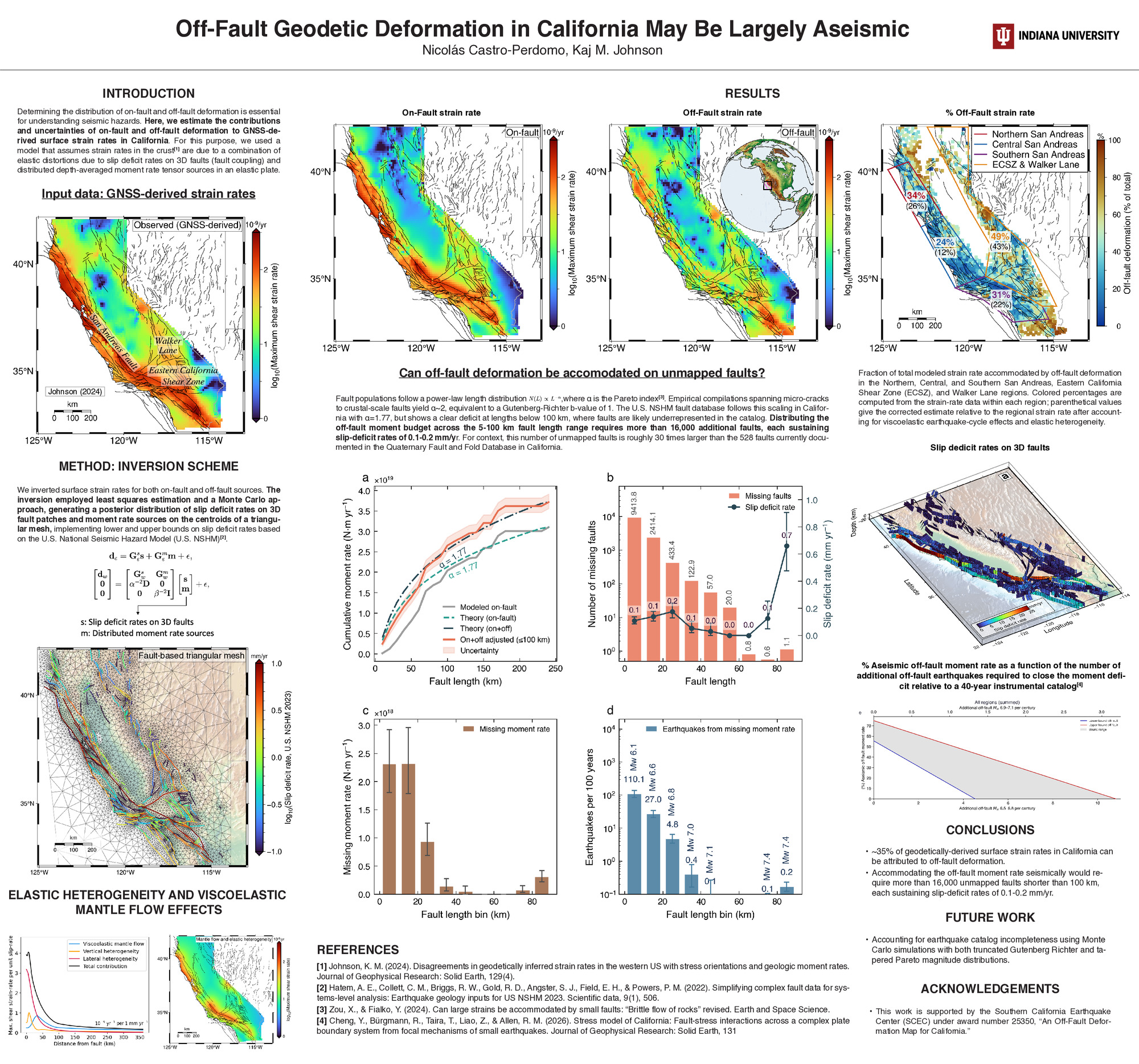
, a finding stable across different regularization choices and robust to conservative corrections for viscoelastic earthquake-cycle effects and elastic heterogeneity. Two separate tests weigh against a seismic explanation: accommodating this off-fault moment rate on unmapped faults would require over 16,000 faults between 5 and 100 km in length, each slipping at 0.1-0.2 mm/yr, while comparing it to the seismic moment rate from the instrumental earthquake catalog shows the off-fault moment rate to be 2.5 to 40 times larger. Our results suggest that off-fault deformation is predominantly aseismic, implying that translating geodetic strain rates into moment rates could overstate earthquake potential along active plate boundaries.
SHOW MORE
SHOW MORE
Citation: Castro-Perdomo, N., & Johnson, K. M. (2026, 08). Off-Fault Geodetic Deformation in California May Be Largely Aseismic. Poster Presentation at 2026 SCEC Annual Meeting.
Keywords: Strain rates, off-fault deformation
SCEC Award: 25350


