Group A, Poster #081, Community Earth Models (CEM)
Seismic wave speed variability beyond geology-based rules in the western United States


Poster Image:
Poster Presentation
2026 SCEC Annual Meeting, Poster #081, SCEC Contribution #15565 VIEW PDF
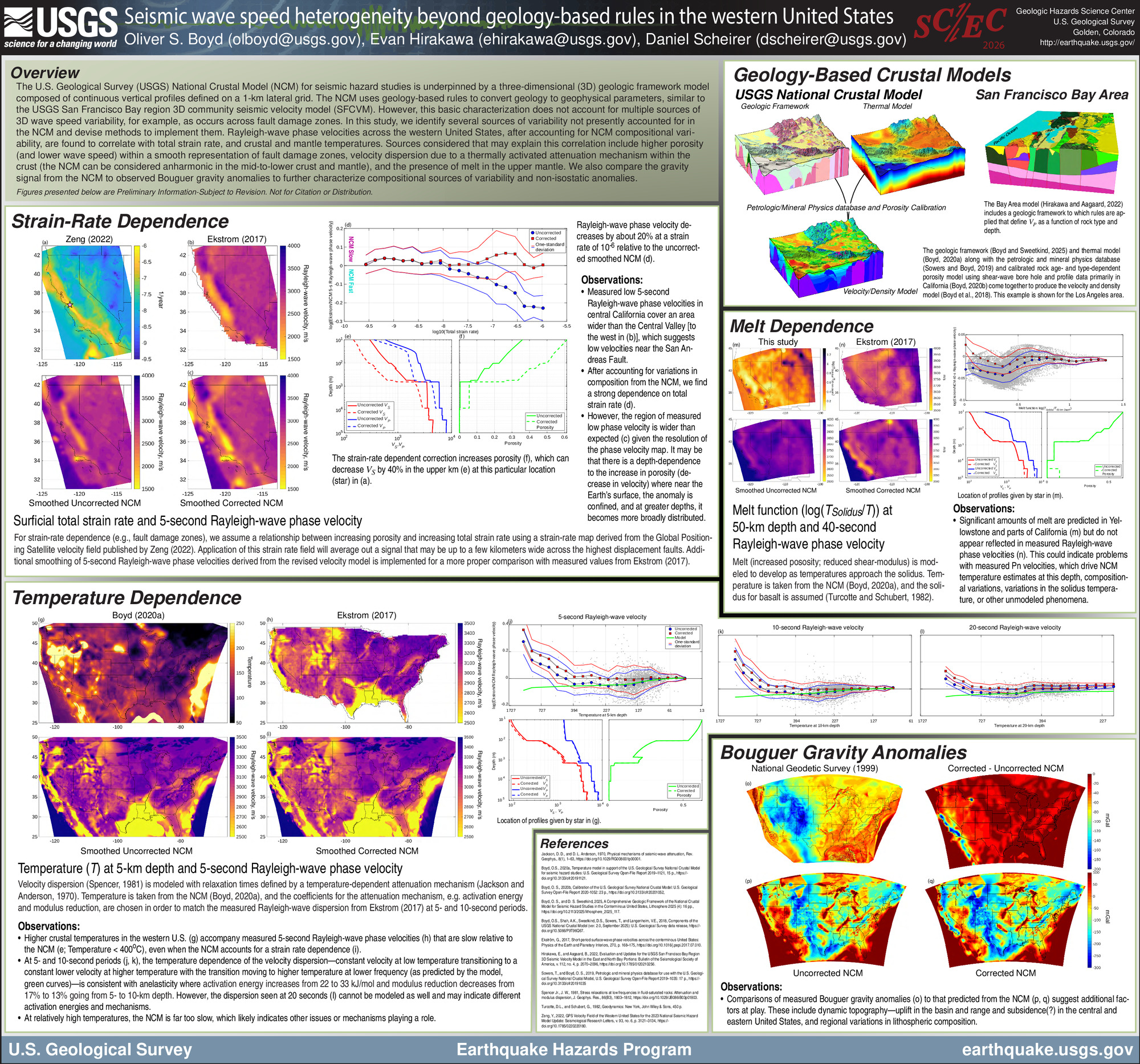
The U.S. Geological Survey (USGS) National Crustal Model (NCM) for seismic hazard studies is underpinned by a three-dimensional (3D) geologic framework model composed of continuous vertical profiles defined on a 1-km lateral grid. The NCM uses geology-based rules to convert geology to geophysical parameters, similar to the USGS San Francisco Bay region 3D community seismic velocity model (SFCVM). However, this basic characterization does not account for multiple sources of 3D wave speed variability, for example, as occurs across fault damage zones. In this study, we identify several sources of variability not presently accounted for in the NCM and devise methods to implement them. Rayleigh-wave phase velocities across the western United States are found to correlate with total strain rate, and crustal and mantle temperatures. Sources considered that may explain this correlation include higher porosity (and lower wave speed) within a smooth representation of fault damage zones, velocity dispersion due to a thermally activated attenuation mechanism within the crust, and the presence of melt in the upper mantle. We also compare the gravity signal from the NCM to observed Bouguer gravity anomalies to further characterize compositional sources of variability and non-isostatic anomalies.
For fault damage zones, we assume a relationship between increasing porosity and increasing total strain rate using a strain-rate map derived from the Global Positioning Satellite velocity field published by Zeng (2022). Application of this strain rate field will average out a signal that may be up to a few kilometers wide across the highest displacement faults. Additional smoothing of 5-second Rayleigh-wave phase velocities derived from the revised velocity model is implemented for a proper comparison with observed dispersion. For the other two mechanisms—velocity dispersion due to a thermally activated attenuation mechanism within the crust, and the presence of melt in the upper mantle—we assume relationships to the 3D thermal model present within the NCM. These mechanisms are likely to be present at much longer wavelengths than the confined width of the fault damage zone. We begin to assess the effect of this wave speed variability, in particular, fault damage zones, on low-frequency (< 1 Hz) 3D ground-motion simulations in the San Francisco Bay area in the vicinity of the San Andreas fault.
For fault damage zones, we assume a relationship between increasing porosity and increasing total strain rate using a strain-rate map derived from the Global Positioning Satellite velocity field published by Zeng (2022). Application of this strain rate field will average out a signal that may be up to a few kilometers wide across the highest displacement faults. Additional smoothing of 5-second Rayleigh-wave phase velocities derived from the revised velocity model is implemented for a proper comparison with observed dispersion. For the other two mechanisms—velocity dispersion due to a thermally activated attenuation mechanism within the crust, and the presence of melt in the upper mantle—we assume relationships to the 3D thermal model present within the NCM. These mechanisms are likely to be present at much longer wavelengths than the confined width of the fault damage zone. We begin to assess the effect of this wave speed variability, in particular, fault damage zones, on low-frequency (< 1 Hz) 3D ground-motion simulations in the San Francisco Bay area in the vicinity of the San Andreas fault.
Citation: Boyd, O. S., Hirakawa, E. T., & Scheirer, D. S. (2026, 08). Seismic wave speed variability beyond geology-based rules in the western United States. Poster Presentation at 2026 SCEC Annual Meeting.
Keywords: seismic velocity, western United States, lithosphere
Relevant SCEC Themes:
Advancing Community Earth Models for Hazard Analyses
Physics-Based Ground Motion Simulations & Validation