
Group A, Poster #205, Earthquake Forecasting and Predictability (EFP)
The Q-Score: A Magnitude-Weighted Goodness-of-Fit Score for Earthquake Forecasting


Poster Image:
Poster Presentation
2026 SCEC Annual Meeting, Poster #205, SCEC Contribution #15336 VIEW PDF
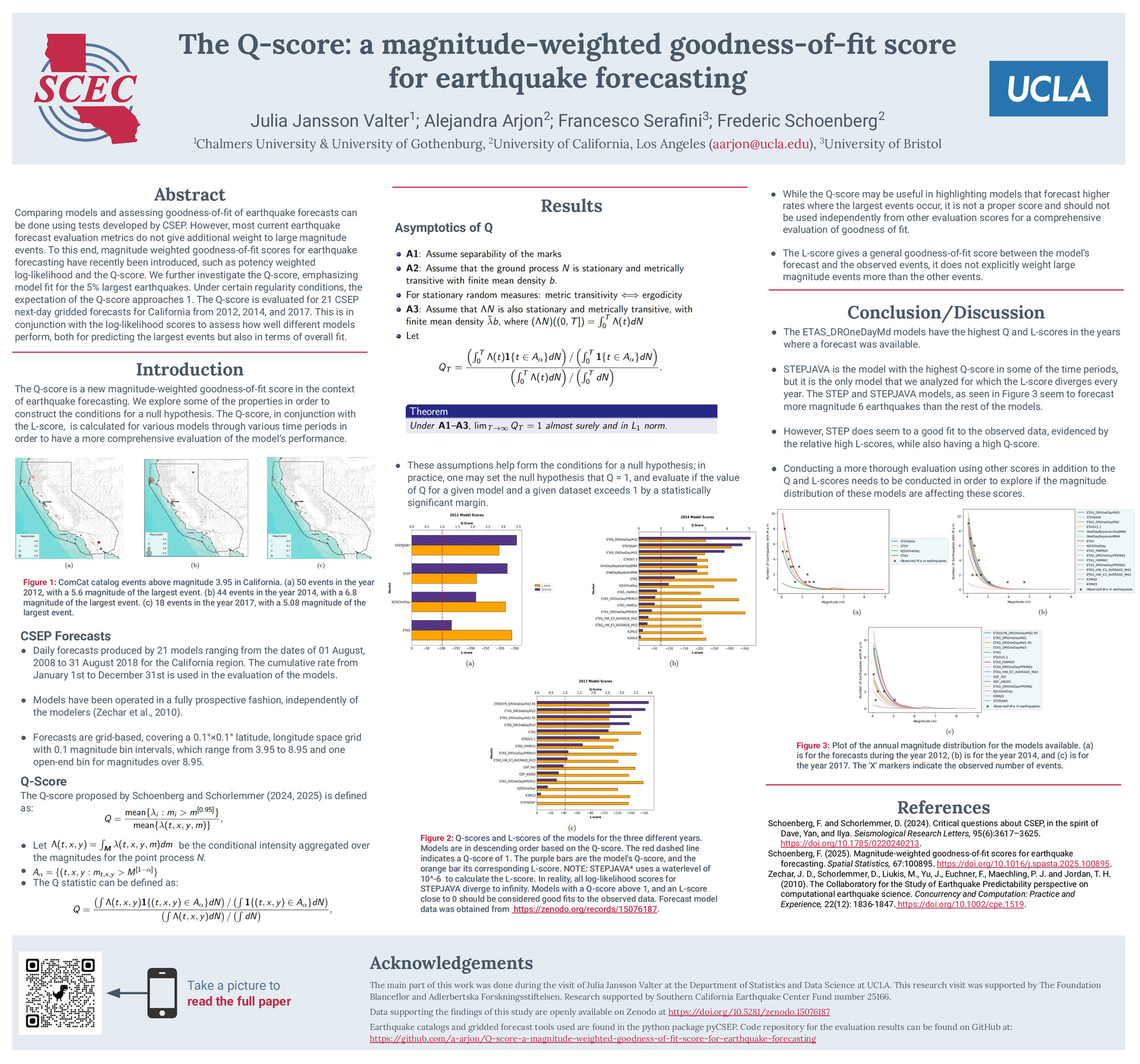
Earthquake occurrences are often modelled with spatial-temporal point process models, such as the Epidemic-Type-Aftershock-Sequence (ETAS) model. Comparing models and assessing goodness-of-fit of earthquake forecasts can be done using tests developed by the Collaboratory for the Study of Earthquake Predictability (CSEP). However, most current earthquake forecast evaluation metrics, such as the N-test and L-test, do not give additional weight to large magnitude events. To this end, magnitude weighted goodness-of-fit scores for earthquake forecasting have recently been introduced, such as potency weighted log-likelihood and the Q-score. We define and further investigate the Q-score, which is a quotient emphasizing model fit for the 5% largest earthquakes. Under certain regularity conditions, the expectation of the Q-score should be close to 1, and it satisfies a law of large numbers. The Q-score is evaluated for 21 CSEP next-day gridded forecasts for California earthquake data from 2012, 2014, and 2017. We also compare the log-likelihood scores of the forecasts to assess how well different models, such as ETAS, perform, both for predicting the largest events but also in terms of overall model fit.
Citation: Arjon, A., Jansson Valter, J., Serafini, F., & Schoenberg, F. (2026, 08). The Q-Score: A Magnitude-Weighted Goodness-of-Fit Score for Earthquake Forecasting. Poster Presentation at 2026 SCEC Annual Meeting.
SCEC Award: 25166


