

| AGENDA | POSTERS | PARTICIPANTS | ABSTRACTS | TRAVEL | FAQ |
Meeting Abstracts
The Statewide California Earthquake Center (SCEC) collaborates with academic, government, industry, and other organizations to advance earthquake science, community resilience, and education by: (1) Gathering and analyzing data from field observations and laboratory experiments. (2) Developing system-level models and simulations of earthquake processes to synthesize knowledge as a physics-based understanding of seismic hazard. (3) Communicating that understanding to expand knowledge and reduce earthquake risk.
Participants are invited to present recent work aligned with SCEC priorities during the poster sessions.
| SCEC ID | Category | Title and Authors | SCEC Award |
|---|---|---|---|
|
Group B Poster 092 |
Geology |
Finding faults with AI: Using high-resolution digital topography data (LiDAR)
Boseong Kang, Kim Blisniuk, Genya Ishigaki, Sally McGill, Michael Oskin This project summarizes initial efforts to fine-tune an Earth Foundation Model (EFM) and develop a multimodal model through model fusion for the specific task of recognizing active faults. Machine learning through imagery has been used successfully... more Themes: Advancing Community Earth Models for Hazard Analyses |
|
|
Group B Poster 032 |
FARM |
Bayesian Calibration of dynamic models of earthquake sequences using observations from past large earthquakes
Hojjat Kaveh, Oliver Dunbar, Jean-Philippe Avouac, Andrew Stuart Physics-based models of the earthquake cycle could be used for time-dependent hazard assessment. For such an application, their parameters must be calibrated so that simulated earthquake sequences reproduce the statistics of past earthquakes,... more Themes: Earthquake Cycle Simulations & Forecasting |
|
|
Group A Poster 239 |
GM |
Next Generation Ground Motion Simulation, Validation, and Utilization (GM-SVU) in Seismic Hazard and Engineering Applications: A New SCEC Technical Activity Group
Maha Kenawy, Sanaz Rezaeian, Scott Callaghan, Chukwuebuka Nweke, Farzin Zareian Physics-based ground motion simulations have matured to the point where they can meaningfully inform probabilistic seismic hazard analysis (PSHA) and building code-oriented response history analysis (RHA), yet their adoption in practice remains... more Themes: Earthquake Scenarios for Hazard and Risk Assessment | Physics-Based Ground Motion Simulations & Validation | Utilization of Ground Motion Simulations & Records |
26089
|
|
Group B Poster 086 |
CEM |
Technical Activity Group (TAG): Northern California Cascadia - San Andreas Transition (NORCAT)
Debi Kilb, Matthew Herman, Kathryn Materna, jason patton, Vera Schulte-Pelkum, David Shelly, Amanda Thomas The NORCAT Technical Activity Group (TAG) focuses on advancing research on the northern California transition between Cascadia subduction, the San Andreas Fault system, and the Mendocino Triple Junction. This interlinked system connects the two... more Themes: Advancing Community Earth Models for Hazard Analyses | Earthquake Scenarios for Hazard and Risk Assessment | Engaging Communities in Earthquake Preparedness |
26083
|
|
Group B Poster 030 |
FARM |
Advancing Community Benchmarking for Sequences of Earthquakes and Aseismic Slip: Objectives and Planned Activities of the SCEC SEAS Technical Activity Group
Taeho Kim, Mohamed Abdelmeguid, Eric Dunham, Brittany Erickson, Valere Lambert, Pierre Romanet, Prithvi Thakur The SCEC (Statewide California Earthquake Center) Sequences of Earthquakes and Aseismic Slip (SEAS) community has developed benchmarks for earthquake-cycle models for more than a decade. Definitions and results are openly available at https://strike... more Themes: Advancing Community Earth Models for Hazard Analyses | Earthquake Cycle Simulations & Forecasting | Engaging Communities in Earthquake Preparedness |
26093
|
|
Talk Mon1400 |
FARM |
From hazard to design variable: slip-induced permeability enhancement in understressed faults and the future of geothermal energy
Taeho Kim Seismic hazard assessment in fluid injection settings has traditionally focused on critically stressed faults, treating understressed faults as benign. We present field observations and models from the world's largest enhanced geothermal system... more Themes: Earthquake Cycle Simulations & Forecasting |
|
|
Group B Poster 082 |
CEM |
Spatially continuous slip rake angles across nonplanar fault geometry
Matthew Knepley, Brad Aagaard, Charles Williams Accurately simulating earthquake rupture requires consistent directional conventions across a fault surface. Lateral (strike-slip) motion is measured along a fault's local strike direction, and reverse (dip-slip) motion along its local up-... more Themes: Advancing Community Earth Models for Hazard Analyses |
|
Group B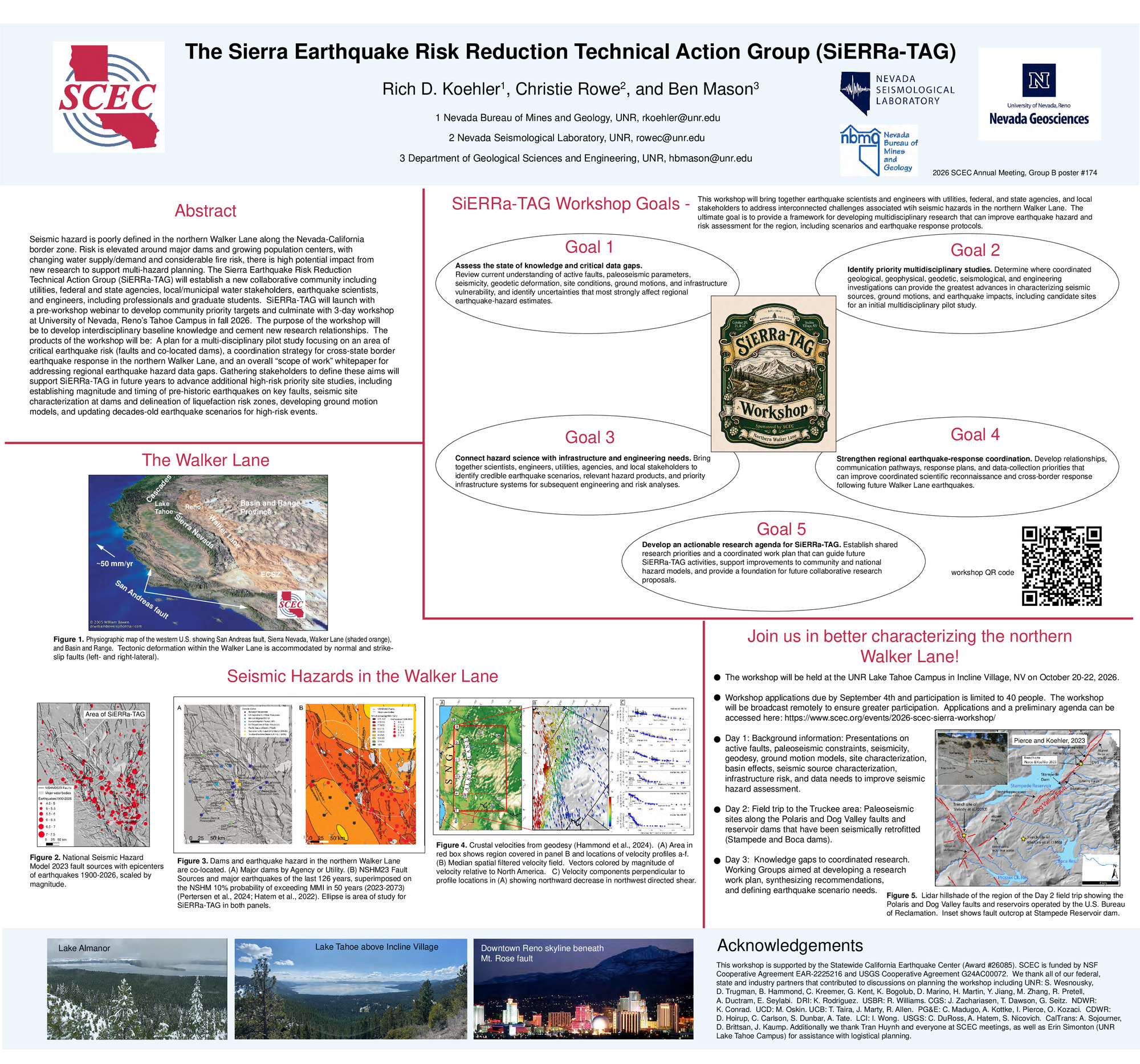 |
ASI |
The Sierra Earthquake Risk Reduction Technical Action Group (SiERRa-TAG)
Rich Koehler, Christie Rowe, Ben Mason Seismic hazard is poorly defined in the northern Walker Lane along the Nevada-California border zone. Risk is elevated around major dams and growing population centers, with changing water supply/demand and considerable fire risk, there is high... more Themes: Earthquake Scenarios for Hazard and Risk Assessment | Rapid Post-Earthquake Investigations & Communications | Engaging Communities in Earthquake Preparedness |
26085
|
|
Group A Poster 179 |
Seismology |
Simulating induced seismicity mitigation measures in the Permian Basin, Texas
Kayla Kroll, Elizabeth Cochran Induced seismicity resulting from subsurface wastewater disposal can be a challenge to operators that seek to meet production or storage objectives. Effective mitigation of induced seismicity requires proactive evaluation of operational controls. We... more Themes: Earthquake Cycle Simulations & Forecasting |
|
|
Group B Poster 044 |
PBS |
Redefining the 3-D Plate Boundary Structure of the Mendocino Triple Junction (MTJ)
Sarah Kummerfeldt, Kevin Furlong, Kirsty Mckenzie This study focuses on the region near the Mendocino Triple Junction (MTJ), where the Gorda slab geometry is not well constrained in terms of its depth and configuration. As a result, earthquake studies have reached disparate conclusions for the... more Themes: Advancing Community Earth Models for Hazard Analyses |
|
|
Group A Poster 049 |
Geodesy |
Linking Fault Slip and Near-Surface Deformation on the Southern San Andreas Fault at Painted Canyon: Preliminary Results
Asenath Kwagalakwe, Eileen Evans, Gladys Pantoja, Allen Gontz, Yehuda Bock, Aubrey Bennett, Jennifer Haase, Matthew Brandin, Yuri Fialko, Cornelius Waldhausen The San Andreas Fault (SAF) is a major plate-boundary fault in California characterized by spatial variations in slip behavior, ranging from fully locked to aseismically creeping. The southern San Andreas Fault (sSAF) is predominantly locked but... more Themes: Advancing Community Earth Models for Hazard Analyses | Earthquake Scenarios for Hazard and Risk Assessment | Earthquake Cycle Simulations & Forecasting |
|
Group A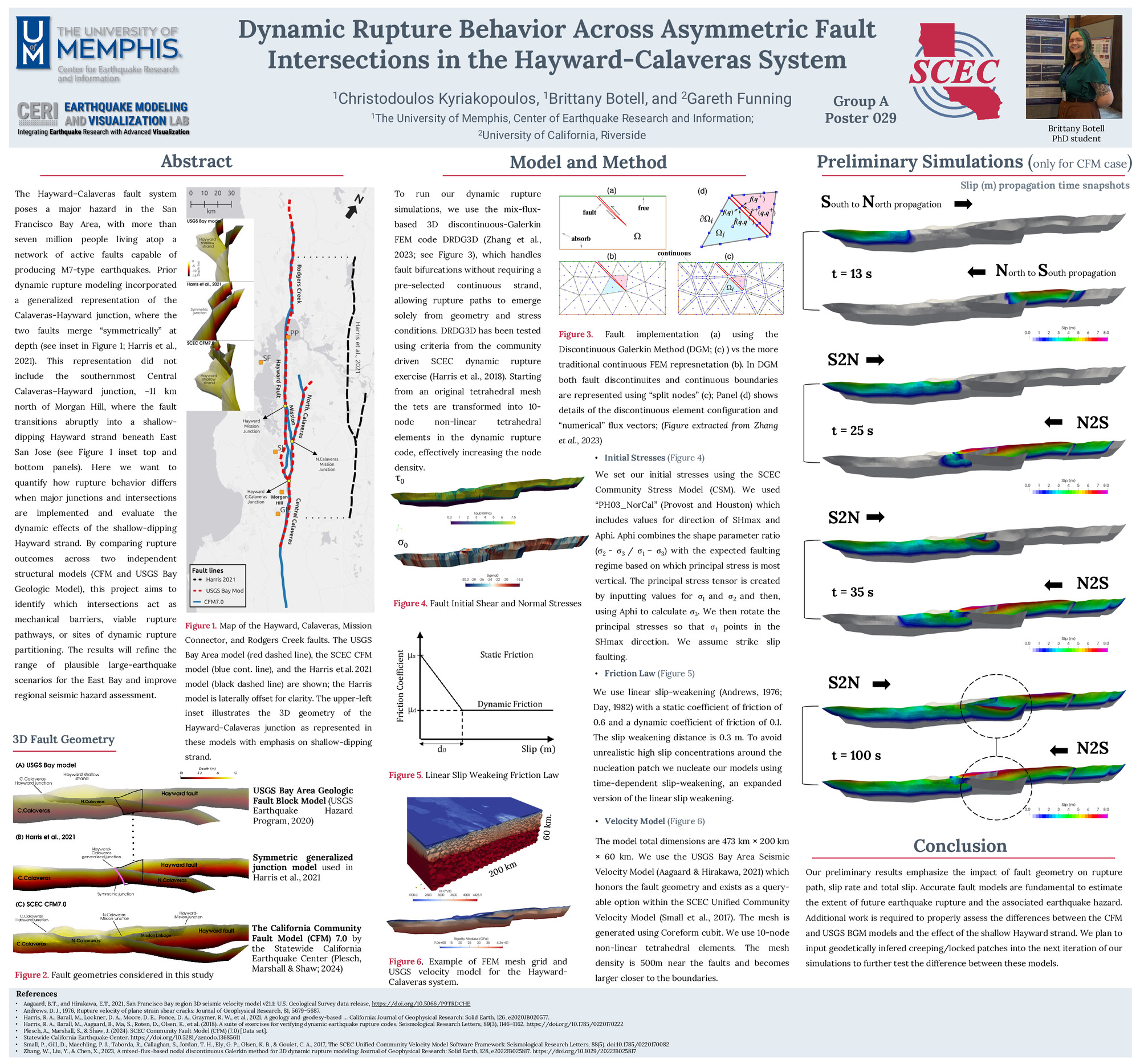 |
FARM |
Dynamic Rupture Behavior Across Asymmetric Fault Intersections in the Hayward-Calaveras System
Christodoulos Kyriakopoulos, Brittany Botell, Gareth Funning The Hayward–Calaveras fault system poses a major hazard in the San Francisco Bay Area, with more than seven million people living atop a network of active faults capable of producing M7-type earthquakes. Previous studies have demonstrated that... more Themes: Earthquake Scenarios for Hazard and Risk Assessment |
|
|
Group B Poster 014 |
FARM |
Ubiquitous interactions and subcritical patches explain the irregularity of repeating earthquakes
Nadia Lapusta, Linxuan Li Repeating earthquakes, or repeaters, are commonly interpreted as ruptures of the same fault patch and widely used to study fault slip behavior, including creep rates, healing, and stress drops. Despite their apparent simplicity, repeaters exhibit... more Themes: Earthquake Cycle Simulations & Forecasting |
25276
|
|
Group B Poster 168 |
ASI |
Seismic Retrofit Needs in Southern California Before the ShakeOut Earthquake, and the Cost of Dithering
Ishmael Legaspi, Sandi Shwe Win, LaMar Anderson, Lucile Jones, Keith Porter Earthquake hazard maps show how strongly the ground will shake with a specified probability. The language of probability tends to hinder rather than to aid decision-making for most people. We used the original ShakeOut scenario shakemap to a... more Themes: Earthquake Scenarios for Hazard and Risk Assessment | Utilization of Ground Motion Simulations & Records | Engaging Communities in Earthquake Preparedness |
26067
|
|
Group A Poster 013 |
FARM |
Gutenberg– Richter or Safer? On the Magnitude–frequency Distributions of Induced Seismicity
Linxuan Li, Kyungjae Im, Jean-Philippe Avouac Injecting fluids into the subsurface frequently triggers earthquakes, yet the maximum magnitude of these events remains difficult to forecast. Earthquake magnitudes are commonly described by the Gutenberg–Richter (GR) distribution, in which... more Themes: Earthquake Scenarios for Hazard and Risk Assessment | Earthquake Cycle Simulations & Forecasting |
|
|
Group A Poster 007 |
FARM |
Offset well pressure transient caused by fault slip constrains fault zone hydraulic properties in EGS stimulation
Meng Li, Taeho Kim, Eric Dunham, Sireesh Dadi, Paul Segall, Aleksei Titov, Richard Gibson, Shanna Chu Safe and successful enhanced geothermal systems (EGS) development requires managing induced seismicity and aseismic slip, which depends crucially on understanding hydraulic fracture-fault interactions and evolution of fault zone hydraulic properties... more Themes: Earthquake Scenarios for Hazard and Risk Assessment | Earthquake Cycle Simulations & Forecasting |
|
|
Group A Poster 187 |
Seismology |
Fault damage structure at depth extracted by FZTWs and receiver functions from teleseismograms possible monitor its variations during earthquake cycle
Yong-Gang Li We analyzed the teleseismograms recorded at a seismic nodal-array consisting of 100 stations deployed atop the Calico Fault (CF) in Mojave Desert, California, and identified the fault-zone trapped waves (FZTWs) characterized by large amplitudes at 0... more Themes: Earthquake Cycle Simulations & Forecasting |
|
|
Group A Poster 009 |
FARM |
Hydraulic Forcing and Fault-Network State Govern Injection-Induced Rupture Cascades
Zhengze Li, Sylvain Barbot Subsurface fluid injection enables wastewater disposal, geoenergy development, and geological storage but can trigger damaging earthquakes. Why some induced instabilities remain localized whereas others escalate into multi-fault rupture cascades... more Themes: Earthquake Scenarios for Hazard and Risk Assessment | Earthquake Cycle Simulations & Forecasting |
|
|
Group A Poster 177 |
Seismology |
Cloud-Based Ambient Noise Interferometry for Statewide Seismic Velocity Monitoring Across California
Chris Lin, Weiqiang Zhu, Taka'aki Taira Passive seismic monitoring has become a powerful tool for tracking environmental and subsurface changes using long-term continuous seismic records. However, the computational and storage demands increase rapidly as the number of stations grows.... more |
|
|
Group B Poster 066 |
Geodesy |
Towards 3D InSAR time series displacement with Kalman filtering - Feasibility and theoretical accuracy
Li-Chieh Lin, Gareth Funning InSAR velocity products have been widely used in various fields to reveal long-term deformation associated with different processes. If sufficient information from different radar lines of sight (LOS) is available, we may decompose such velocities... more Themes: Advancing Community Earth Models for Hazard Analyses |
|
Group B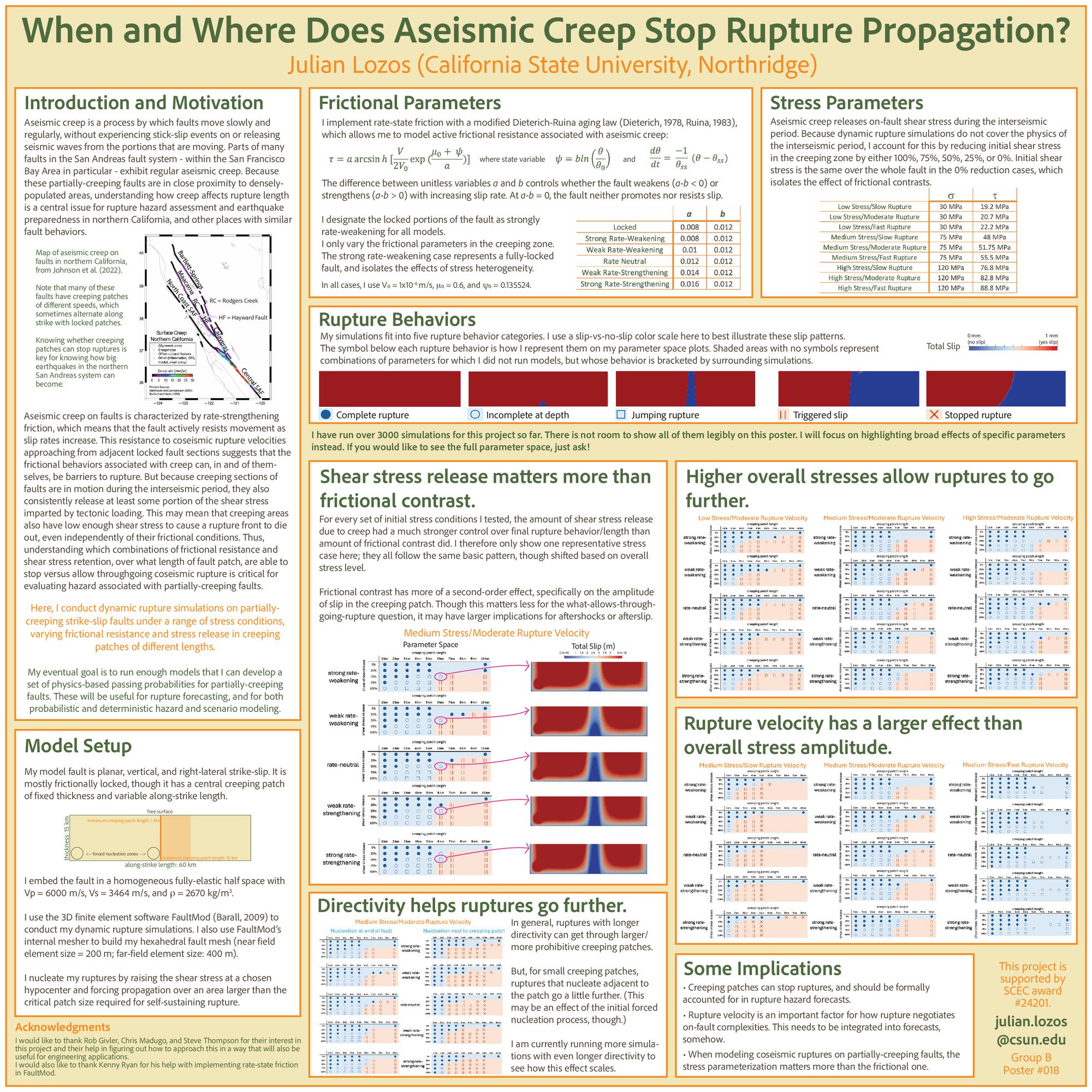 |
FARM |
When and where does aseismic creep stop rupture propagation?
Julian Lozos
Aseismic creep on faults is characterized by rate-strengthening friction, which means that the fault actively resists movement as slip rates increase. This resistance to coseismic rupture velocities approaching from adjacent locked fault sections... more |
24201
|
|
Group A Poster 131 |
Seismology |
Seismic Geodesy with Distributed Acoustic Sensing: Static Deformation from Aftershocks of the 2024 Mw 7.2 Hualien Earthquake
Yang Ma, Lingsen Meng, Yen-Yu Lin Seismic geodesy has traditionally relied on Global Navigation Satellite System (GNSS) measurements to resolve coseismic deformation and constrain earthquake source processes. However, the spatial density and sensitivity of geodetic observations... more |
|
Group B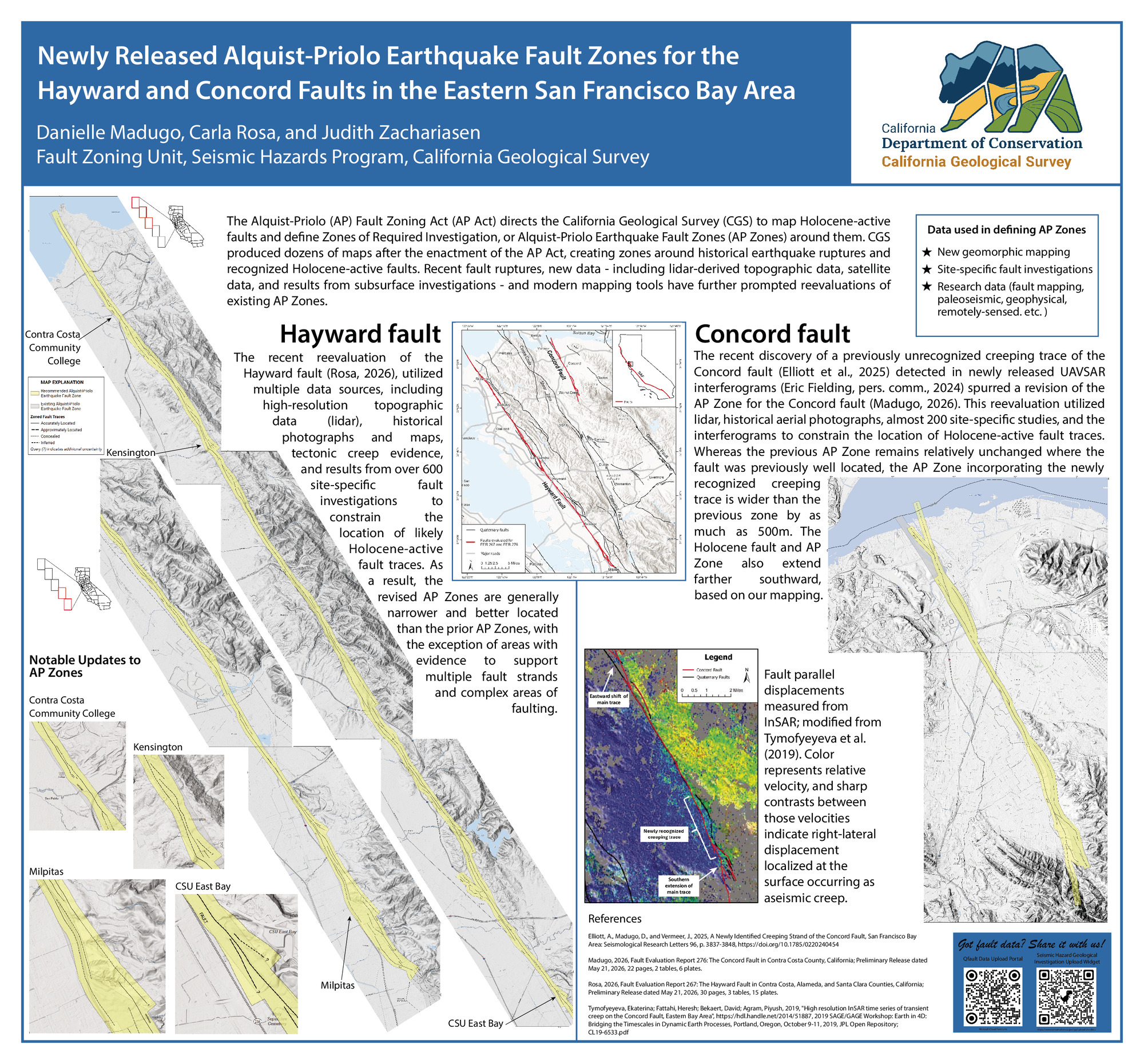 |
Geology |
Newly released Alquist-Priolo Earthquake Fault Zones (APEFZs) for the Hayward and Concord faults in the eastern San Francisco Bay Area
Danielle Madugo, Carla Rosa, Judith Zachariasen The Alquist-Priolo (AP) Fault Zoning Act (AP Act) directs the California Geological Survey (CGS) to map Holocene-active faults and define Zones of Required Investigation, or Alquist-Priolo Earthquake Fault Zones (APEFZs) and hereafter referred to as... more Themes: Advancing Community Earth Models for Hazard Analyses | Engaging Communities in Earthquake Preparedness |
|
Group A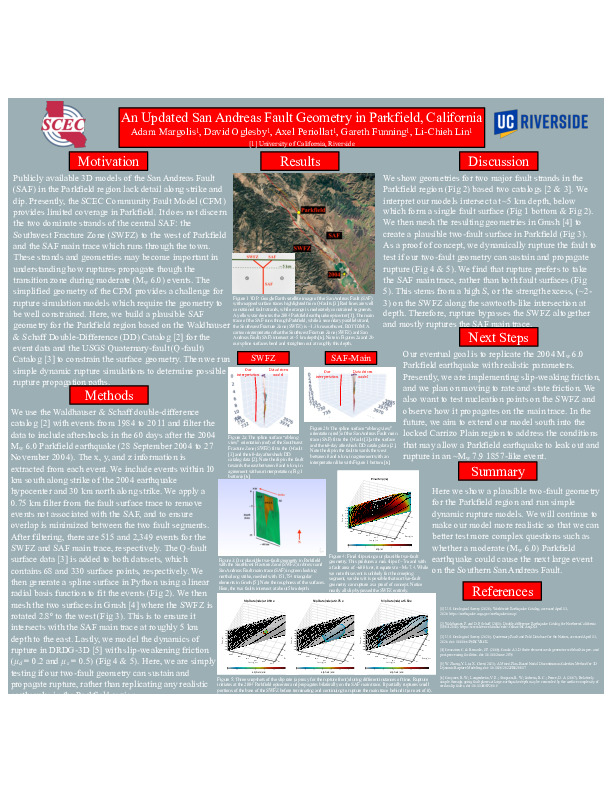 |
FARM |
An Updated San Andreas Fault Geometry in Parkfield, California
Adam Margolis, David Oglesby Publicly available 3D models of the San Andreas Fault (SAF) in the Parkfield region lack fine details along strike and dip. Presently, the Statewide California Earthquake Center – Community Fault Model (SCEC-CFM) provides limited coverage along the... more Themes: Earthquake Scenarios for Hazard and Risk Assessment | Earthquake Cycle Simulations & Forecasting |
|
|
Group A Poster 027 |
FARM |
Fault Connectivity Controls Synthetic Earthquake Catalogs and 30-Year Rupture Probabilities in RSQSim Simulations of the Eastern San Francisco Bay Area
Evan Marschall, Alice-Agnes Gabriel, Bruce Shaw, Jeena Yun, Albert Kottke, Jennifer Donahue, Michael Oskin The faults of the eastern San Francisco Bay Area, California, have long been known as a source of seismic hazard. This potential for large earthquakes, paired with high population density and economic activity, leads to a high seismic risk in the... more Themes: Earthquake Cycle Simulations & Forecasting |
|
|
Group B Poster 124 |
Seismology |
Shallow Crustal Defocusing of Near-Fault S-Waves: A physical Origin for Distance attenuation
Alex Marston, Chen Ji, Morgan Moschetti, Jorge Crempien Conventionally, near-fault geometrical spreading (GS) of S waves is assumed to follow a 1/R decay, where R is hypocentral distance. While steeper apparent decay rates are occasionally reported for R<50-60 km, their physical origin remains... more Themes: Physics-Based Ground Motion Simulations & Validation |
26018
|
|
Group B Poster 170 |
ASI |
Superresolution of the urban subsurface using telecommunications fiber optic sensors
Eric Matzel, Gene Ichinose, Claire Doody, Rengin Gok, Jiun-Ting Lin, Christina Morency, Justin Barno Telecommunications fiber-optic networks provide a widespread, high-bandwidth resource for distributed acoustic sensing (DAS), enabling unprecedented seismic sampling across urban environments. DAS collects detailed records of the complex urban... more Themes: Advancing Community Earth Models for Hazard Analyses | Utilization of Ground Motion Simulations & Records | Engaging Communities in Earthquake Preparedness |
|
|
Group A Poster 151 |
Seismology |
Optimized Source and Station Graphs for Spatially Adaptive Earthquake Phase Association with Graph Neural Networks
Ian McBrearty, Gregory Beroza Earthquake phase association is an essential step for developing high-quality earthquake catalogs. Many algorithms have recently been proposed, however most still struggle on dense seismicity sequences, high density seismic networks, and large... more Themes: Earthquake Scenarios for Hazard and Risk Assessment | Rapid Post-Earthquake Investigations & Communications |
|
|
Talk Mon0800 |
ASI |
Scenarios as agents of change
Sara McBride How do we implement proactive measures en masse that help our communities strengthen their physical and social infrastructure before the next large earthquake? One efficacious approach involves the utilization of scenarios, exemplified by the... more Themes: Earthquake Scenarios for Hazard and Risk Assessment | Engaging Communities in Earthquake Preparedness |
|
|
Group B Poster 084 |
CEM |
Development of a SCEC Paleoseismic Database
Sally McGill, Kim Blisniuk, Michael Oskin, Kathy Barton, Ethan Failano, Annie Hinh, Angelika Jones, Miranda Owen, Thomas Rockwell, Sinan Akciz, Timothy Dawson, Scott Marshall, Belle Philibosian, Ian Pierce, Katherine Scharer, Gordon Seitz Building on prior SCEC-funded efforts, we are compiling a paleoseismic database for the major strike-slip plate boundary faults in California. This work is a part of the UNREST TAG effort to develop an AI/ML-ready Digital Twin Fault System for... more Themes: Advancing Community Earth Models for Hazard Analyses | Earthquake Scenarios for Hazard and Risk Assessment | Earthquake Cycle Simulations & Forecasting |
26076, 25121
|
|
Group B Poster 098 |
Geology |
Powell Center Working Group on Paleoseismometry Constraints for Seismic Hazard Models
Devin McPhillips, Drake Singleton, Thomas Pratt, Edward Field, Ramon Arrowsmith, Daniel Brothers, Zhiang Chen, Audrey Dunham, Christopher DuRoss, Fernando Garcia, Alex Grant, Anne Hulsey, Albert Kottke, Sean Lahusen, Christopher Madugo, Xiaofeng Meng, Anna Rood, Brian Sherrod, Mark Stirling, Katleen Wils, Robert C. Witter The U.S. National Seismic Hazard Model (NSHM) quantifies the probability of damaging earthquake shaking to guide engineering, planning and preparedness. Both the NSHM and ground-motion simulations are difficult to test because the return times of... more Themes: Physics-Based Ground Motion Simulations & Validation | Utilization of Ground Motion Simulations & Records |
|
|
Group B Poster 106 |
Geology |
Does Singapore have active faults? Emerging geomorphic, sedimentological, and coral microatoll evidence for recent coseismic rupture
Aron Meltzner, Liam Newman, Fangyi Tan, Tingli Yan, Lin Thu Aung, Yu Wang Singapore is commonly believed to be tectonically stable, with seismic hazard thought to arise solely from distant Sumatran earthquakes. This view, however, overlooks two M≥5 earthquakes in 1922, less than ~140 km away in neighboring Johor, and a... more |
|
|
Group B Poster 236 |
GM |
Toward Incorporating DAS into Ground Motion Studies
Xiaofeng Meng, Qiushi Zhai, Albert Kottke, James Atterholt, Camilo Ignacio Pinilla Ramos, Yehuda Ben-Zion Applications of Distributed Acoustic Sensing (DAS)’s in earthquake studies have mostly focused on arrival times. Its potential for improving ground motion quantification has not been rigorously investigated yet. We make several steps towards... more Themes: Utilization of Ground Motion Simulations & Records |
|
|
Talk Tue0800 |
EFP |
SCEC’s Earthquake Rupture and Ground Motion Forecasting Capabilities
Xiaofeng Meng Over the past two decades, SCEC has built an integrated pipeline for seismic hazard forecasting supported by best available science in aftershock sequence statistics (ETAS), earthquake rupture forecasts (UCERF), and ground motion models. These... more Themes: Physics-Based Ground Motion Simulations & Validation | Earthquake Cycle Simulations & Forecasting |
|
|
Group A Poster 125 |
Geology |
Refining Time-Dependent Probabilities of Full-Margin Rupture Along the Cascadia Subduction Zone Using Recurrence Intervals Derived from Sediment Deposition Rate and Thickness
Chris Milliner, Michael Oskin, Jessica Velasquez, Jochen Woessner Paleoseismic and historic records indicate full-margin Cascadia Subduction Zone (CSZ) megathrust ruptures (Mw 9+) depart from a Poisson, memoryless process, motivating a renewal-based, time-dependent probability model. In this study, we investigate... more Themes: Advancing Community Earth Models for Hazard Analyses | Earthquake Scenarios for Hazard and Risk Assessment | Earthquake Cycle Simulations & Forecasting |
|
|
Group B Poster 152 |
EFP |
Bayesian on-fault b-value estimates inferred from paleoseismology and the NSHM23-WUS model
Kevin Milner, Morgan Page, Edward Field Although the Gutenberg-Richter (GR) magnitude-frequency distribution (MFD) with a b-value of approximately 1 has been robustly observed globally and for regions, the magnitude-frequency distribution of large ruptures on individual faults remains... more Themes: Earthquake Cycle Simulations & Forecasting |
|
Group A |
CEM |
Regionalization of a California-wide seismic tomography model
Laurent Montesi, Arfan Rashid Due to its long geological history, the continental crust is composed of many heterogeneous fragments separated by sharp faults and boundaries. Better understanding this heterogeneity and its effect on the stress field can help refine estimates of... more Themes: Advancing Community Earth Models for Hazard Analyses |
24181
|
Group A |
Seismology |
Exploring the Increasing Prevalence of Swarms and Foreshocks in Tiny Earthquakes as Detected by Recent High-Sensitivity Earthquake Catalogs
Taiga Morioka, Peter Shearer, Wenyuan Fan The prevalence of foreshocks before larger earthquakes has long been debated and remains central to understanding earthquake initiation. Foreshocks are observed far less frequently in standard seismic catalogs than in some laboratory experiments.... more |
|
|
Group A Poster 237 |
GM |
Ground-motion variability in SCEC CyberShake
Morgan Moschetti, Scott Callaghan, Kyle Withers, Xiaofeng Meng, Robert Graves We analyze CyberShake version 22.12 to identify the controlling features of variability from three-dimensional (3D) ground-motion simulations. Low-frequency results (T≥2 s) consist of pseudospectral accelerations from seismic sources in the Uniform... more Themes: Physics-Based Ground Motion Simulations & Validation |
|
|
Group A Poster 047 |
Geodesy |
USGS GNSS data collection and analysis for quantifying interseismic fault creep and imaging slip throughout the earthquake cycle
Jessica Murray, Eleyne Phillips, Ryan Turner Creep is well-documented on several faults of the San Andreas system in northern California. Geodetic measurements of crustal deformation surrounding creeping faults are a primary observation for modeling the rates and spatial distribution of creep... more |
|
|
Group A Poster 101 |
Geology |
Characterizing the Quaternary slip history of an unmapped strand of the southern San Andreas fault near San Gorgonio Pass through sedimentary provenance and stratigraphy
Leigh Musick, Kim Blisniuk, Julie Fosdick, Patrick O'Connor This study presents the mid to late Quaternary slip history of a recently identified unmapped strand of the San Andreas fault in the San Gorgonio Pass region of Southern California through detailed stratigraphy and sedimentary provenance. This... more Themes: Advancing Community Earth Models for Hazard Analyses |
|
|
Group A Poster 219 |
GM |
High-Fidelity 0-5 Hz Physics-Based Ground-Motion Simulation for the Los Angeles Basin Using the EQSIM Framework
Rie Nakata The Los Angeles Basin Area contains dense urban communities, major lifeline infrastructure, and multiple active faults capable of producing damaging earthquakes. Because its three-dimensional sedimentary structure can amplify ground motion, extend... more Themes: Advancing Community Earth Models for Hazard Analyses | Physics-Based Ground Motion Simulations & Validation |
|
|
Group A Poster 037 |
FARM |
The influence of fracture propagation mode on surface rupture morphology during the 2019 M7.1 Ridgecrest, California earthquake
Josie Nevitt, Benjamin Brooks, Todd Ericksen, Nima Ekhtari, Craig Glennie, Kenneth Hudnut, Simone Yeager Earthquake surface rupture results from the propagation and interaction of fractures in the shallow crust but is rarely investigated using fracture mechanics concepts. In this study, we use mobile laser scanning, low-altitude aerial imagery, and... more |
|
Group B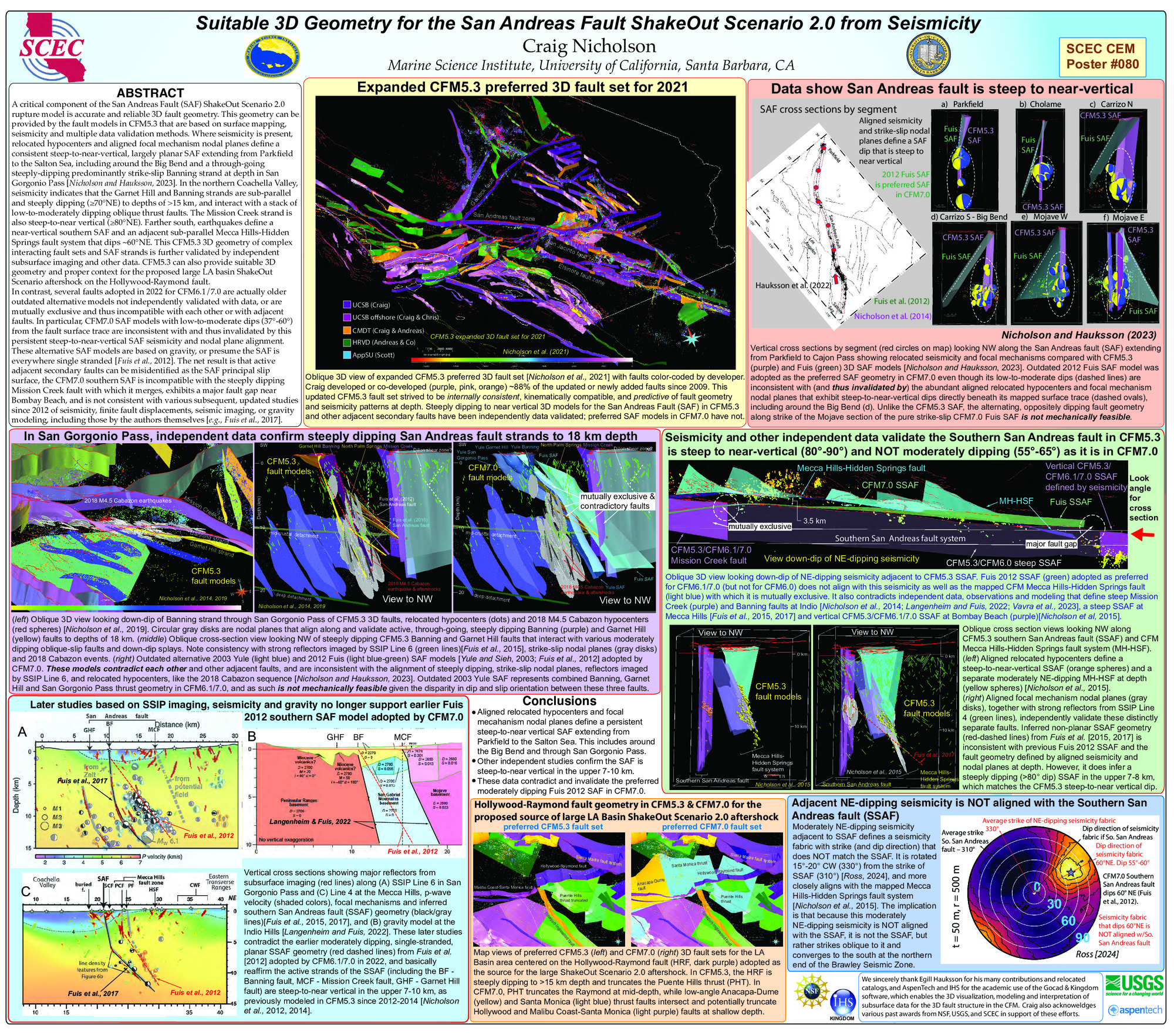 |
CEM |
Suitable 3D Geometry for the San Andreas Fault ShakeOut Scenario 2.0 from Seismicity
Craig Nicholson A critical component of the San Andreas Fault (SAF) ShakeOut Scenario 2.0 rupture model is accurate and reliable 3D fault geometry. This geometry can be provided by the fault models in CFM5.3 that are based on surface mapping, seismicity and... more Themes: Advancing Community Earth Models for Hazard Analyses | Earthquake Scenarios for Hazard and Risk Assessment |
21023
|
|
Group B Poster 054 |
SDOT |
Investigating the impact of restraining bend dip on fault evolution using scaled experiments
Michelle Nishimoto, Michele Cooke Scaled experiments provide direct observations of and detailed insights into evolving fault networks. Active strike-slip fault systems host many restraining bends, which can serve as points of earthquake initiation or termination. Because the... more |
|
|
Group A Poster 233 |
GM |
Comparative Validation of Physics-Based Ground Motion Simulations in Northern and Southern California
Chukwuebuka Nweke, Sajan K C, Robert Graves, Evan Hirakawa This study evaluates and compares physics-based ground-motion simulations for moderate-magnitude earthquakes in Northern and Southern California. The dataset includes 26 San Francisco Bay Area events and 30 Southern California events with magnitudes... more Themes: Advancing Community Earth Models for Hazard Analyses | Physics-Based Ground Motion Simulations & Validation | Utilization of Ground Motion Simulations & Records |
24062, 22160
|
|
Group A Poster 103 |
Geology |
New field observations reveal two previously unmapped fault strands in the San Gorgonio Pass region of the San Andreas fault system
Patrick OConnor, Kim Blisniuk, Michae Musick This study presents results of new bedrock and geomorphic mapping from field observations and high-resolution airborne LiDAR topographic scanning, undertaken in the San Gorgonio Pass region of the San Andreas fault system, in the study area south of... more Themes: Advancing Community Earth Models for Hazard Analyses | Earthquake Scenarios for Hazard and Risk Assessment |
|
Group A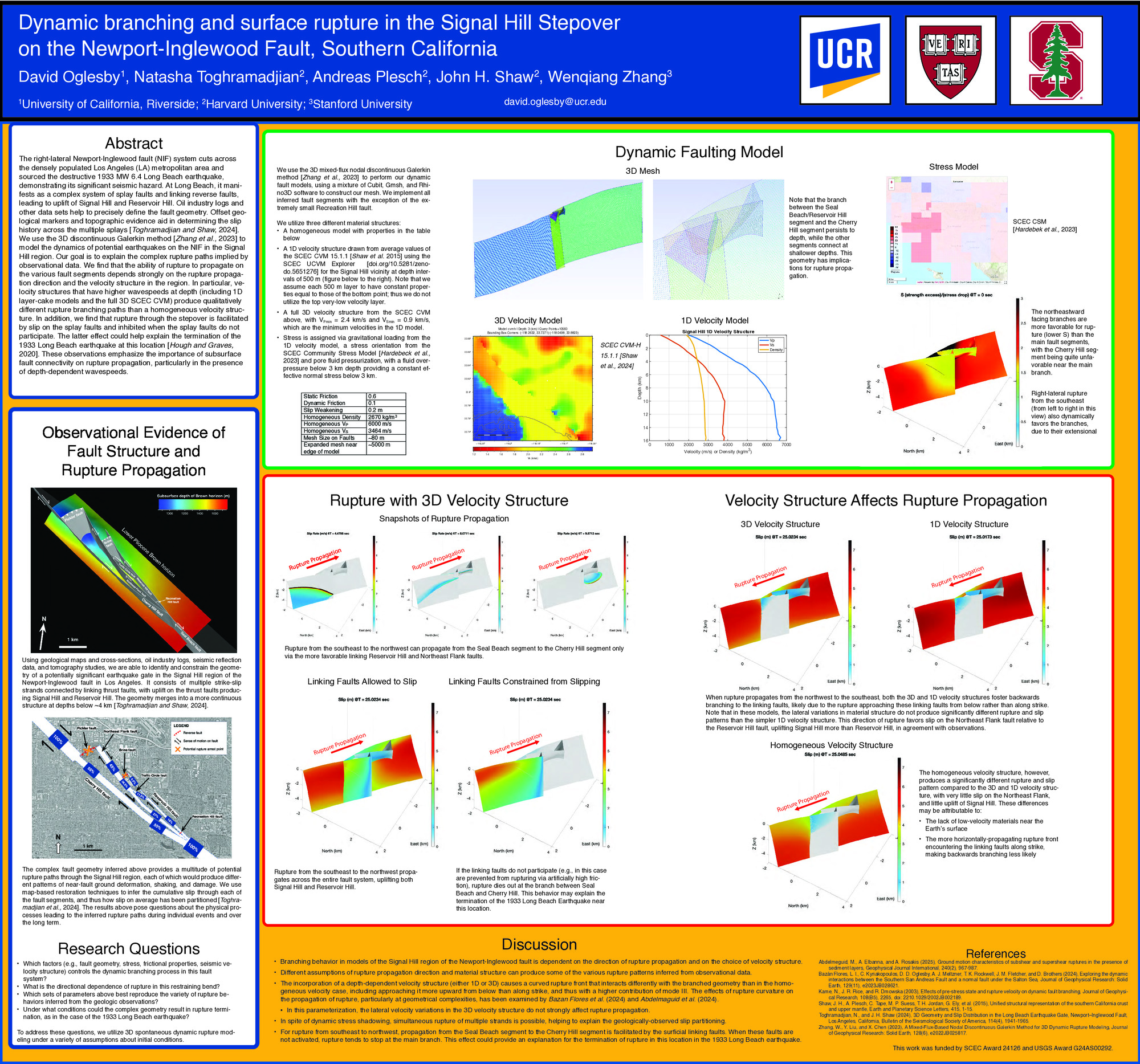 |
FARM |
Dynamic branching and surface rupture in the Signal Hill Stepover on the Newport-Inglewood Fault, Southern California
David Oglesby, Natasha Toghramadjian, Andreas Plesch, John Shaw, Wenqiang Zhang The right-lateral Newport-Inglewood fault (NIF) system cuts across the densely populated Los Angeles (LA) metropolitan area and sourced the destructive 1933 MW 6.4 Long Beach earthquake, demonstrating its significant seismic hazard. At Long Beach,... more Themes: Advancing Community Earth Models for Hazard Analyses | Earthquake Scenarios for Hazard and Risk Assessment | Physics-Based Ground Motion Simulations & Validation |
24126
|
Group A |
CEM |
SCEC Multi-scale Community Velocity Model TAG
Kim Olsen, Evan Hirakawa, Te-Yang Yeh, Yehuda Ben-Zion, Clifford Thurber, Oliver Boyd, . the SCEC Multi-scale Community Velocity Model TAG Working Group The SCEC Multi-scale Community Velocity Model TAG is centered on the multi-scale P and S seismic velocity models of California and Western Nevada version 1 (MUSCAL) recently developed by Yeh, Ben-Zion and Olsen (2026). MUSCAL was generated by... more Themes: Advancing Community Earth Models for Hazard Analyses | Physics-Based Ground Motion Simulations & Validation |
26094
|
|
Group A Poster 121 |
Geology |
Understanding Natural Recurrence of Earthquakes and Slip over Time (UNREST) Technical Activity Group
Michael Oskin, Sinan Akciz, Kim Blisniuk, Sally McGill, Thomas Rockwell, Alba Rodriguez Padilla, Ramon Arrowsmith, Timothy Dawson, Lisa Grant Ludwig, Genya Ishigaki, Ian Pierce, Gordon Seitz, Erik Perkins, Sophia Esquenet, Brian Ducharme The UNREST TAG leads a community effort to develop an AI/ML-ready Digital Twin Fault System to test earthquake-cycle models against the observed paleoseismic record, refine data interpretation, and improve time-dependent rupture forecasts. The... more Themes: Advancing Community Earth Models for Hazard Analyses | Earthquake Scenarios for Hazard and Risk Assessment | Earthquake Cycle Simulations & Forecasting |
26076
|
The Statewide California Earthquake Center is committed to providing a safe, productive, and welcoming environment for all participants. We take pride in fostering a diverse and inclusive SCEC community, and therefore expect all participants to abide by the SCEC Activities Code of Conduct.


