Group A, Poster #029, Fault and Rupture Mechanics (FARM)
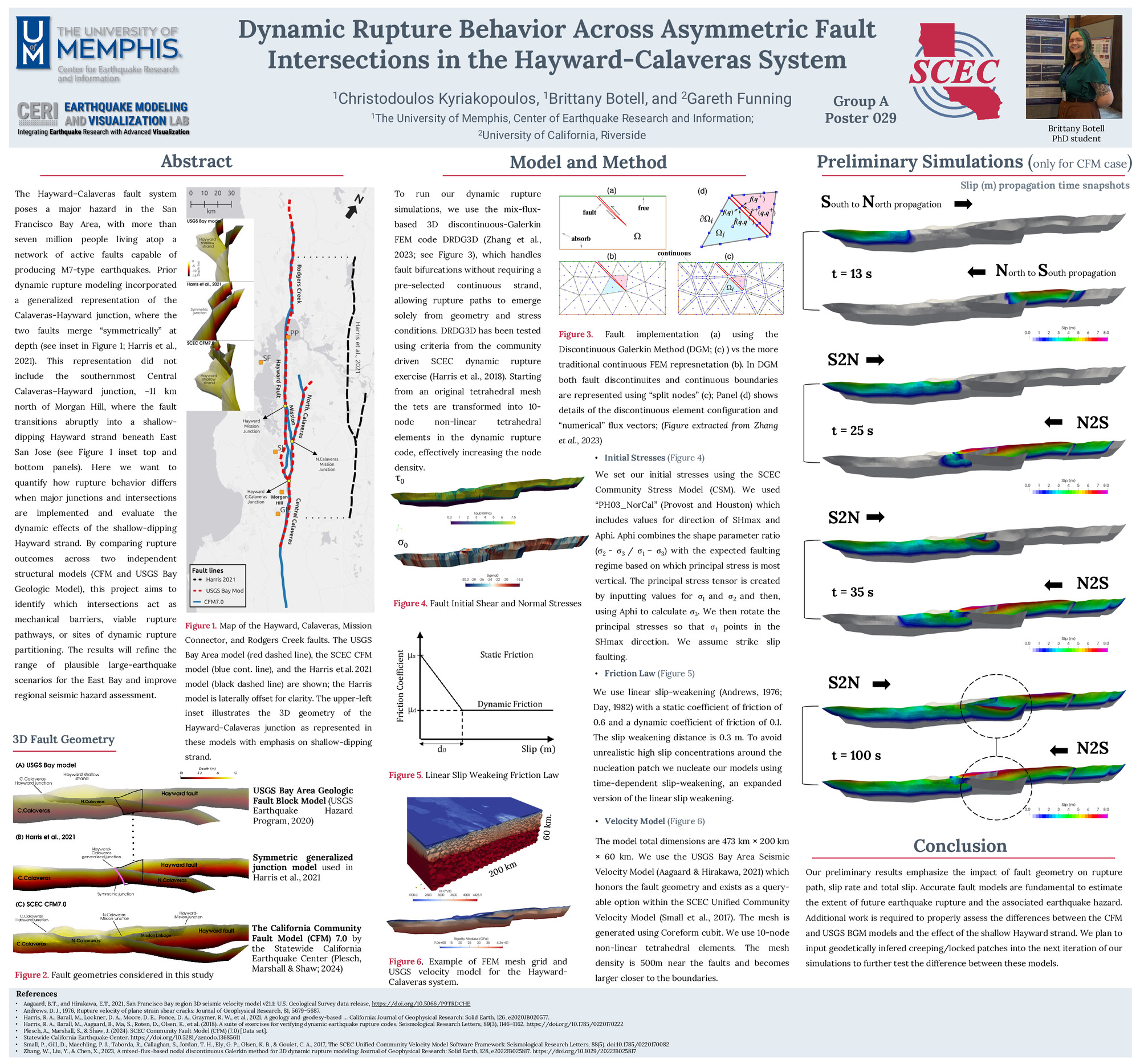
Dynamic Rupture Behavior Across Asymmetric Fault Intersections in the Hayward-Calaveras System



Poster Image:
Poster Presentation
2026 SCEC Annual Meeting, Poster #029, SCEC Contribution #15620 VIEW PDF
The Hayward–Calaveras fault system poses a major hazard in the San Francisco Bay Area, with more than seven million people living atop a network of active faults capable of producing M7-type earthquakes. Previous studies have demonstrated that rupture behavior is highly sensitive to the geometry of fault intersections. Yet, the full three-dimensional complexity of these junctions and their effects in the Bay Area have not been systematically explored. Prior dynamic rupture modeling incorporated a generalized representation of the Calaveras-Hayward junction, where the two faults merge “symmetrically” at depth, but did not include the southernmost Central Calaveras–Hayward junction near the San Felipe Creek, roughly 11 km north of Morgan Hill, where the fault transitions abruptly into a shallow-dipping Hayward strand beneath East San Jose. This asymmetric junction strongly influences rupture propagation, maximum slip rate values, and the likelihood of rupture branching or arrest. Here we want to quantify how rupture behavior differs when major junctions and intersections are implemented and evaluate the dynamic effects of the shallow-dipping Hayward strand, which preliminary simulations show can amplify slip rate and promote a supershear jump. We will use the 3D discontinuous-Galerkin FEM code DRDG3D, which handles fault bifurcations without requiring a pre-selected continuous strand, allowing rupture paths to emerge solely from geometry and stress conditions. Simulations will combine realistic 3D fault surfaces with known friction laws, and heterogeneous initial stress conditions informed by geodetically observed creep rates. By comparing rupture outcomes across two independent structural models (CFM and USGS Bay Model), this project aims to identify which intersections act as mechanical barriers, viable rupture pathways, or sites of dynamic rupture partitioning. The results will refine the range of plausible large-earthquake scenarios for the East Bay and improve regional seismic hazard assessment.
Citation: Kyriakopoulos, C., Botell, B., & Funning, G. J. (2026, 08). Dynamic Rupture Behavior Across Asymmetric Fault Intersections in the Hayward-Calaveras System. Poster Presentation at 2026 SCEC Annual Meeting.
Relevant SCEC Themes:
Earthquake Scenarios for Hazard and Risk Assessment