Group A, Poster #143, Seismology
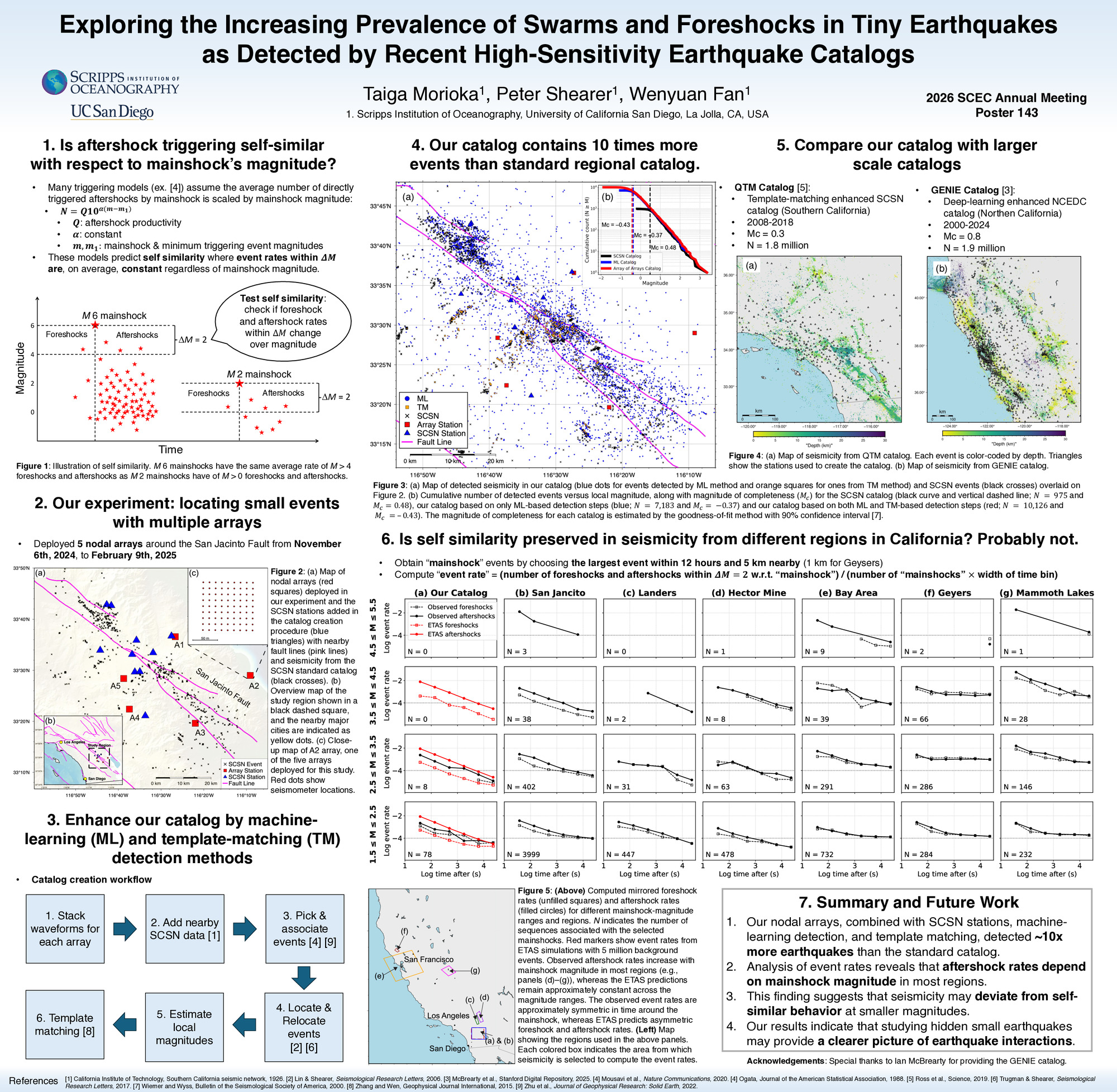
Exploring the Increasing Prevalence of Swarms and Foreshocks in Tiny Earthquakes as Detected by Recent High-Sensitivity Earthquake Catalogs


Poster Image:
Poster Presentation
2026 SCEC Annual Meeting, Poster #143, SCEC Contribution #15393 VIEW PDF
The prevalence of foreshocks before larger earthquakes has long been debated and remains central to understanding earthquake initiation. Foreshocks are observed far less frequently in standard seismic catalogs than in some laboratory experiments. Recent advances in template matching and machine-learning-based earthquake detection have revealed that a greater fraction of earthquakes are preceded by foreshocks than previously recognized. However, most seismic networks cannot routinely detect earthquakes with magnitudes below zero, leaving a hidden population of microearthquakes that may help clarify foreshock behavior.
In previous work, we constructed a regional earthquake catalog with a magnitude of completeness of –0.43 for a 3-month period around the San Jacinto Fault in southern California by combining observations from five dense seismic arrays with machine-learning and template-matching techniques. The resulting catalog contains earthquake clusters, and the timing of small earthquakes in these clusters appears to be independent of the magnitudes of preceding events, producing approximately time-symmetric foreshock and aftershock rates around the largest events. The prevalence of swarm-like behavior at small magnitudes further suggests that conventional magnitude-dependent self-similar triggering, in which aftershocks substantially outnumber foreshocks, may break down for small earthquakes.
To assess whether this behavior extends beyond the array experiment, we investigate seismicity and clustering statistics over broader spatial and temporal scales, including a potential transition in clustering behavior with increasing magnitude. In addition to comparing foreshock and aftershock rates, we quantify the degree to which individual earthquakes are associated with other events using nearest-neighbor clustering methods and examine how these relationships vary with magnitude. We apply these analyses to enhanced earthquake catalogs produced using deep-learning detection and template matching for California. Study of previously hidden patterns in micro-seismicity may provide new insights into earthquake nucleation and interaction.
In previous work, we constructed a regional earthquake catalog with a magnitude of completeness of –0.43 for a 3-month period around the San Jacinto Fault in southern California by combining observations from five dense seismic arrays with machine-learning and template-matching techniques. The resulting catalog contains earthquake clusters, and the timing of small earthquakes in these clusters appears to be independent of the magnitudes of preceding events, producing approximately time-symmetric foreshock and aftershock rates around the largest events. The prevalence of swarm-like behavior at small magnitudes further suggests that conventional magnitude-dependent self-similar triggering, in which aftershocks substantially outnumber foreshocks, may break down for small earthquakes.
To assess whether this behavior extends beyond the array experiment, we investigate seismicity and clustering statistics over broader spatial and temporal scales, including a potential transition in clustering behavior with increasing magnitude. In addition to comparing foreshock and aftershock rates, we quantify the degree to which individual earthquakes are associated with other events using nearest-neighbor clustering methods and examine how these relationships vary with magnitude. We apply these analyses to enhanced earthquake catalogs produced using deep-learning detection and template matching for California. Study of previously hidden patterns in micro-seismicity may provide new insights into earthquake nucleation and interaction.
Citation: Morioka, T., Shearer, P. M., & Fan, W. (2026, 08). Exploring the Increasing Prevalence of Swarms and Foreshocks in Tiny Earthquakes as Detected by Recent High-Sensitivity Earthquake Catalogs. Poster Presentation at 2026 SCEC Annual Meeting.
Keywords: Small earthquakes, Swarms, Enhanced catalogs