
Group B, Poster #018, Fault and Rupture Mechanics (FARM)
When and where does aseismic creep stop rupture propagation?

Poster Image:
Poster Presentation
2026 SCEC Annual Meeting, Poster #018, SCEC Contribution #15595 VIEW PDF
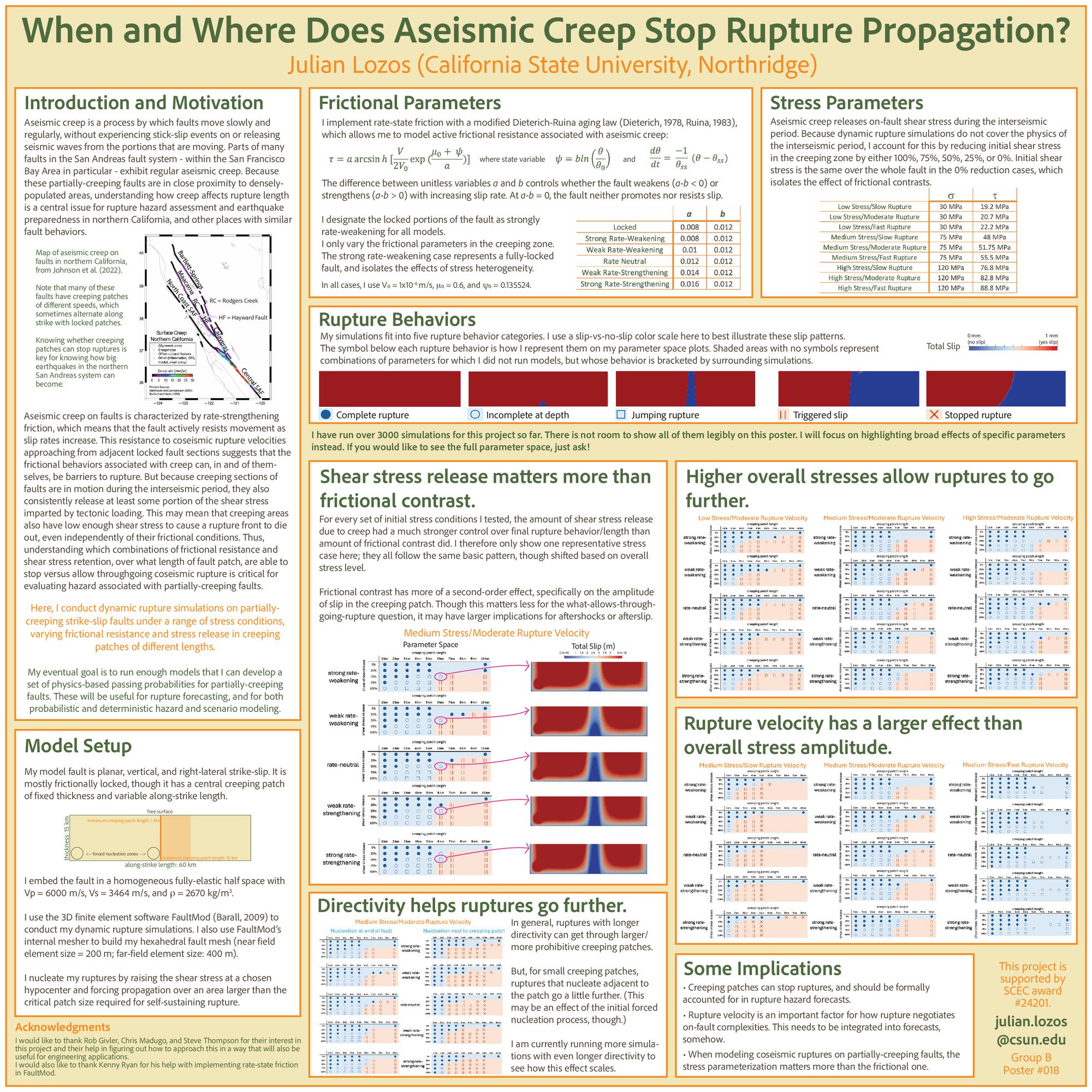
ions of frictional resistance and shear stress retention, over what length of fault patch, are able to stop throughgoing coseismic rupture is critical for evaluating hazard from partially-creeping faults. Here, I conduct a broad suite of dynamic rupture simulations on partially-creeping strike-slip faults under a range of stress conditions, varying frictional resistance and stress release in creeping patches of different lengths, with different distances between the nucleation point and the creeping patch. I compare the length and amount of surface slip of the resulting earthquake across parameter space. Over the course of 3000+ individual rupture simulations (more than 6x as many as when I last presented this at SCEC), I find a largely unsurprising hierarchy of which factors control rupture length/stopping point. Creeping areas that are longer and have more stress release are more likely to prevent rupture from reaching the end of the fault. The frictional properties of the creeping patch have less of an effect on rupture length, though they still affect slip patterns. More energetic ruptures, whether that energy comes directly from initial stress conditions or from longer rupture directivity leading into the creeping patch, can also overcome larger and more resistant creeping patches. I am still running additional simulations at the time of submitting this abstract, working toward the goal of developing physics-based passing probabilities for partially-creeping faults. These probabilities will be useful for a range of applications, including interpreting evidence of past ruptures, probabilistic rupture forecasting, and source scenario development for both probabilistic and deterministic hazard modeling.
SHOW MORE
SHOW MORE
Citation: Lozos, J. C. (2026, 08). When and where does aseismic creep stop rupture propagation?. Poster Presentation at 2026 SCEC Annual Meeting.
Keywords: aseismic creep, dynamic rupture modeling, partially creeping faults, strike slip, parameter study, frictional controls on rupture
SCEC Award: 24201


