

| AGENDA | POSTERS | PARTICIPANTS | ABSTRACTS | TRAVEL | FAQ |
Meeting Abstracts
The Statewide California Earthquake Center (SCEC) collaborates with academic, government, industry, and other organizations to advance earthquake science, community resilience, and education by: (1) Gathering and analyzing data from field observations and laboratory experiments. (2) Developing system-level models and simulations of earthquake processes to synthesize knowledge as a physics-based understanding of seismic hazard. (3) Communicating that understanding to expand knowledge and reduce earthquake risk.
Participants are invited to present recent work aligned with SCEC priorities during the poster sessions.
| SCEC ID | Category | Title and Authors | SCEC Award |
|---|---|---|---|
|
Group A Poster 141 |
Seismology |
Seeking Waveform Changes in a San Jacinto Fault Aftershock Sequence by Dense-Array Stacking
Mingze Du, John Vidale, Quentin Higueret The trifurcation zone of the San Jacinto Fault is a structurally complex region where multiple fault strands interact, making it an important setting for investigating fault zone structure and how earthquake sources and the surrounding fault zone... more Themes: Earthquake Cycle Simulations & Forecasting |
25253
|
|
Group B Poster 052 |
SDOT |
Viscoplastic deformation of naturally damaged rocks from the San Andreas Fault from creep and pure shear experiments
Nairong Du, Hiroki Sone Shallow fault zone rocks are often damaged by fault activities, making them more susceptible to bulk plastic deformation upon mechanical loading. Because viscoplastic deformation can relax differential stress over time and accommodate distributed... more Themes: Physics-Based Ground Motion Simulations & Validation | Earthquake Cycle Simulations & Forecasting |
|
|
Group B Poster 192 |
CCB |
The SCEC Wish Wall
Ahmed Elbanna We want to hear from you, our community, about what we should do together over the next 2–4 years. Share your ideas, priorities, and dreams directly on this poster. Your input will help shape SCEC’s science, collaborations, and impact.
Themes: Engaging Communities in Earthquake Preparedness |
|
|
Group A Poster 155 |
Seismology |
Resolving the Structure of a Slowly Slipping Plate Boundary: Insights from the Dead Sea Fault
Shaked Engelberg, Zachary Ross Low seismicity rates along slowly slipping plate boundaries limit the resolution at which active fault structures can be imaged using earthquake catalogs. Here, we present a framework to overcome this limitation at the Dead Sea Fault. We generate a... more |
|
|
Group A Poster 057 |
Geodesy |
A geologic block model of southern California
Eileen Evans, Abigail Travers, Jayson Sellars, Monica Diaz, Jack Loveless Determining fault slip rates throughout a complex fault system, such as in southern California, is essential for understanding tectonic strain partitioning and seismic hazard at plate-boundary scales. Fault slip rates may be estimated using tectonic... more Themes: Advancing Community Earth Models for Hazard Analyses |
|
|
Group A Poster 165 |
Seismology |
Investigating the origin of seismic clustering in the Salton Trough
Claire Fagan, Allen Husker, Joann Stock The Salton Trough region is one of the most geologically active regions in California. It experiences oblique extension between the Pacific and North American Plates, geothermal and magmatic activity, changes in hydrological loading, and very high... more Themes: Earthquake Scenarios for Hazard and Risk Assessment |
|
|
Group B Poster 090 |
Geology |
Undergraduate Research Internship: Learning LiDAR differencing to study and document surface changes at Pillar Point Bluff
Ethan Failano, Annie Hinh, Ashley Walsh, Kim Blisniuk This summer internship focused on learning how to acquire LiDAR data using a mobile unit to collect surface topography data. We collected data at Pillar Point Bluff along the San Gregorio Fault of the northern San Andreas fault system to identify... more Themes: Engaging Communities in Earthquake Preparedness |
|
|
Talk Mon1400 |
EFP |
Why we need Multicycle Physics-Based Earthquake Simulators
Edward Field Seismic hazard and risk analyses—which influence building codes, insurance models, and disaster preparedness—depend on Earthquake Rupture Forecasts (ERFs), which quantify future earthquake rupture probabilities. Unfortunately, many assumptions... more Themes: Earthquake Cycle Simulations & Forecasting |
|
Group A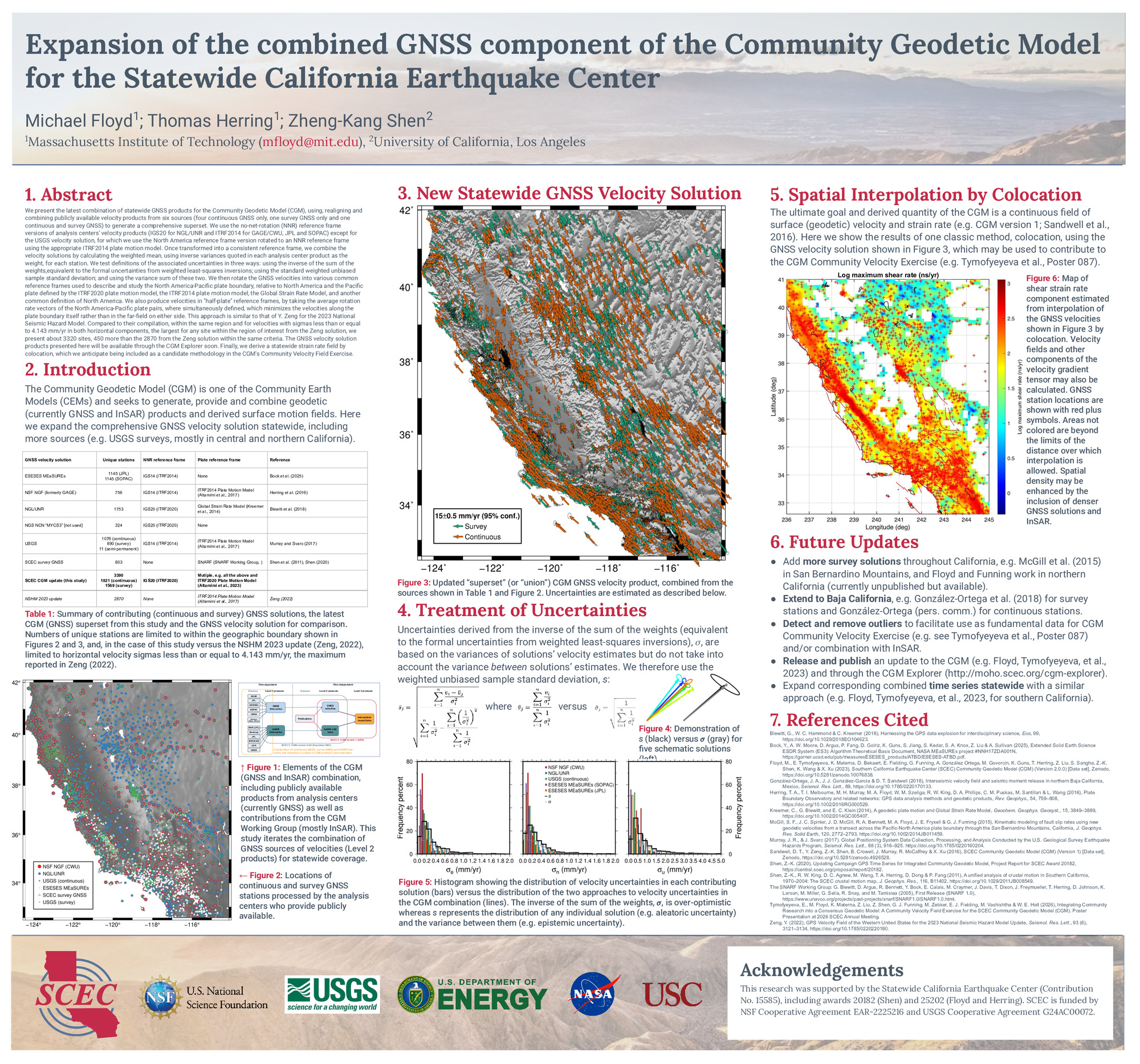 |
CEM |
Expansion of the combined GNSS component of the Community Geodetic Model for the Statewide California Earthquake Center
Michael Floyd, Thomas Herring, Zheng-Kang Shen We present the latest combination of statewide GNSS products for the Community Geodetic Model (CGM), using, realigning and combining publicly available velocity products from six sources (four continuous GNSS only, one survey GNSS only and one... more Themes: Advancing Community Earth Models for Hazard Analyses | Rapid Post-Earthquake Investigations & Communications |
25202, 20182
|
|
Group B Poster 134 |
Seismology |
The Evaluating Las Vegas’s Internal Seismic structure (ELVIS) experiment
Heather Ford, Joseph Byrnes, Delton Samuel, Beth Shallon, Ashley Stroup, Binayak Parida, Groniston Dorome, Evan Marschall, Jennifer Garcia, Nicolas Barth, Jose Murillo, Ashley Luna, Long Ho, Rufus Catchings, Donna Shillington, James Gaherty, Ryan Porter, Luke Frazeur The Las Vegas Valley is a densely populated region located within the Central Basin and Range, bounded by mountain ranges and underlain by a basin thought to extend to depths of up to 5 km. At one time it was thought that the present-day Las Vegas... more Themes: Advancing Community Earth Models for Hazard Analyses |
|
|
Group A Poster 217 |
GM |
Using dynamic rupture simulations to improve ground motion models for normal-slip earthquakes
Yair Franco, Daniel Trugman Normal-slip earthquakes are a regular occurrence in the Intermountain West region of the United States. Hazard assessments such as the 2023 National Seismic Hazard Model (NSHM) require the capacity to accurately predict the range of possible ground... more Themes: Physics-Based Ground Motion Simulations & Validation |
|
|
Group B Poster 190 |
CCB |
U.S. Geological Survey Earthquake Hazards External Grants – Advancing Seismic Hazard Research, National Resilience, and Public Safety
Jill Franks The U.S. Geological Survey (USGS) Earthquake Hazards External Grants Program advances nationwide earthquake hazards research by funding competitive, mission aligned projects that strengthen public safety and resilience, supporting work in fault... more |
|
|
Group B Poster 128 |
Seismology |
The Southern California plate boundary, the San Andreas fault, is traceable as a dipping structure throughout the lithosphere
Gary Fuis, Victoria Langenheim, Daniel Scheirer The predicted strong ground motions in Southern California for a Shakeout Scenario rupture on the San Andreas fault (SAF) were reported by Jones et al. (2008). These predictions were updated for a similar rupture but with a northeast dipping fault... more Themes: Earthquake Scenarios for Hazard and Risk Assessment |
|
|
Group A Poster 017 |
FARM |
Rupture sensitivity to dynamic source parameters revealed by variational fracture mechanics and adjoint rupture dynamics
Rikuto Fukushima, Eric Dunham Dynamic source inversion incorporating fault mechanics advances our understanding of earthquake source processes and provides a complementary approach to kinematic slip inversion. Stiernström et al. (2024) introduced adjoint-based dynamic rupture... more Themes: Physics-Based Ground Motion Simulations & Validation | Earthquake Cycle Simulations & Forecasting |
25156
|
Group A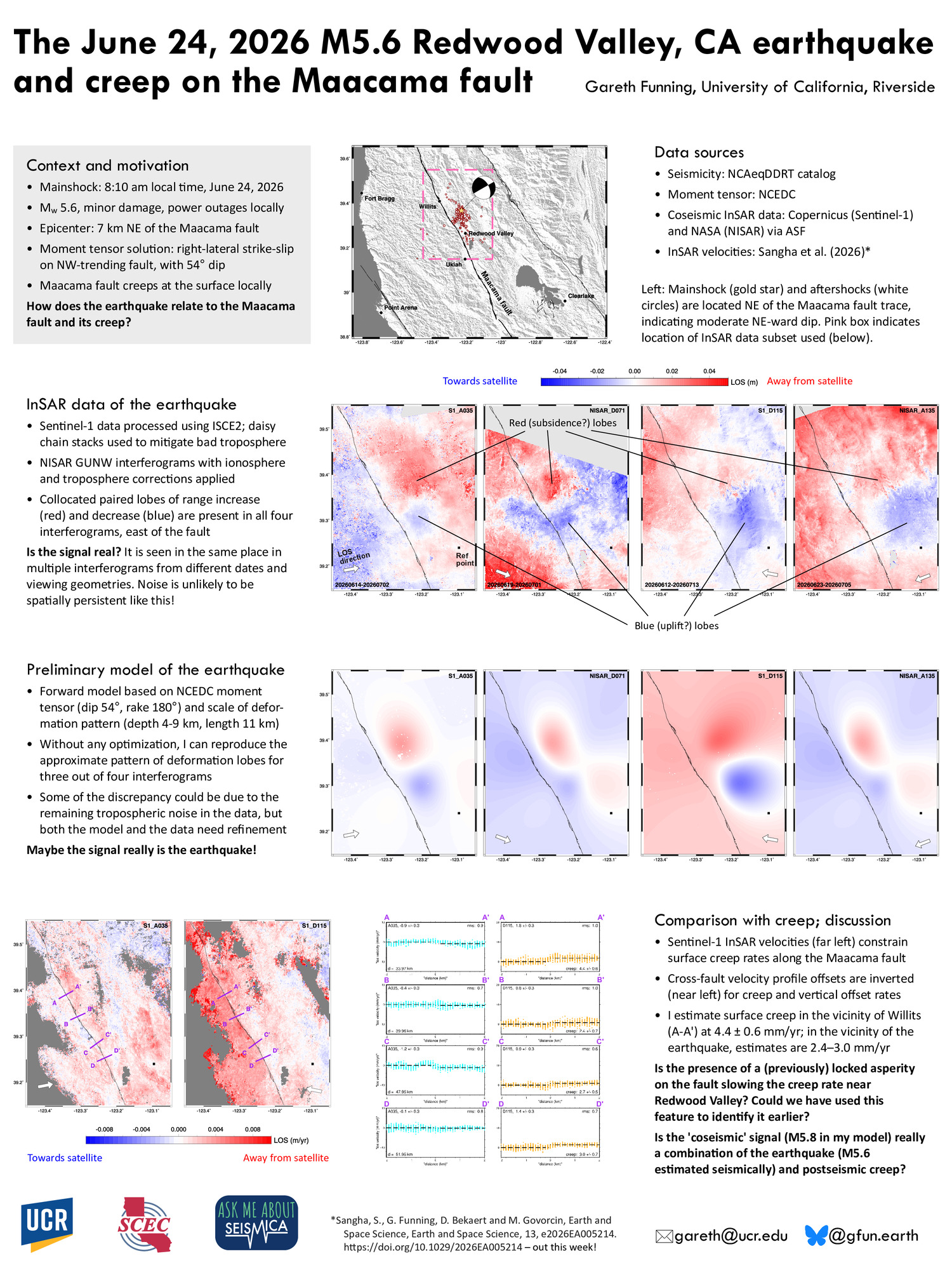 |
Geodesy |
The June 24, 2026 M5.6 Redwood Valley, CA earthquake and creep on the Maacama fault
Gareth Funning At 8:10 am local time on June 24th, 2026, a M5.6 event shook Redwood Valley in northern California, causing minor damage, power outages and minor injuries in surrounding communities. The epicenter of the event lies close to the trace of the Maacama... more Themes: Advancing Community Earth Models for Hazard Analyses | Rapid Post-Earthquake Investigations & Communications |
25295, 25141, 26092
|
|
Group B Poster 042 |
PBS |
Seismic Imaging of the Mendocino Triple Junction: Defining the Geodynamics of an Evolving Plate Boundary Transition
Kevin Furlong, Matthew Herman, Kirsty McKenzie The Mendocino Triple Junction (MTJ) demarcates the fundamental change along the North American plate boundary from subduction (Cascadia) to translation (San Andreas). This plate boundary transition zone hosts the initiation of the lithospheric... more Themes: Advancing Community Earth Models for Hazard Analyses | Engaging Communities in Earthquake Preparedness |
25062
|
|
Group A Poster 023 |
FARM |
Controls on the Connected, Multistage 2026 Mw 7.6 Venezuela Earthquake from EKI MultiCMT, 3D Dynamic Rupture Modeling, NISAR and ALOS-2 InSAR analyses
Alice-Agnes Gabriel, Jeremy Wing Ching Wong, Rubi Garcia-Gonzalez, Eitan Rapaport Bruck, Mathilde Marchandon, Molly Zebker, Baoning Wu, Yohai Magen, Claudia Abril, David Sandwell, Yuri Fialko, Wenyuan Fan The destructive 2026 Mw 7.6 Venezuela earthquake ruptured the Boconó and the San Sebastián fault systems, causing more than 5,000 fatalities. Initial reports suggested a doublet: an Mw 7.2 event ~30s before the Mw 7.5 mainshock. We integrate... more Themes: Physics-Based Ground Motion Simulations & Validation | Earthquake Cycle Simulations & Forecasting | Rapid Post-Earthquake Investigations & Communications |
|
|
Group A Poster 021 |
FARM |
Characterization of earthquake source properties for weak events using broadband dynamic rupture models
Frantisek Gallovic, Lubica Valentova K., Lav Joshi, Sara Sgobba Standard characterization of weak earthquakes from observed source spectra relies on corner frequency (stress drop) and radiated energy estimates only as general source characteristics. However, the standard seismological analysis cannot provide... more Themes: Physics-Based Ground Motion Simulations & Validation |
24103
|
|
Group A Poster 055 |
Geodesy |
Coseismic 3D surface deformation and slip distribution of the M7.5 Venezuela Earthquake doublet revealed by NISAR and ALOS-2 InSAR data
Rubi Garcia-Gonzalez On June 24, an earthquake sequence, comprising an M7.2 foreshock followed 32 seconds later by the M7.5 mainshock, struck the coastal region of Venezuela. With only a single operational Global Navigation Satellite System (GNSS) station in the... more Themes: Advancing Community Earth Models for Hazard Analyses | Earthquake Scenarios for Hazard and Risk Assessment | Rapid Post-Earthquake Investigations & Communications |
|
|
Group B Poster 046 |
PBS |
Seismicity along the Southern Edge of the Subducted Gorda Plate
Jianhua Gong The southernmost Cascadia subduction zone is where the Gorda, Pacific, and North American plates converge at the Mendocino Triple Junction (MTJ). This region is one of the most seismically active areas in North America, characterized by frequent... more Themes: Advancing Community Earth Models for Hazard Analyses |
|
|
Group A Poster 039 |
FARM |
The equation of motion for rate-and-state supershear earthquake rupture
Zekang Gong, Federico Ciardo, Dmitry Garagash Supershear earthquakes propagate faster than the shear-wave speed V_S and generate shear Mach fronts that can produce intense ground motions. Although the mechanics of supershear rupture has been extensively investigated with rate-independent... more |
|
Group B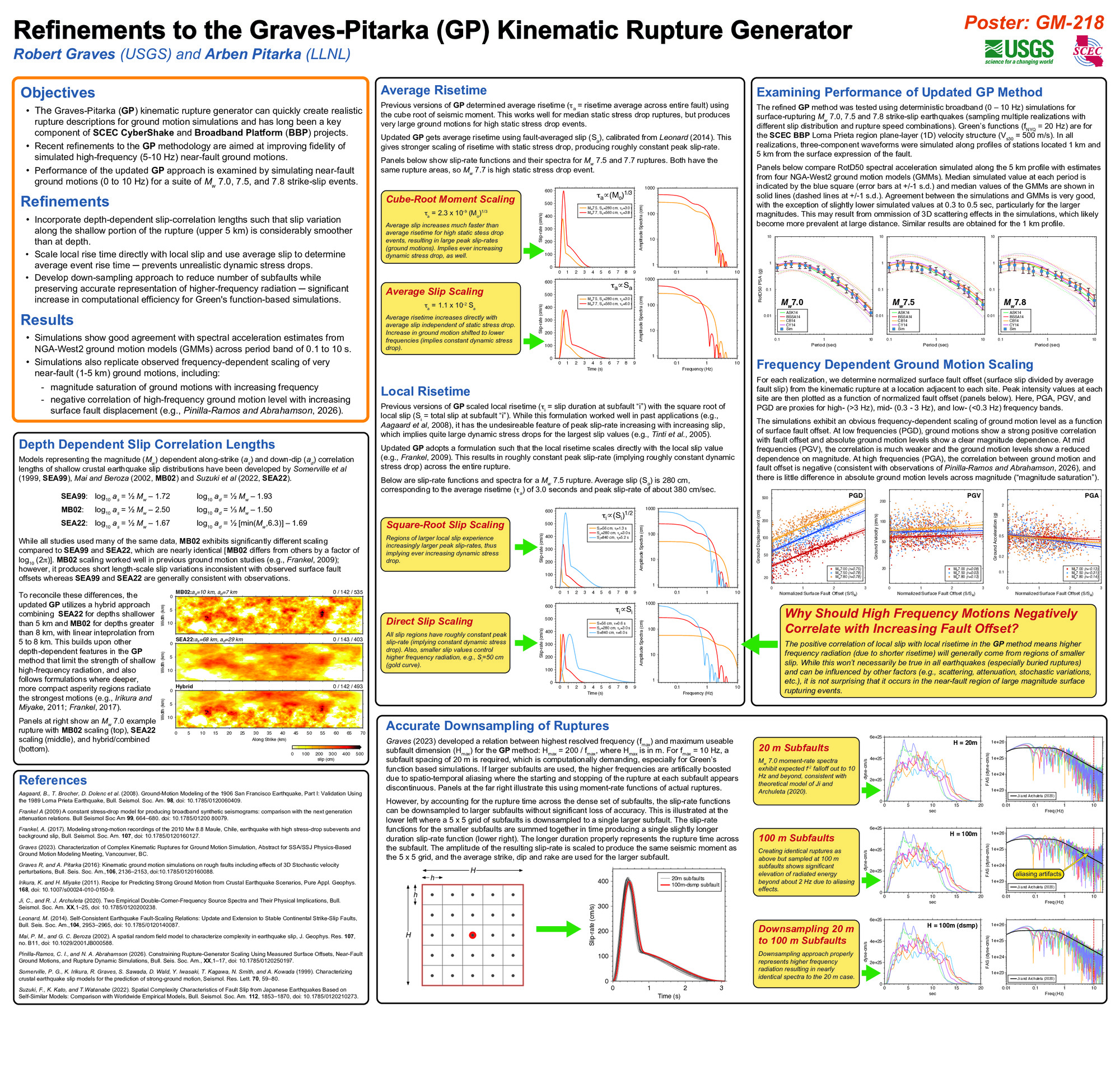 |
GM |
Refinements to the Graves-Pitarka (GP) Kinematic Rupture Generator
Robert Graves, Arben Pitarka The Graves-Pitarka (GP) kinematic rupture generator provides a fast and efficient approach for creating realistic rupture descriptions used in ground motion simulations, and for many years, it has served as a key component of the SCEC CyberShake and... more Themes: Earthquake Scenarios for Hazard and Risk Assessment | Physics-Based Ground Motion Simulations & Validation | Utilization of Ground Motion Simulations & Records |
|
Group A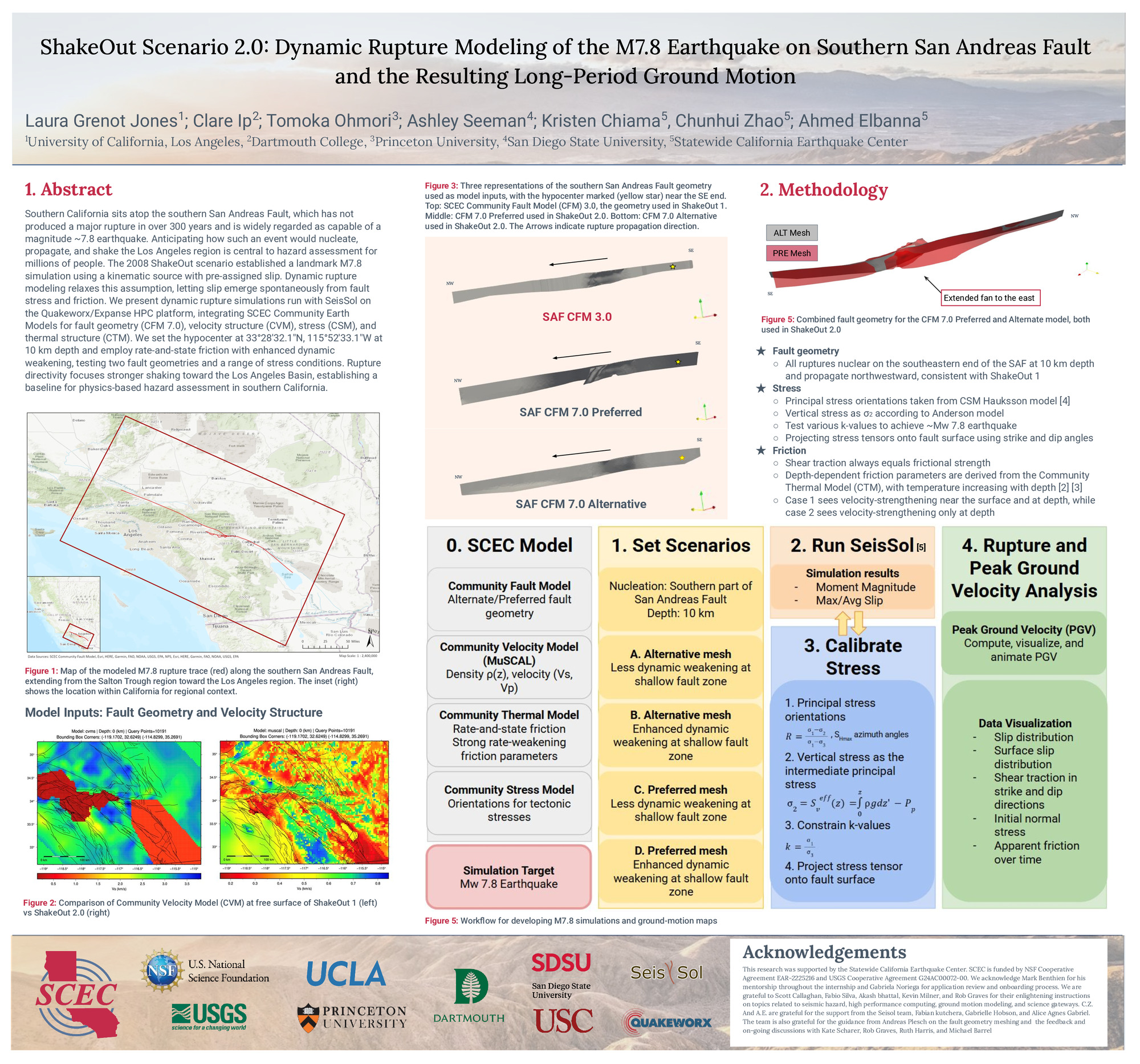 |
GM |
ShakeOut Scenario 2.0: Dynamic Rupture Modeling of the M7.8 Earthquake on Southern San Andreas Fault and the Resulting Long-Period Ground Motion
Laura Grenot Jones, Clare Ip, Tomoka Ohmori, Ashley Seeman, Chunhui Zhao, Ahmed Elbanna Southern California sits atop the southern San Andreas Fault, which has not produced a major rupture in over 300 years and is capable of a magnitude ~7.8 earthquake. Anticipating how such an event would nucleate, propagate, and shake the Los Angeles... more Themes: Earthquake Scenarios for Hazard and Risk Assessment | Physics-Based Ground Motion Simulations & Validation |
26067
|
|
Group A Poster 001 |
FARM |
SEM: Shallow Earth Materials (TAG)
William Griffith, Alexis Ault, Thomas Rockwell, Brady Cox, Eileen Evans, Yihe Huang, Kathryn Materna, Alba Rodriguez Padilla, Hiroki Sone Shallow Earth Materials (SEM), encompassing the upper ~3 km of rock, sediment, and soil, strongly influence earthquake rupture propagation, interseismic creep, near-fault deformation, seismic site response, and the geologic record of past... more Themes: Advancing Community Earth Models for Hazard Analyses | Physics-Based Ground Motion Simulations & Validation | Rapid Post-Earthquake Investigations & Communications |
25246, 26091
|
Group B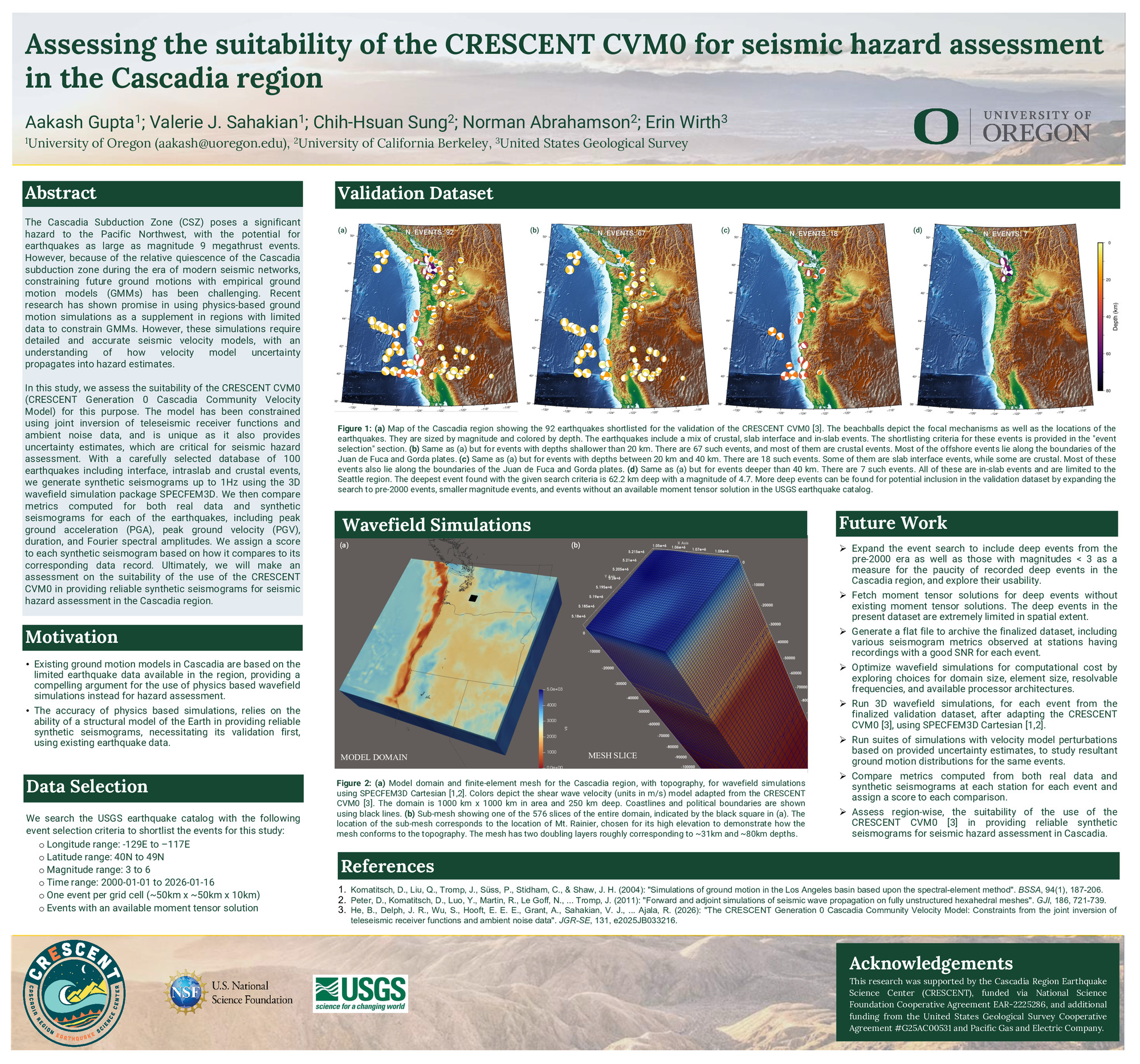 |
GM |
Assessing the suitability of the CRESCENT CVM0 for seismic hazard assessment in the Cascadia region
Aakash Gupta, Valerie Sahakian, Chih-Hsuan Sung, Norman Abrahamson, Erin Wirth The Cascadia Subduction Zone (CSZ) poses a significant hazard to the Pacific Northwest, with the potential for earthquakes as large as magnitude 9 megathrust events. However, because of the relative quiescence of the Cascadia subduction zone during... more Themes: Physics-Based Ground Motion Simulations & Validation |
|
Group B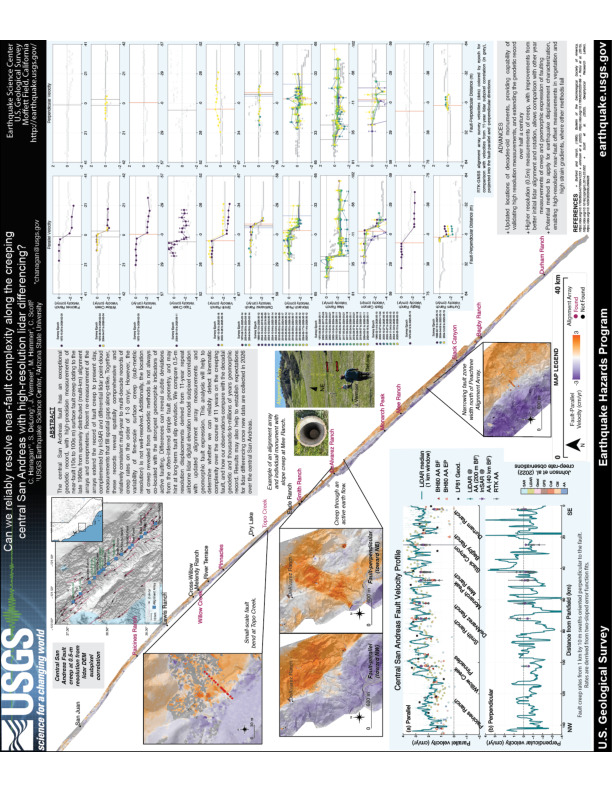 |
SDOT |
Can we reliably resolve near-fault complexity along the creeping central San Andreas with high-resolution lidar differencing?
Catherine Hanagan, Stephen DeLong, Jessie Vermeer, Morena Hammer, Chelsea Scott The central San Andreas fault has an exceptional geodetic record, with high-precision measurements of near-fault (10s to 100s m) surface fault creep dating to the late 1960s from sparsely distributed (multi-km) alignment arrays and creepmeters.... more |
|
Group B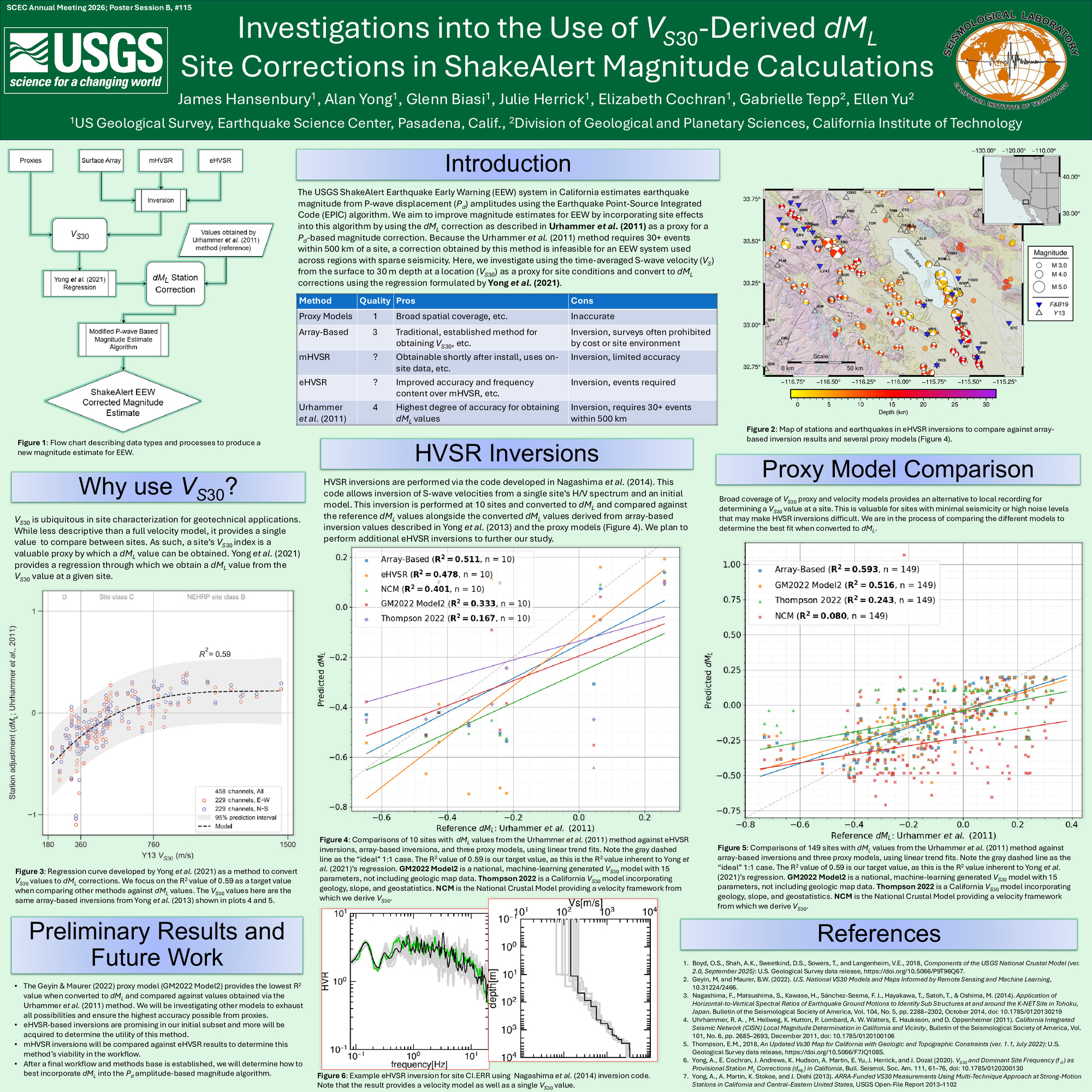 |
Seismology |
Investigations into the use of VS30-derived dML site corrections in ShakeAlert magnitude calculations
James Hansenbury, Alan Yong, Glenn Biasi, Julie Herrick, Elizabeth Cochran, Gabrielle Tepp, Ellen Yu The USGS ShakeAlert Earthquake Early Warning (EEW) system in California, Oregon, and Washington estimates earthquake magnitude from P-wave displacement (Pd) amplitudes recorded by as few as four seismic stations. This small sample size means site... more Themes: Rapid Post-Earthquake Investigations & Communications |
|
|
Group A Poster 211 |
EFP |
Estimating Aftershock Risk for Entry into Earthquake-Damaged Buildings
Jeanne Hardebeck, Alan Poulos Following a major earthquake, entry into damaged buildings may be necessary for response, recovery, and rebuilding activities. However, aftershocks may further damage or collapse these already-damaged structures, posing a risk to the people entering... more Themes: Earthquake Cycle Simulations & Forecasting | Rapid Post-Earthquake Investigations & Communications |
|
|
Group A Poster 227 |
GM |
Planning for simulations of a scenario large aftershock in the Los Angeles Basin - ShakeOut2.0
Ruth Harris, Michael Barall, Katherine Scharer, Ahmed Elbanna, Kristen Chiama, Andreas Plesch, Alice-Agnes Gabriel, Chunhui Zhao, James Dolan, Craig Nicholson, Kim Olsen, Robert Graves, Jeanne Hardebeck, Karen Luttrell, Scott Callaghan, Mei-Hui Su, Kevin Milner, Morgan Page, Akash Bhatthal, Lucile Jones Observations of earthquakes over the centuries have taught us that large earthquakes are always followed by aftershocks. The ShakeOut Scenario 2.0 mainshock simulates a dynamically propagating large earthquake rupturing the southern San Andreas... more Themes: Earthquake Scenarios for Hazard and Risk Assessment |
|
|
Group A Poster 171 |
Seismology |
The next M6 Parkfield Earthquake: USGS science priorities and plans
Elizabeth Hearn The San Andreas Fault at Parkfield, California is perhaps unique in the world as a site for in-depth study of earthquakes and their effects. It regularly hosts M6 earthquakes (with recurrence intervals of 12 - 38 years), displays a wide range of... more |
|
|
Group A Poster 215 |
EFP |
There are no Earthquake Cycles
Thomas Heaton There is extensive evidence that the effective coefficient of friction is in the range of 0.5 to 0.7 for shallow crustal faults. It is also clear that a coefficient of dynamic friction of more than 0.05 causes extensive melting that is not observed... more Themes: Earthquake Cycle Simulations & Forecasting |
|
|
Group A Poster 099 |
Geology |
Holocene Earthquakes and Slip Rates within the San Gorgonio Pass and implications for the ShakeOut Scenario 2.0
Richard Heermance, Katherine Scharer, Bryan Castillo The San Gorgonio Pass (SGP) represents a structurally complex region of the southern San Andreas fault (SAF), where it diverges into multiple strands and has produced a region of low hills. Over the last decade, at least six published studies... more Themes: Advancing Community Earth Models for Hazard Analyses | Earthquake Scenarios for Hazard and Risk Assessment |
12209
|
|
Group B Poster 138 |
Seismology |
Array-wise self-supervised encoding of the volcanic wavefield tracks the continuum of an eruption: the 2025 to 2026 reawakening of Piton de la Fournaise volcano
Quentin Higueret, Zachary Ross, Yaozhong Shi Volcano observatories track unrest by compressing the continuous seismic wavefield into a few hand-crafted summaries such as the real-time amplitude, the earthquake catalog and the coherence of the network. Each reduces the record to one property,... more |
|
|
Group B Poster 222 |
GM |
The 2026 Mw4.6 Boulder Creek earthquake and insights for seismic hazard associated with the southern Santa Cruz Mountains section of the San Andreas Fault
Evan Hirakawa, Grace Parker, Annemarie Baltay, Tara Nye, Tim Clements We investigate the ground motions generated by the April 2, 2026 Mw4.6 Boulder Creek, California, earthquake. This event occurred on the Santa Cruz Mountains section of the San Andreas Fault, and is the largest earthquake to occur there since the... more |
|
|
Group A Poster 067 |
Geodesy |
How did two large (M>6.5) earthquakes affect creep rates on the Pütürge segment of the East Anatolian Fault?
Celeste Hofstetter, Seda Özarpacı, Gareth Funning The Pütürge segment of the East Anatolian Fault (EAF) in eastern Turkey is a known creeping segment, where two large-magnitude (M>6.5) earthquakes (the 2020 M6.7 Elazig and the 2023 M7.7 Pazarcık earthquakes) have failed to rupture the surface (... more Themes: Earthquake Scenarios for Hazard and Risk Assessment |
|
|
Group A Poster 173 |
Seismology |
Revisiting Parkfield Mainshocks: A Characteristic Snowflake Model
Susan Hough, William Ellsworth, Aarnav Agrawal, Luke Blair, Morgan Page We use early instrumental and macroseismic data to improve the characterization of nine moderately large earthquakes in central California, including seven events on the Parkfield segment of the San Andreas Fault and three earthquakes that may have... more |
|
|
Group A Poster 153 |
Seismology |
FaultNet: Deep Learning Reconstruction of Three-Dimensional Fault Geometry from Earthquake Hypocenters
Yanlan Hu, Gregory Beroza Accurately characterizing fault geometry is fundamental to understanding earthquake processes, stress transfer, and dynamic rupture, as well as assessing seismic hazard. Recent advances in earthquake detection, phase picking, and relocation have... more Themes: Advancing Community Earth Models for Hazard Analyses | Earthquake Scenarios for Hazard and Risk Assessment | Rapid Post-Earthquake Investigations & Communications |
|
|
Group A Poster 231 |
GM |
Performance evaluation of physics-based ground-motion simulations in the New Madrid region: effects of embayment structure and stochastic velocity variability
Junfei Huang, Arben Pitarka, Rie Nakata, Tang Houjun, David McCallen The New Madrid seismic zone produced the 1811-1812 earthquake sequence, among the largest earthquakes in the United States, yet ground-motion simulation and validation in this region remain challenging because both recordings and subsurface... more Themes: Physics-Based Ground Motion Simulations & Validation |
|
Group B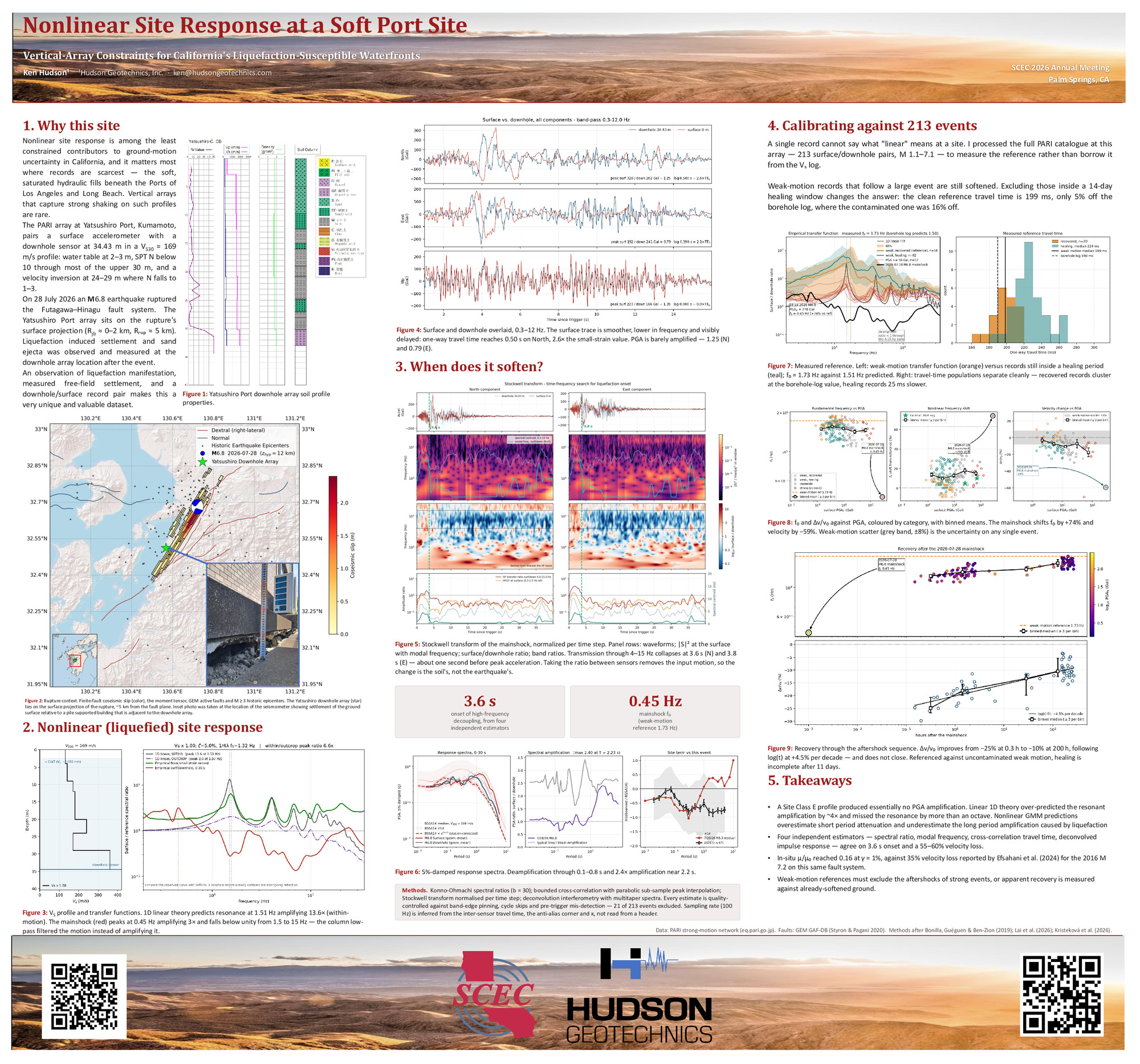 |
GM |
Nonlinear Site Response at a Soft Port Site: Vertical-Array Constraints for California's Liquefaction-Susceptible Waterfronts
Kenneth Hudson Nonlinear site response remains among the least constrained contributors to ground-motion uncertainty in California, and it matters most precisely where records are scarcest: soft, saturated, liquefaction-susceptible profiles such as the hydraulic... more Themes: Physics-Based Ground Motion Simulations & Validation |
|
Group B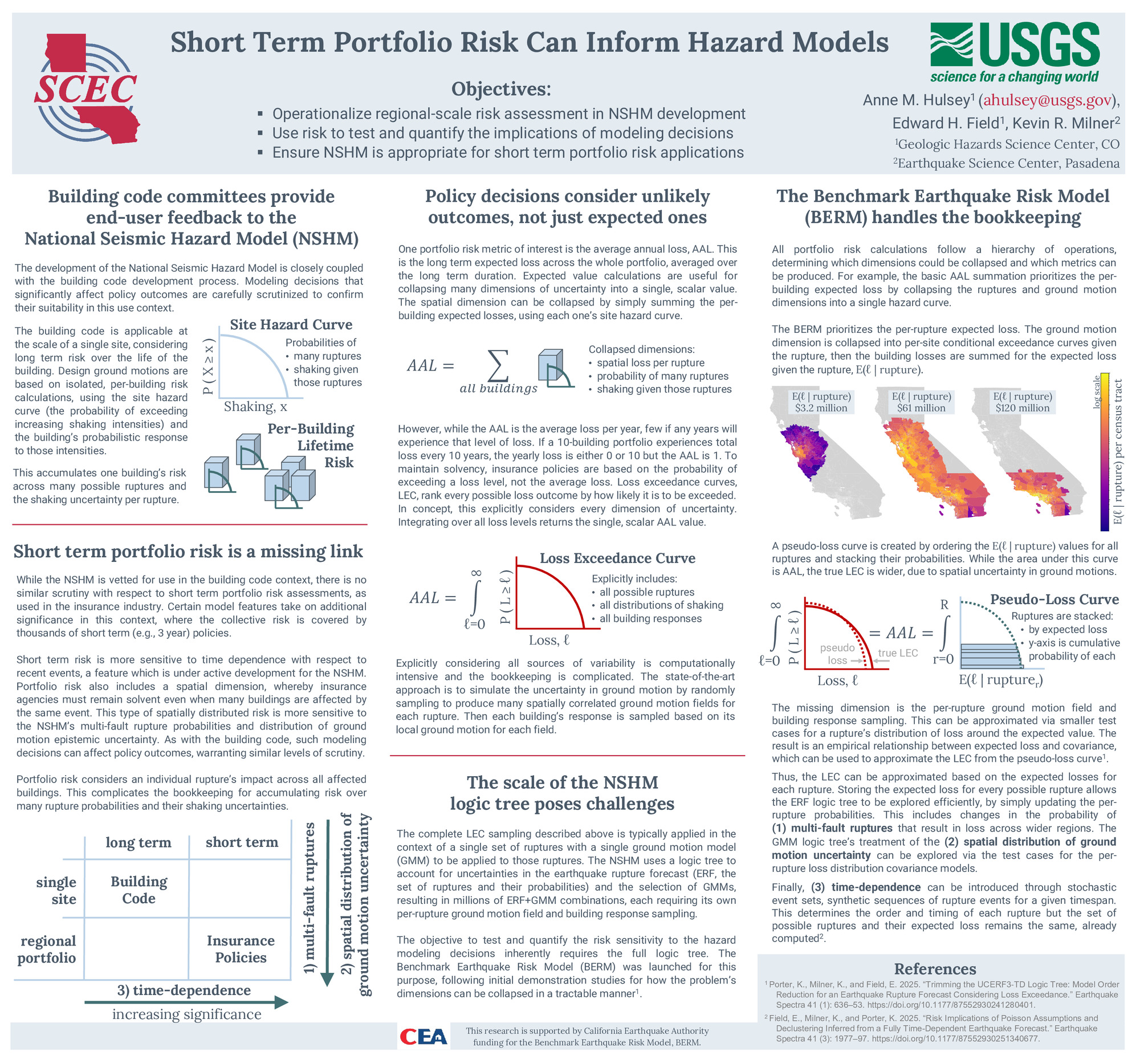 |
ASI |
Operationalizing regional risk assessments in the development of the National Seismic Hazard Model
Anne Hulsey The National Seismic Hazard Model (NSHM) incorporates many sources of epistemic uncertainty to reflect current scientific understanding and to identify areas where further research could most improve hazard characterization and support downstream... more Themes: Earthquake Scenarios for Hazard and Risk Assessment |
|
|
Group B Poster 146 |
Seismology |
Seismic velocity and anisotropy characteristics of active basal accretion: the Olympic Mountains and northern Cascadia Forearc
Manuela Hurtado Betancur, Jonathan Delph, Bin He, Shihan Wu The Cascadia subduction zone shows correlation in subduction-related characteristics along the margin, such as seismogenic behavior, surface uplift and exhumation, and the seismic characteristics of the forearc crust. In particular, the Olympic... more Themes: Advancing Community Earth Models for Hazard Analyses |
|
|
Group B Poster 026 |
FARM |
Evolution of frictional strength and fluid flow in shear fractures in granitic rock under hydrothermal conditions
Tamara Jeppson, David Lockner, Joshua Taron, N. Beeler, Stephen Hickman, Diane Moore, Brian Kilgore The failure of faults in the brittle crust is dependent on frictional strength and in situ effective stress. Both are influenced by fluid transport properties of the fault zone, yet relatively few studies have examined the evolution of both... more |
|
|
Group B Poster 126 |
Seismology |
Causal velocity dispersion for general frequency-dependent Q: An iterative Kramers–Kronig method
Chen Ji, Yuehua Zeng To accurately simulate seismic-wave movement in viscoelastic media, it is essential to use phase velocity dispersion that is both causal and matches the intended frequency-dependent attenuation model, Q(f), where f denotes the frequency. This is... more Themes: Physics-Based Ground Motion Simulations & Validation |
26069
|
|
Group B Poster 060 |
Geodesy |
Multi-Track InSAR Resolves Distributed, Seasonal, and Ridgecrest-Related Deformation Across the Southern Walker Lane
Yu Jiang, Jingyi Chen, Daniel Trugman In the southern Walker Lane, dextral shear and extension are distributed across fault systems along the eastern Sierra Nevada, Owens Valley, Panamint Valley, and Death Valley that have historically produced large and damaging earthquakes. Resolving... more |
|
|
Group A Poster 063 |
Geodesy |
Time-dependent strain rate field for California from inversion of geodetic data
Kaj Johnson GNSS and InSAR time series data provide increasingly detailed records of transient crustal deformation, but converting spatially irregular and noisy station time series into temporally resolved strain-rate fields remains challenging. For this... more Themes: Advancing Community Earth Models for Hazard Analyses |
|
|
Talk Tue1400 |
CCB |
Science, Safety and Solvency: Working with Governments, Utilities and Insurers to Enhance California’s Earthquake Readiness and Resilience
Laurie Johnson Coming soon Themes: Engaging Communities in Earthquake Preparedness |
|
|
Group A Poster 111 |
Geology |
Paleoseismic Investigation of the Western End of the 1976 Surface Rupture of the Motagua Fault, Guatemala
Angelika Jones, Tina Neimi, Christoph Grützner, Emma Pollice, Omar Flores Beltetón, Luis Romero, Rupert Hauschild The Motagua Fault is a left-lateral, strike-slip fault along the North American-Caribbean plate boundary in Guatemala. It last slipped in the devastating 1976 Mw 7.5 earthquake with a 230 km-long surface rupture. Field surveys documented 142 cm of... more Themes: Rapid Post-Earthquake Investigations & Communications |
|
|
Talk Mon0800 |
ASI |
ShakeOut Scenario 2.0: Leading the way for a Quake-safe Future Across California
Lucile Jones ShakeOut Scenario 2.0 will be a comprehensive update to the original 2008 ShakeOut Scenario, which catalyzed mitigation investments, emergency planning, and public communication about seismic risk. Nearly 20 years later, our tools for modeling... more Themes: Earthquake Scenarios for Hazard and Risk Assessment | Engaging Communities in Earthquake Preparedness |
26067
|
|
Group B Poster 224 |
GM |
Simulation-Based Ground Motions for Earthquake-Triggered Landslide Hazard: Validation Against Historical Events and Application to Scenario Earthquakes
Fengjiang Ju, Te-Yang Yeh, Josh West, Yehuda Ben-Zion Co-seismic landslide probability models rely on ground-motion parameters such as peak ground velocity (PGV). In regions with abundant historical earthquake recordings, empirical Ground Motion Models (GMMs) are well constrained and products such as... more Themes: Earthquake Scenarios for Hazard and Risk Assessment | Physics-Based Ground Motion Simulations & Validation | Utilization of Ground Motion Simulations & Records |
|
|
Group A Poster 235 |
GM |
Toward Response-Informed Validation of Physics-Based Ground Motions for Nonlinear Structural Analysis
Sajan K C, Shun Myint Than, Chukwuebuka Nweke, Sifat Muin Physics-based ground motion simulations are increasingly used in nonlinear response history analysis (NRHA) to supplement limited empirical records while preserving physically realistic rupture, path, and site effects. However, application specific... more Themes: Physics-Based Ground Motion Simulations & Validation | Utilization of Ground Motion Simulations & Records |
|
The Statewide California Earthquake Center is committed to providing a safe, productive, and welcoming environment for all participants. We take pride in fostering a diverse and inclusive SCEC community, and therefore expect all participants to abide by the SCEC Activities Code of Conduct.


