Group B, Poster #058, Stress and Deformation Over Time (SDOT)
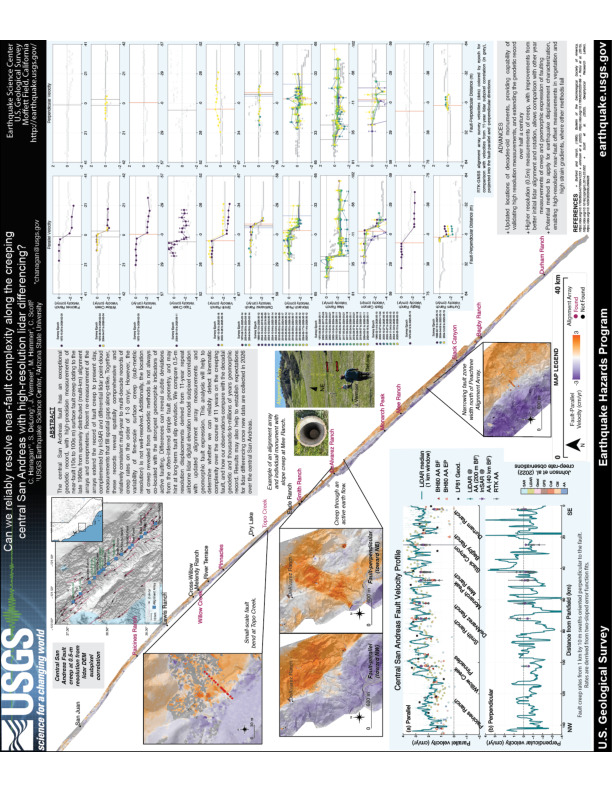
Can we reliably resolve near-fault complexity along the creeping central San Andreas with high-resolution lidar differencing?


Poster Image:
Poster Presentation
2026 SCEC Annual Meeting, Poster #058, SCEC Contribution #15278 VIEW PDF
onally, the location of creep revealed from geodetic methods is not always co-located with the strongest geomorphic indicators of active faulting. Differences can reveal subtle deviations from the often-inferred simple fault geometry, and may hint at long-term fault slip evolution. We compare 0.5-m resolution displacements derived from 11-year repeat airborne lidar digital elevation models with updated alignment array measurements and geomorphic fault expression. This analysis will help to determine whether we can reliably detect kinematic complexity over the course of 11 years on the creeping fault, and how our observations compare with the decadal geodetic and thousands-to-millions of years geomorphic record. Results may also help to establish expectations for lidar differencing once new data are collected in 2026 over the central San Andreas.
SHOW MORE
SHOW MORE
Citation: Hanagan, C. E., DeLong, S., Vermeer, J., Hammer, M., & Scott, C. P. (2026, 08). Can we reliably resolve near-fault complexity along the creeping central San Andreas with high-resolution lidar differencing?. Poster Presentation at 2026 SCEC Annual Meeting.
Keywords: Creep, San Andreas, Lidar Differencing, High-resolution Displacement Detection