Group A, Poster #079, Community Earth Models (CEM)
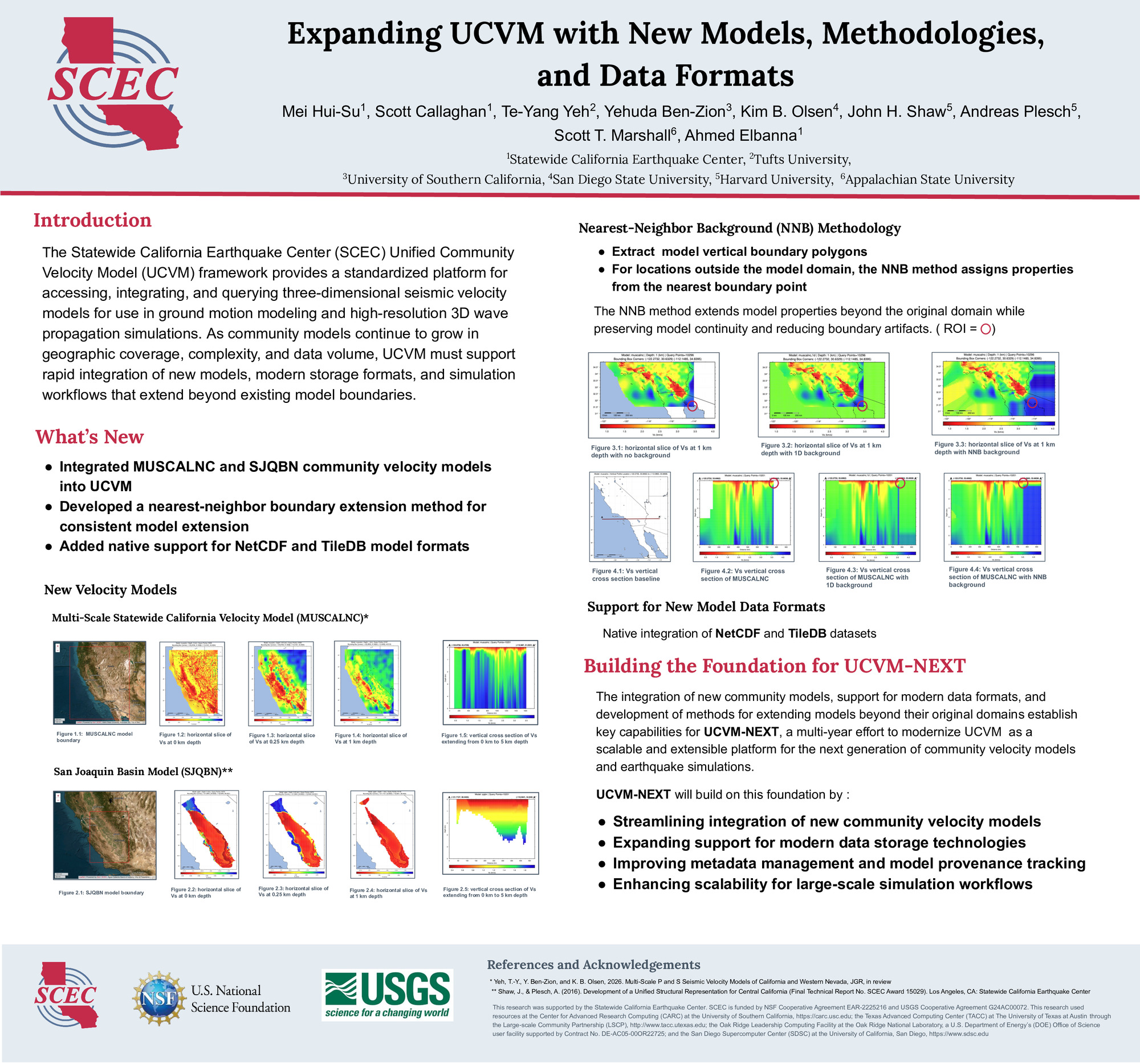
Expanding UCVM with New Models, Methodologies, and Data Formats


Poster Image:
Poster Presentation
2026 SCEC Annual Meeting, Poster #079, SCEC Contribution #15469 VIEW PDF
The Statewide California Earthquake Center (SCEC) Unified Community Velocity Model (UCVM) framework provides a standardized platform for accessing, integrating, and querying seismic velocity models for use in ground motion modeling and high-resolution 3D wave propagation simulations.
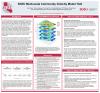
Two additional velocity models have been integrated into UCVM: the Multi-Scale Statewide California (MUSCAL) model and the San Joaquin Basin (SJQBN) model. Both models are also available through the CVM Explorer for community access and visualization. To support simulation domains that extend beyond the MUSCAL region of California and Nevada, such as those required for CyberShake simulations, a new methodology was developed to extend the model beyond the defined region. The approach leverages the 3D velocity structure sampled from vertical boundary polygons and applies a nearest-neighbor extrapolation strategy to generate physically consistent properties beyond the defined model region. This method preserves key features of the MUSCAL model without introducing abrupt boundary differences that might lead to artifacts during simulations or requiring an additional smoothing step. In addition, UCVM has been enhanced to integrate models in NetCDF and TileDB formats. This simplifies the process of new model ingestion and improves metadata tracking and model versioning.
By expanding model availability, data format support, and support for simulations that extend beyond model boundaries, these enhancements improve the accessibility, interoperability, and scalability of UCVM for the broader earthquake science community.
Two additional velocity models have been integrated into UCVM: the Multi-Scale Statewide California (MUSCAL) model and the San Joaquin Basin (SJQBN) model. Both models are also available through the CVM Explorer for community access and visualization. To support simulation domains that extend beyond the MUSCAL region of California and Nevada, such as those required for CyberShake simulations, a new methodology was developed to extend the model beyond the defined region. The approach leverages the 3D velocity structure sampled from vertical boundary polygons and applies a nearest-neighbor extrapolation strategy to generate physically consistent properties beyond the defined model region. This method preserves key features of the MUSCAL model without introducing abrupt boundary differences that might lead to artifacts during simulations or requiring an additional smoothing step. In addition, UCVM has been enhanced to integrate models in NetCDF and TileDB formats. This simplifies the process of new model ingestion and improves metadata tracking and model versioning.
By expanding model availability, data format support, and support for simulations that extend beyond model boundaries, these enhancements improve the accessibility, interoperability, and scalability of UCVM for the broader earthquake science community.
Citation: Su, M., Callaghan, S., Yeh, T., Ben-Zion, Y., Olsen, K. B., Plesch, A., Shaw, J. H., Marshall, S. T., & Elbanna, A. E. (2026, 08). Expanding UCVM with New Models, Methodologies, and Data Formats. Poster Presentation at 2026 SCEC Annual Meeting.
Keywords: Seismic Velocity Models, UCVM
Relevant SCEC Themes:
Advancing Community Earth Models for Hazard Analyses
MORE POSTERS BY THE AUTHORS
|
|
|
|
|
|
|

|
|
|
|

|
|
|