
Group B, Poster #078, Community Earth Models (CEM)
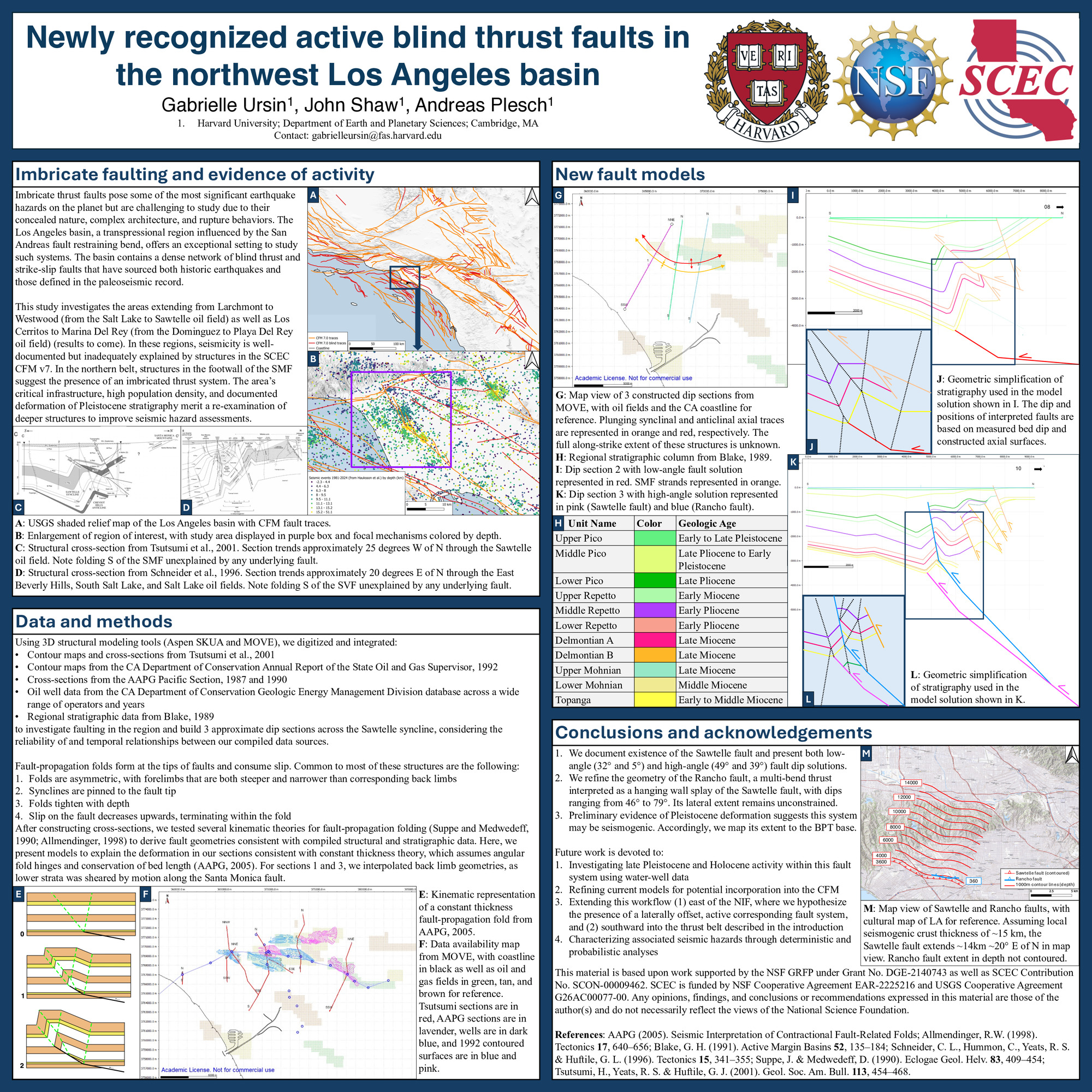
Newly recognized active blind thrust faults in the northwest Los Angeles basin


Poster Image:
Poster Presentation
2026 SCEC Annual Meeting, Poster #078, SCEC Contribution #15233 VIEW PDF
mic record. This study characterizes the area extending from Larchmont (near the Salt Lake oil field) to Westwood (near the Sawtelle oil field). Seismicity here is abundant but inadequately explained by structures in the SCEC CFM v7.
We integrate seismicity, surface traces, well data, seismic reflection profiles, cross sections, maps, and water well records using CFM workflows in MOVE and SKUA to investigate faults in the region. Fault-propagation folding theories (Suppe et al., 1990; Allmendinger, 1998; Shaw et al., 2005) are applied to derive fault geometries consistent with stratigraphic and structural data. The resulting subsurface model is expressed as balanced 2D cross sections and 3D fault surfaces. Results reveal at least two thrust faults not represented in the CFM, tentatively named the Sawtelle and Rancho faults. The Sawtelle fault is a newly defined blind thrust system, while our work refines the geometry and extent of the Rancho fault previously described by Tsutsumi et al. (2001). Both faults dip north at moderate angles (≈50°), with displacements that form fault-propagation folds that define the southern margins of the Sawtelle and Cheviot Hills fields. While the Late Pleistocene to Holocene activity of the faults remains undefined, these surfaces provide candidate sources for earthquakes currently unattributed in the CFM v7 and a basis for assessing the potential for future events, including multi-fault rupture scenarios.
Our fault interpretations can guide paleoseismic investigations to constrain recent fault activity, slip rate, and rupture history as well as inform dynamic rupture and strong ground-motion modeling of future scenarios. These results will support probabilistic and deterministic hazard assessments and inform updates to regional models.
SHOW MORE
We integrate seismicity, surface traces, well data, seismic reflection profiles, cross sections, maps, and water well records using CFM workflows in MOVE and SKUA to investigate faults in the region. Fault-propagation folding theories (Suppe et al., 1990; Allmendinger, 1998; Shaw et al., 2005) are applied to derive fault geometries consistent with stratigraphic and structural data. The resulting subsurface model is expressed as balanced 2D cross sections and 3D fault surfaces. Results reveal at least two thrust faults not represented in the CFM, tentatively named the Sawtelle and Rancho faults. The Sawtelle fault is a newly defined blind thrust system, while our work refines the geometry and extent of the Rancho fault previously described by Tsutsumi et al. (2001). Both faults dip north at moderate angles (≈50°), with displacements that form fault-propagation folds that define the southern margins of the Sawtelle and Cheviot Hills fields. While the Late Pleistocene to Holocene activity of the faults remains undefined, these surfaces provide candidate sources for earthquakes currently unattributed in the CFM v7 and a basis for assessing the potential for future events, including multi-fault rupture scenarios.
Our fault interpretations can guide paleoseismic investigations to constrain recent fault activity, slip rate, and rupture history as well as inform dynamic rupture and strong ground-motion modeling of future scenarios. These results will support probabilistic and deterministic hazard assessments and inform updates to regional models.
SHOW MORE
Citation: Ursin, G., Shaw, J. H., & Plesch, A. (2026, 08). Newly recognized active blind thrust faults in the northwest Los Angeles basin. Poster Presentation at 2026 SCEC Annual Meeting.
Keywords: community fault model, seismic hazards, blind thrusting
Relevant SCEC Themes:
Advancing Community Earth Models for Hazard Analyses
Earthquake Scenarios for Hazard and Risk Assessment
MORE POSTERS BY THE AUTHORS
|
|
|
|
|
|


