Group A, Poster #077, Community Earth Models (CEM)
SCEC Multi-scale Community Velocity Model TAG
Kim B. Olsen, Evan T. Hirakawa, Te-Yang Yeh, Yehuda Ben-Zion, Clifford H. Thurber, Oliver S. Boyd, & . the SCEC Multi-scale Community Velocity Model TAG Working Group


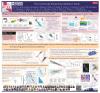
Poster Image:
Poster Presentation
2026 SCEC Annual Meeting, Poster #077, SCEC Contribution #15646 VIEW PDF
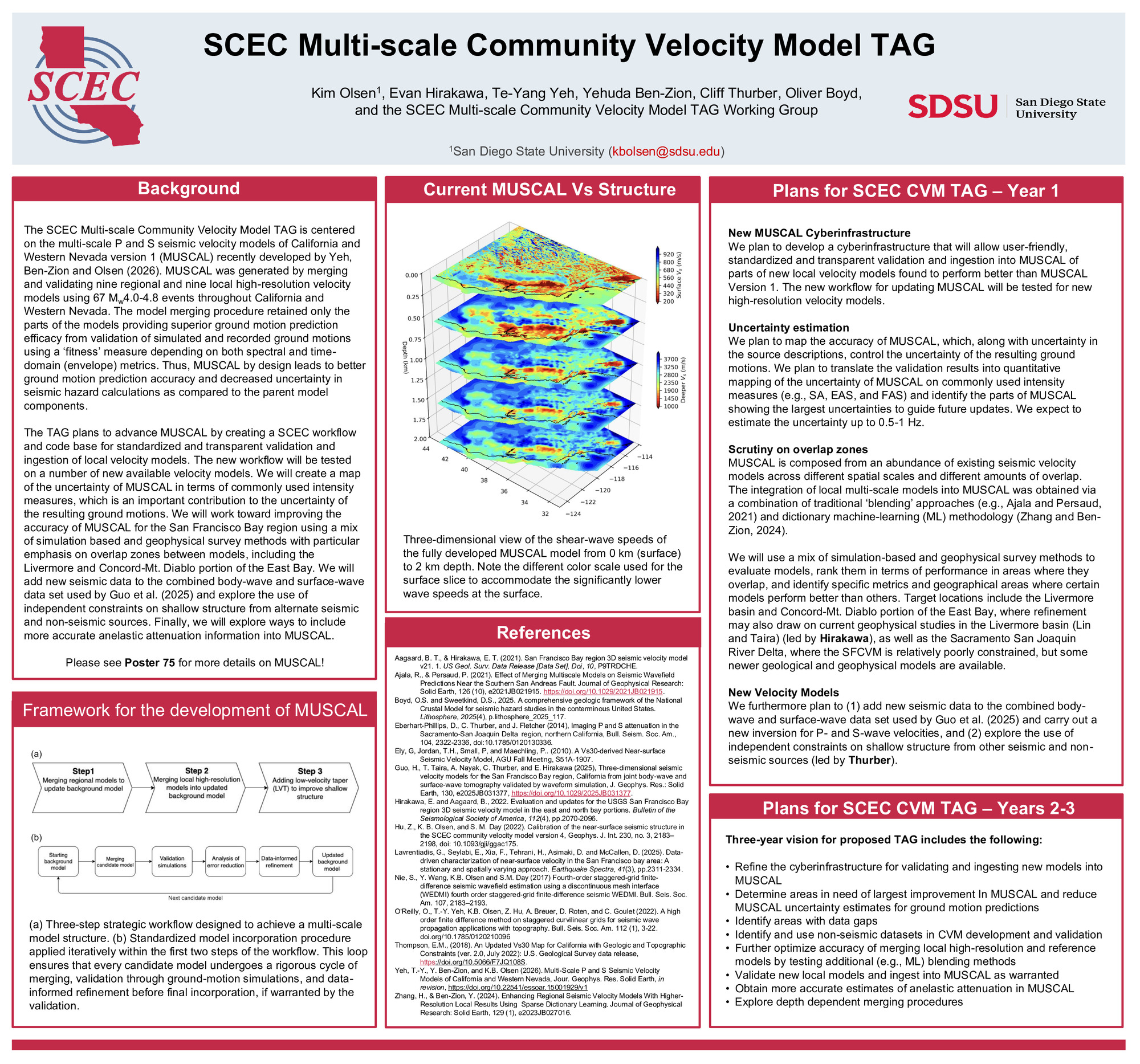
round motion prediction accuracy and decreased uncertainty in seismic hazard calculations as compared to the parent model components.
The TAG plans to advance MUSCAL by creating a SCEC workflow and code base for standardized and transparent validation and ingestion of local velocity models. The new workflow will be tested on a number of new available velocity models. We will create a map of the uncertainty of MUSCAL in terms of commonly used intensity measures, which is an important contribution to the uncertainty of the resulting ground motions. We will work toward improving the accuracy of MUSCAL for the San Francisco Bay region using a mix of simulation based and geophysical survey methods with particular emphasis on overlap zones between models, including the Livermore and Concord-Mt. Diablo portion of the East Bay. We will add new seismic data to the combined body-wave and surface-wave data set used by Guo et al. (2025) and explore the use of independent constraints on shallow structure from alternate seismic and non-seismic sources. Finally, we will explore ways to include more accurate anelastic attenuation information into MUSCAL.
SHOW MORE
The TAG plans to advance MUSCAL by creating a SCEC workflow and code base for standardized and transparent validation and ingestion of local velocity models. The new workflow will be tested on a number of new available velocity models. We will create a map of the uncertainty of MUSCAL in terms of commonly used intensity measures, which is an important contribution to the uncertainty of the resulting ground motions. We will work toward improving the accuracy of MUSCAL for the San Francisco Bay region using a mix of simulation based and geophysical survey methods with particular emphasis on overlap zones between models, including the Livermore and Concord-Mt. Diablo portion of the East Bay. We will add new seismic data to the combined body-wave and surface-wave data set used by Guo et al. (2025) and explore the use of independent constraints on shallow structure from alternate seismic and non-seismic sources. Finally, we will explore ways to include more accurate anelastic attenuation information into MUSCAL.
SHOW MORE
Citation: Olsen, K. B., Hirakawa, E. T., Yeh, T., Ben-Zion, Y., Thurber, C. H., Boyd, O. S., & the SCEC Multi-scale Community Velocity Model TAG Working Group, .. (2026, 08). SCEC Multi-scale Community Velocity Model TAG. Poster Presentation at 2026 SCEC Annual Meeting.
Keywords: MUSCAL, Community Velocity Model, Seismic Velocity Model, Ground Motion Simulation, Seismic Hazard
SCEC Award: 26094
Relevant SCEC Themes:
Advancing Community Earth Models for Hazard Analyses
Physics-Based Ground Motion Simulations & Validation
MORE POSTERS BY THE AUTHORS
|
|
|
|
|
|