
Group A, Poster #035, Fault and Rupture Mechanics (FARM)
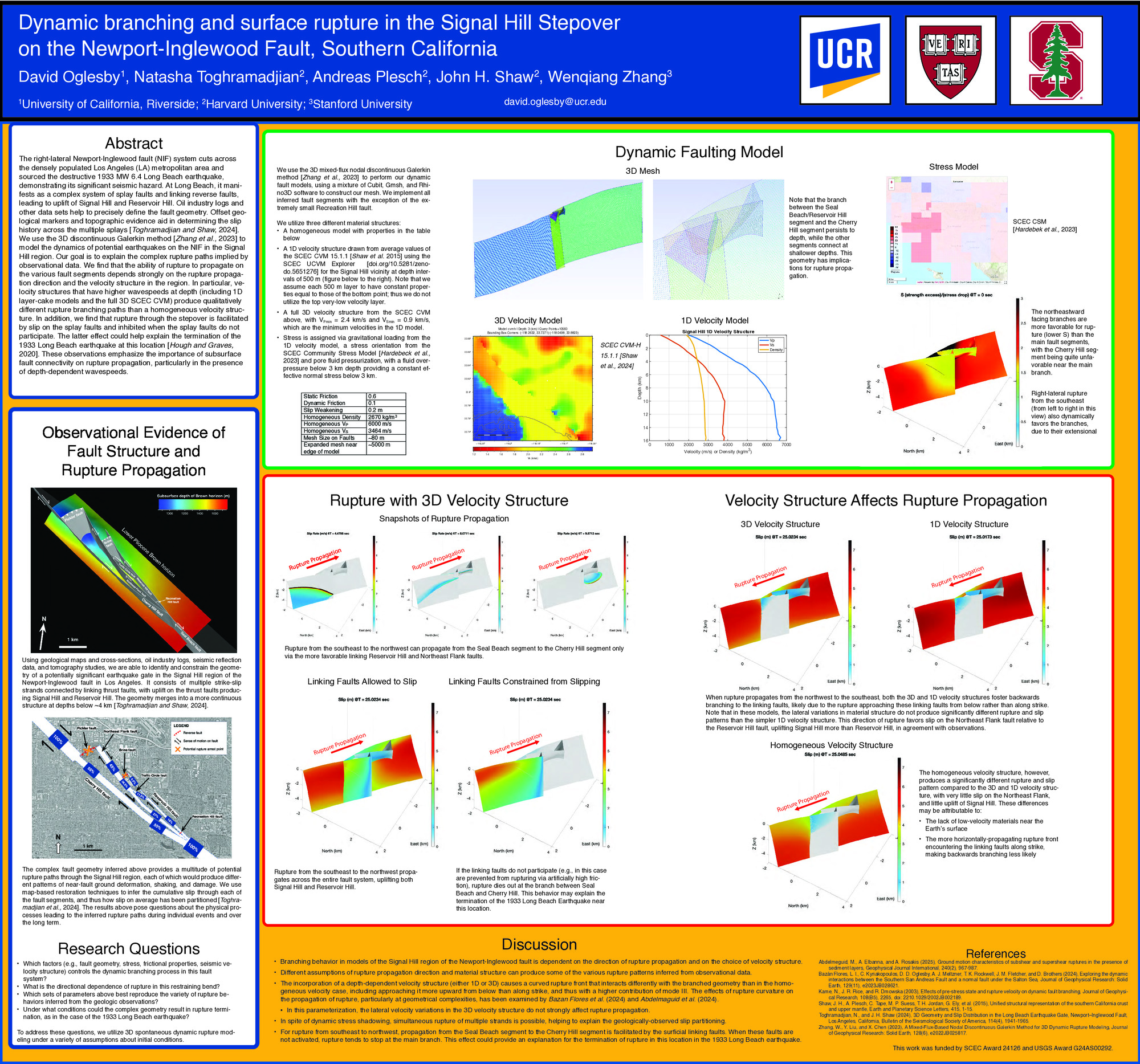
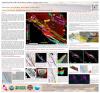
Dynamic branching and surface rupture in the Signal Hill Stepover on the Newport-Inglewood Fault, Southern California


Poster Image:
Poster Presentation
2026 SCEC Annual Meeting, Poster #035, SCEC Contribution #15557 VIEW PDF
dynamics of potential earthquakes on the NIF in the Signal Hill region. Our goal is to explain the complex rupture paths implied by observational data. We find that the ability of rupture to propagate on the various fault segments depends strongly on the rupture propagation direction and the velocity structure in the region. In particular, velocity structures that have higher wavespeeds at depth (including 1D layer-cake models and the full 3D SCEC CVM) produce qualitatively different rupture branching paths than a homogeneous velocity structure. In addition, we find that rupture through the stepover is facilitated by slip on the splay faults and inhibited when the splay faults do not participate. The latter effect could help explain the termination of the 1933 Long Beach earthquake at this location [Hough and Graves, 2020]. These observations emphasize the importance of subsurface fault connectivity on rupture propagation, particularly in the presence of depth-dependent wavespeeds.
SHOW MORE
SHOW MORE
Citation: Oglesby, D. D., Toghramadjian, N., Plesch, A., Shaw, J. H., & Zhang, W. (2026, 08). Dynamic branching and surface rupture in the Signal Hill Stepover on the Newport-Inglewood Fault, Southern California. Poster Presentation at 2026 SCEC Annual Meeting.
Keywords: Rupture Dynamics, Fault Geometry, Fault Slip, Seismic Wavespeed
SCEC Award: 24126
Relevant SCEC Themes:
Advancing Community Earth Models for Hazard Analyses
Earthquake Scenarios for Hazard and Risk Assessment
Physics-Based Ground Motion Simulations & Validation
MORE POSTERS BY THE AUTHORS
|
|
|
|
|
|
|


