

| AGENDA | POSTERS | PARTICIPANTS | ABSTRACTS | TRAVEL | FAQ |
Meeting Abstracts
The Statewide California Earthquake Center (SCEC) collaborates with academic, government, industry, and other organizations to advance earthquake science, community resilience, and education by: (1) Gathering and analyzing data from field observations and laboratory experiments. (2) Developing system-level models and simulations of earthquake processes to synthesize knowledge as a physics-based understanding of seismic hazard. (3) Communicating that understanding to expand knowledge and reduce earthquake risk.
Participants are invited to present recent work aligned with SCEC priorities during the poster sessions.
- <
- 5 of 5
| SCEC ID | Category | Title and Authors | SCEC Award |
|---|---|---|---|
Group B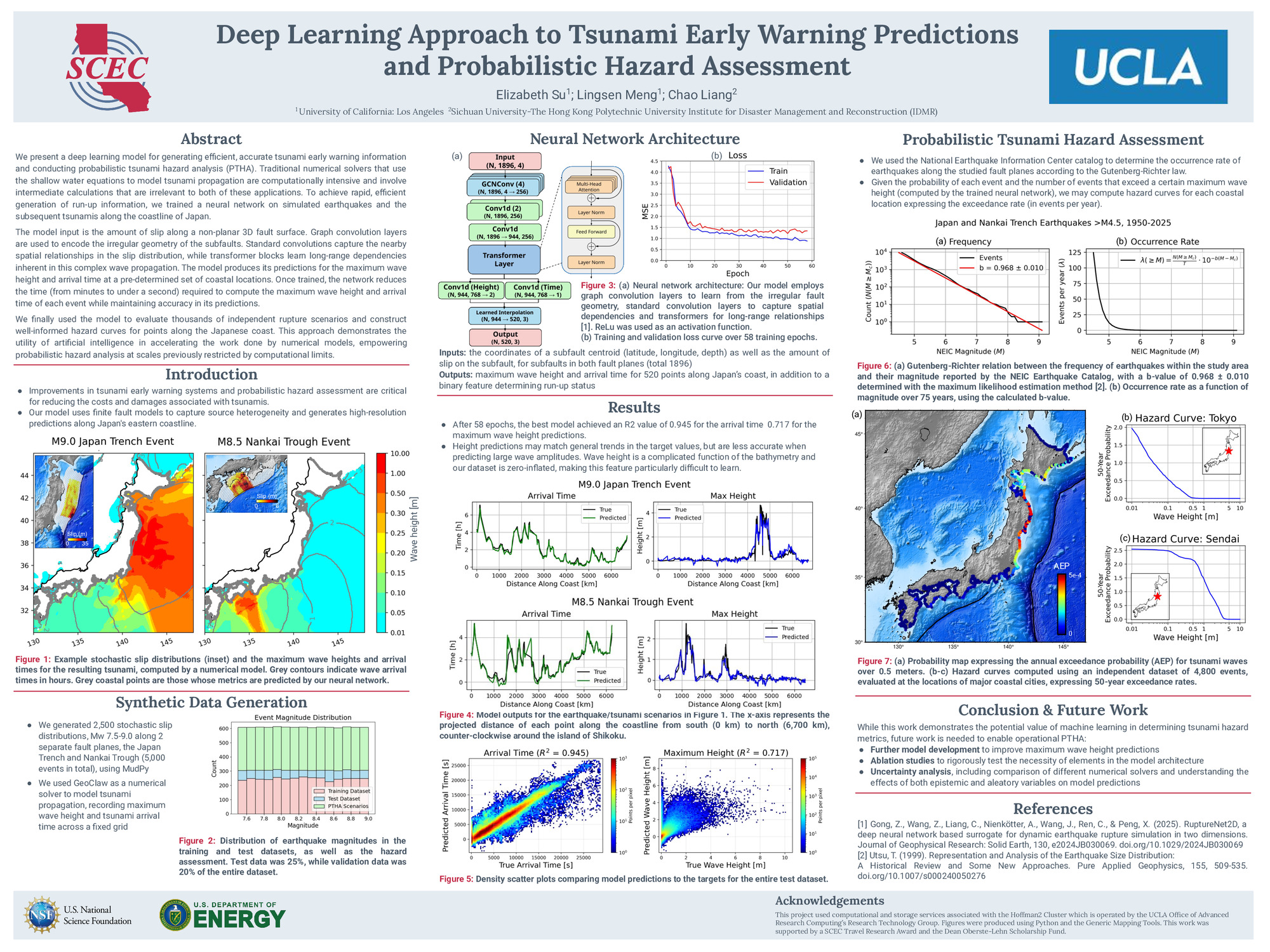 |
RC |
Deep Learning Approach to Tsunami Early Warning Predictions and Probabilistic Hazard Assessment
Elizabeth Su, Lingsen Meng, Chao Liang We present a deep learning model for generating efficient, accurate tsunami early warning information and conducting probabilistic tsunami hazard analysis (PTHA). Traditional numerical solvers that use the shallow water equations to model tsunami... more Themes: Earthquake Scenarios for Hazard and Risk Assessment |
|
Group A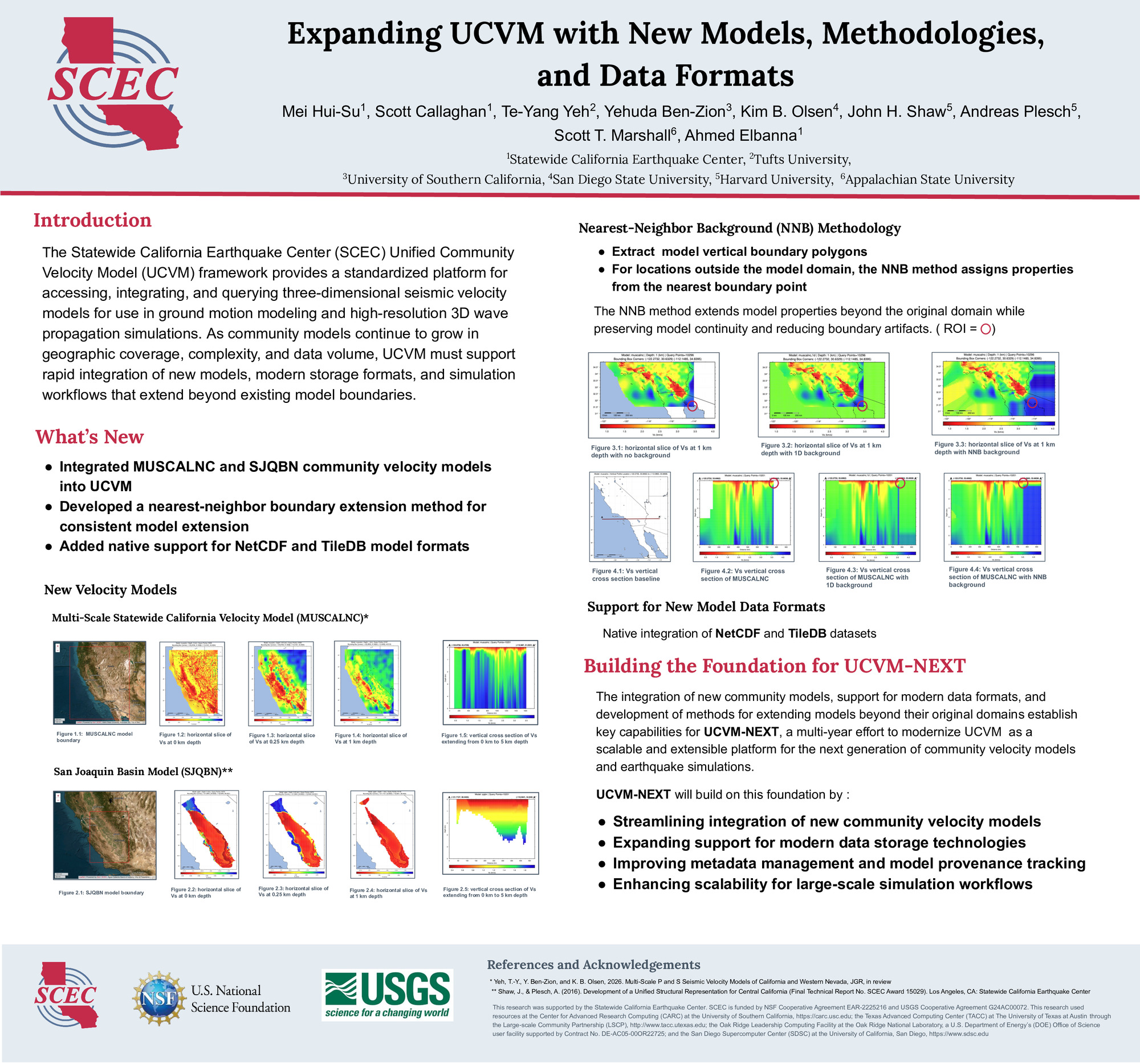 |
CEM |
Expanding UCVM with New Models, Methodologies, and Data Formats
Mei-Hui Su, Scott Callaghan, Te-Yang Yeh, Yehuda Ben-Zion, Kim Olsen, Andreas Plesch, John Shaw, Scott Marshall, Ahmed Elbanna The Statewide California Earthquake Center (SCEC) Unified Community Velocity Model (UCVM) framework provides a standardized platform for accessing, integrating, and querying seismic velocity models for use in ground motion modeling and high-... more Themes: Advancing Community Earth Models for Hazard Analyses |
|
|
Group B Poster 038 |
FARM |
Generalization of Satellite-Based Building Damage Mapping Across Earthquake Events
Yifan Sun, Lingsen Meng Rapid and accurate post-earthquake damage assessment is critical for emergency response. This study evaluates the spatial and cross-event generalizability of two complementary satellite-based paradigms: a physics-based Synthetic Aperture Radar (SAR... more Themes: Rapid Post-Earthquake Investigations & Communications |
|
|
Group B Poster 028 |
FARM |
Earthquake Cycle Simulations on Complex Three-Dimensional Fault Geometries Using Curved Boundary Elements
Yudong Sun, Andrew Bradley, Paul Segall Earthquake cycle simulations have traditionally represented complex three-dimensional faults using tessellations of planar boundary elements, which introduce inaccuracies in stress calculations. We present a curved boundary element framework for... more Themes: Earthquake Cycle Simulations & Forecasting |
|
Group A |
Seismology |
Updates and Evaluations of the Southern California Regional Earthquake Catalog and Related Products
Gabrielle Tepp, Ellen Yu, Aparna Bhaskaran, Ryan Tam, Shang-Lin Chen, Erika Jaski, Yijian Zhou, Ettore Biondi Since 1932, the Southern California Seismic Network (SCSN) has been maintaining a manually-reviewed earthquake catalog for Southern California as the regional earthquake authority. The catalog now contains over 1,000,000 seismic events. Recorded... more |
|
|
Group B Poster 186 |
CCB |
California’s Post-Earthquake Clearinghouse: A Place for Collaboration
Kate Thomas, Brian Olson Did you know California establishes a Clearinghouse where scientists, engineers, and emergency managers coordinate after a major natural hazard event, and that you can be part of it? The California Geological Survey is mandated to stand up a... more Themes: Rapid Post-Earthquake Investigations & Communications |
|
|
Group A Poster 115 |
Geology |
Multi-Trace Rupture Behaviour of Reverse Faults: New Paleoseismic Insights from the Dunstan Fault, Otago, New Zealand
Alex Travers, Mark Stirling, Kathleen Rodrigues, Jonathan Griffin, Dan Clark The Dunstan Fault is a slow slip rate reverse fault within the Otago Range and Basin Province, South Island, New Zealand. It is expressed at the surface by multiple parallel to sub-parallel traces spanning a ≤2.5km fault zone width. On the... more Themes: Earthquake Scenarios for Hazard and Risk Assessment | Earthquake Cycle Simulations & Forecasting |
|
Group A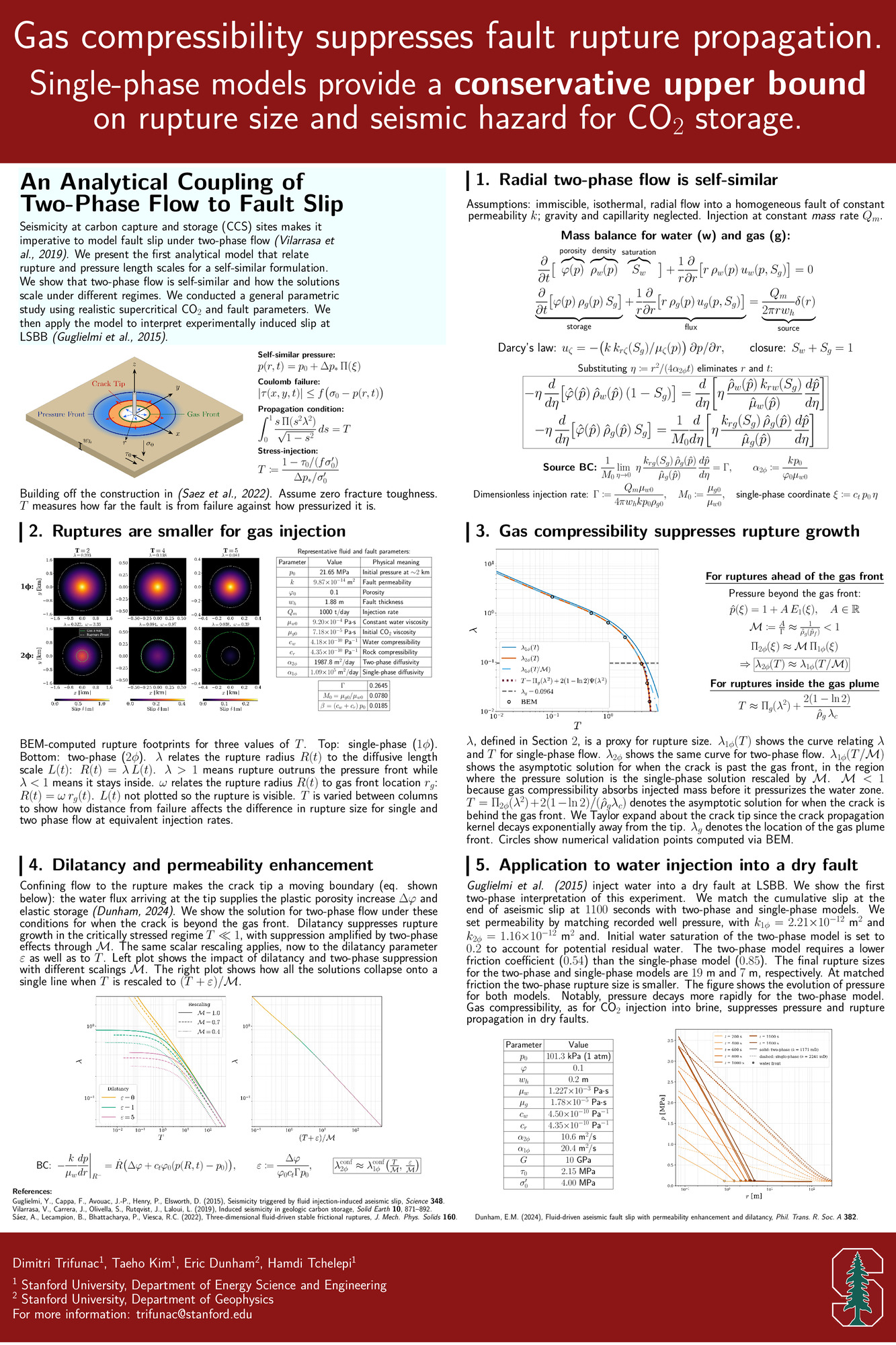 |
FARM |
Gas compressibility suppresses injection induced fault rupture
Dimitri Trifunac, Taeho Kim, Hamdi Tchelepi Fluid injection can activate faults by reducing the effective normal stress acting on the fault. Occurrences of microseismicity at the Decatur and In Salah carbon capture and sequestration (CCS) sites, and two recent magnitude 4 earthquakes in... more Themes: Earthquake Cycle Simulations & Forecasting |
|
|
Group A Poster 087 |
CEM |
Integrating Community Research into a Consensus Geodetic Model: A Community Velocity Field Exercise for the SCEC Community Geodetic Model (CGM)
Ekaterina Tymofyeyeva, Michael Floyd, Kathryn Materna, Zhen Liu, Zheng-Kang Shen, Gareth Funning, Molly Zebker, Eric Fielding, Mradula Vashishtha, William Holt The SCEC Community Geodetic Model (CGM) is a unified representation of crustal deformation across California, integrating GNSS and InSAR observations to constrain interseismic strain accumulation, fault slip rates, and other deformation processes.... more Themes: Advancing Community Earth Models for Hazard Analyses |
|
Group B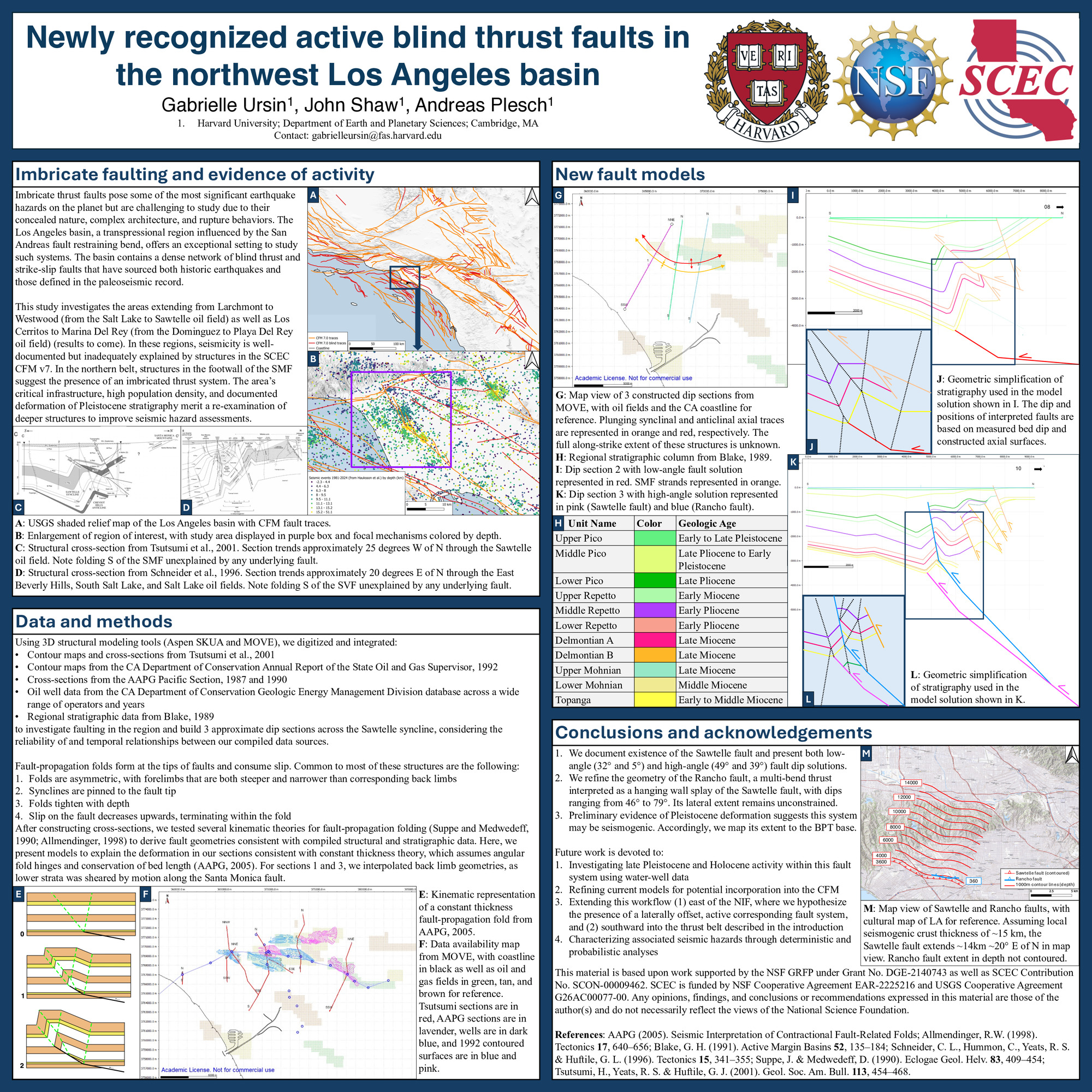 |
CEM |
Newly recognized active blind thrust faults in the northwest Los Angeles basin
Gabrielle Ursin, John Shaw, Andreas Plesch Our research characterizes previously undocumented blind thrust faults in the northwestern Los Angeles basin that deform Pleistocene sediments and represent a potential unaddressed seismic hazard. Imbricate thrust faults pose some of the most... more Themes: Advancing Community Earth Models for Hazard Analyses | Earthquake Scenarios for Hazard and Risk Assessment |
|
|
Group A Poster 209 |
EFP |
Modeling swarms as a random walk within a branching process
Nicholas van der Elst Assessing the earthquake hazard during seismic swarms presents a unique challenge in operational forecasting. Whereas aftershock sequences follow a typical temporal decay pattern (Omori’s law) that allows for an estimate of the duration of the... more |
|
|
Group A Poster 065 |
Geodesy |
Depth-Dependent Crustal Deformation from a Physics-Based Joint Inversion of GNSS and InSAR in Southern California
Mradula Vashishtha, William Holt, Jeonghyeop Kim Crustal strain transitions vertically from locked faulting in the brittle upper crust to distributed shear in the lower crust. Standard geodetic inversions simplify this 3D deformation field by assuming a uniform elastic thickness (H) to convert... more Themes: Advancing Community Earth Models for Hazard Analyses |
25322, 24177
|
Group A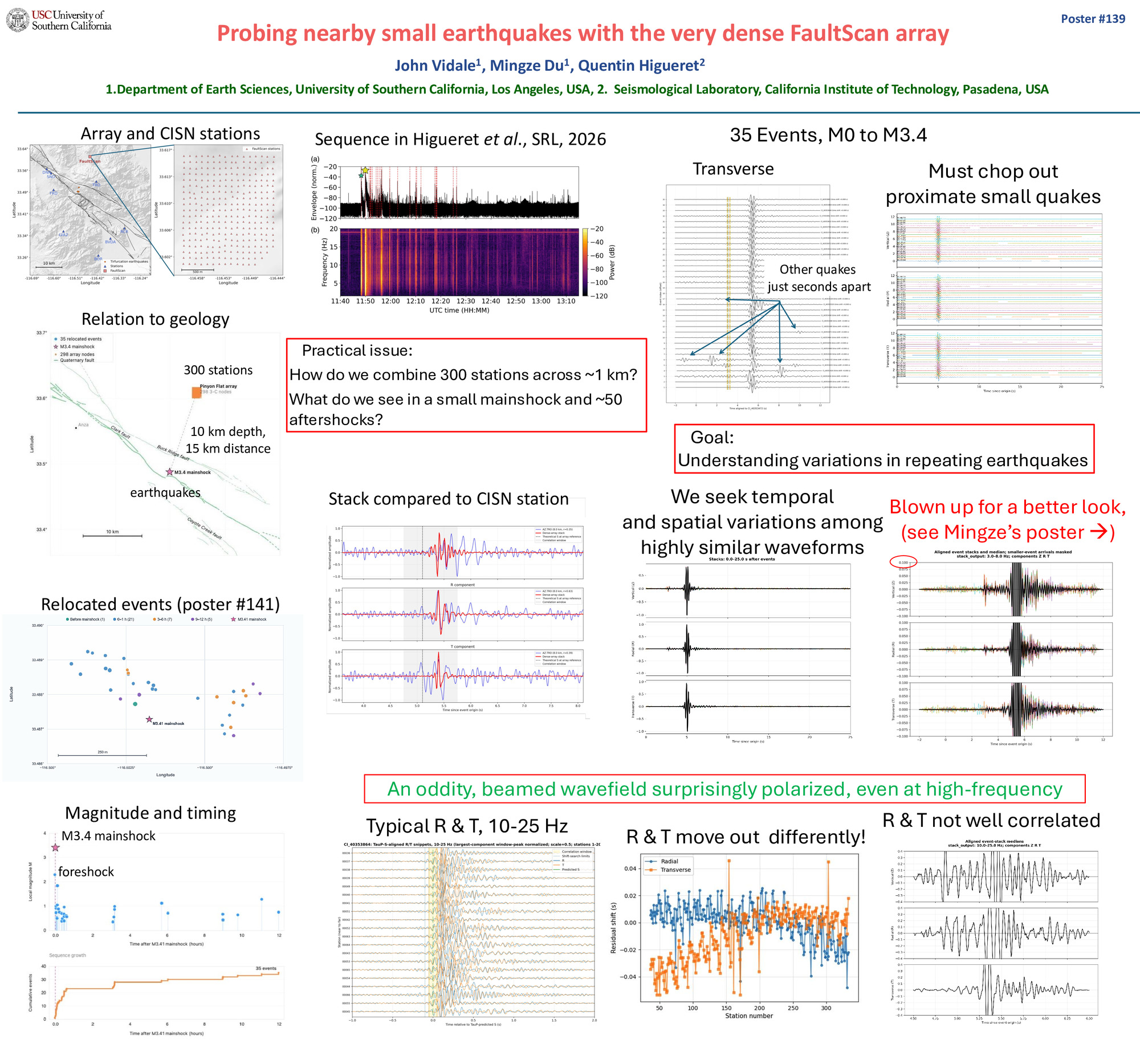 |
Seismology |
Probing nearby small earthquakes with the very dense FaultScan array
John Vidale, Mingze Du, Quentin Higueret The Faultscan array [Higueret et al., SRL, 2026] consists of 300 stations in a 2 km square grid. Such dense recordings are increasingly feasible with nodal and DAS developments. Seismograms recorded on the surface are dominated by scattering in... more Themes: Earthquake Cycle Simulations & Forecasting |
25253
|
|
Group B Poster 022 |
FARM |
Evolving seismic asperities by velocity- and temperature-dependent friction
Binhao Wang, Sylvain Barbot Seismic asperities are widely treated as fault patches with fixed velocity-weakening friction, a material property frozen in time, implying a static separation between coseismic and aseismic slip. However, in nature the same fault regions can host... more Themes: Earthquake Cycle Simulations & Forecasting |
|
|
Group A Poster 159 |
Seismology |
Potential earthquake-triggered landslides near Palos Verdes and implications for near-field tsunami early warning
Jingchuan Wang, Shane Zhang, Allen Husker Steep coastal topography and seafloor relief, inherently weak bedrock units, and seismic activity in the Southern California Borderland create favorable conditions for major landslides capable of generating local tsunamis. Active landslides along... more Themes: Earthquake Scenarios for Hazard and Risk Assessment | Utilization of Ground Motion Simulations & Records | Rapid Post-Earthquake Investigations & Communications |
|
Group B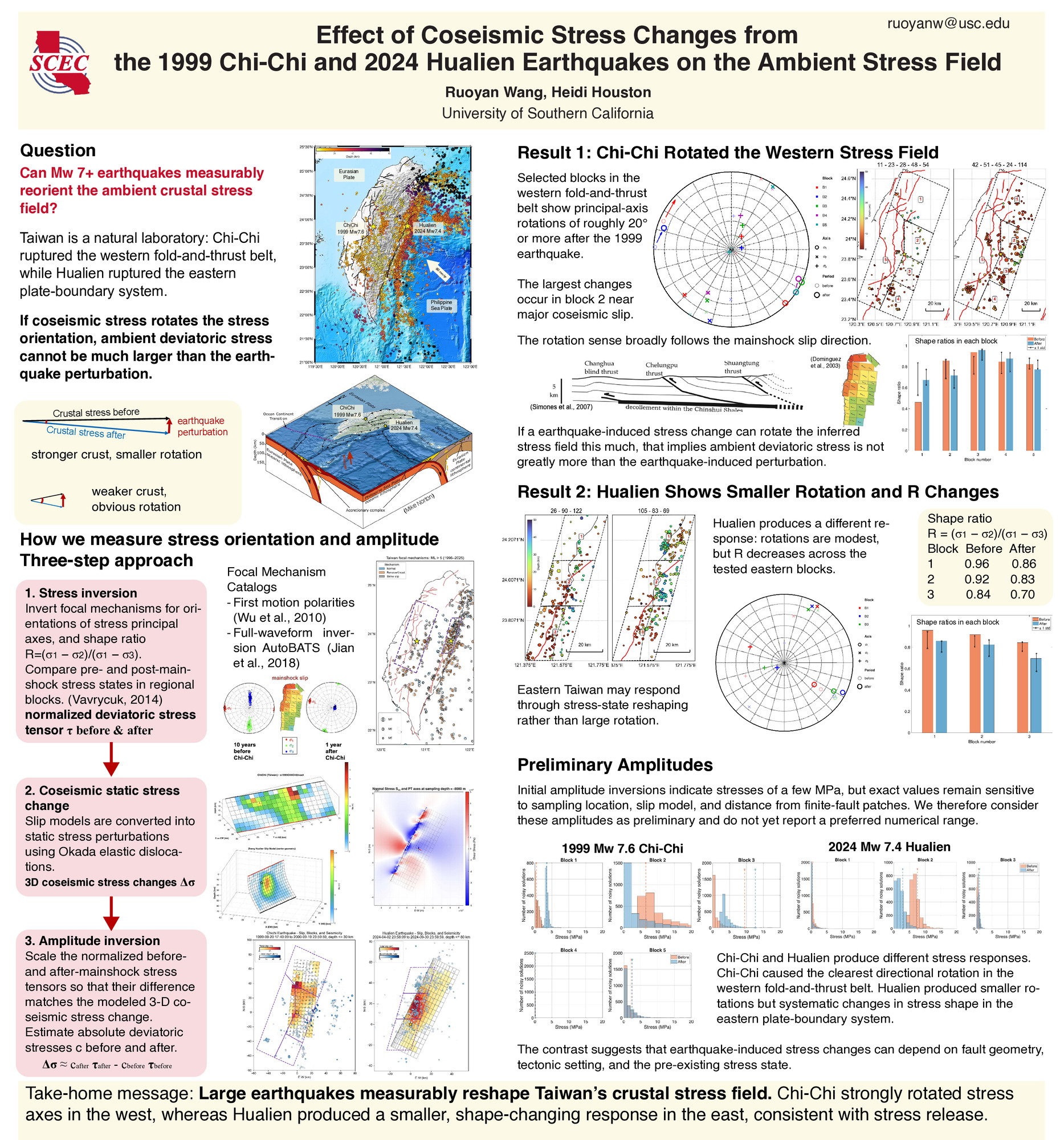 |
FARM |
Effect of Coseismic Stress Changes from the 1999 Chi-Chi and 2024 Hualien Earthquakes on the Ambient Stress Field
Ruoyan Wang, Heidi Houston Large earthquakes can reorganize crustal stress fields, producing detectable changes in both stress orientation and, in some cases, absolute stress state. Here we extend analyses of coseismic stress rotations in Taiwan by combining stress tensor... more Themes: Earthquake Cycle Simulations & Forecasting |
|
|
Group B Poster 036 |
FARM |
Thermoelastic unclamping and pressure-driven fluid loss during multiyear circulation in enhanced geothermal systems
Matthew Weingarten, David Dempsey Large-scale enhanced geothermal system (EGS) energy production is rapidly advancing through the use of multi-stage stimulation of horizontal wells. We analyze the first two years of continuous circulation at EGS Project Red, Nevada, drawing on... more Themes: Advancing Community Earth Models for Hazard Analyses | Earthquake Cycle Simulations & Forecasting |
|
|
Group B Poster 240 |
GM |
Evaluating Variation in Rupture Directivity from Hypocenter Distributions in PSHA
Kyle Withers, Morgan Moschetti, Jeff Bayless Rupture directivity models modify the median and variability of ground-motion models (GMMs) but alternatives remain for how to properly incorporate them into probabilistic seismic hazard analyses (PSHAs). Directivity model modifications depend on... more Themes: Earthquake Scenarios for Hazard and Risk Assessment |
|
|
Group B Poster 140 |
Seismology |
Feature Extraction from Seismic Waveforms for Earthquake-Explosion Discrimination
Jeongung Woo, Alamgir Hosain, Nathan Maier, Ting Chen Accurate classification of seismic source types is an important task for seismic monitoring. While classical methods such as the P-to-S ratio provide a simple and general standard for discrimination, recent deep-learning methods can improve... more |
|
|
Group B Poster 220 |
GM |
Strong Ground Motions near La Guaira during the 2026 Venezuela Earthquake: Effects of Rupture Dynamics and Slip Heterogeneity
Baoning Wu, David Sandwell, Rubi Garcia-Gonzalez, Jeremy Wing Ching Wong, Molly Zebker, Alice-Agnes Gabriel On June 24, 2026, an Mw7.5 earthquake occurred in northern Venezuela and caused catastrophic damage, with La Guaira among the most severely affected regions. We use 3D dynamic rupture simulations with linear slip-weakening friction to quantify how... more Themes: Earthquake Scenarios for Hazard and Risk Assessment | Physics-Based Ground Motion Simulations & Validation | Rapid Post-Earthquake Investigations & Communications |
|
|
Group A Poster 025 |
FARM |
A Simple Discrete Elastic Model Exhibits Both the Statistical Properties and Migration Patterns of Slow Slip
Ling Xia, Allan Rubin 25 years after their discovery, the physical mechanisms of slow earthquakes remain enigmatic. Here we develop a simple quasi-static elastic model that reproduces both the migration patterns of elastic/frictional models, and the statistical... more |
|
Group A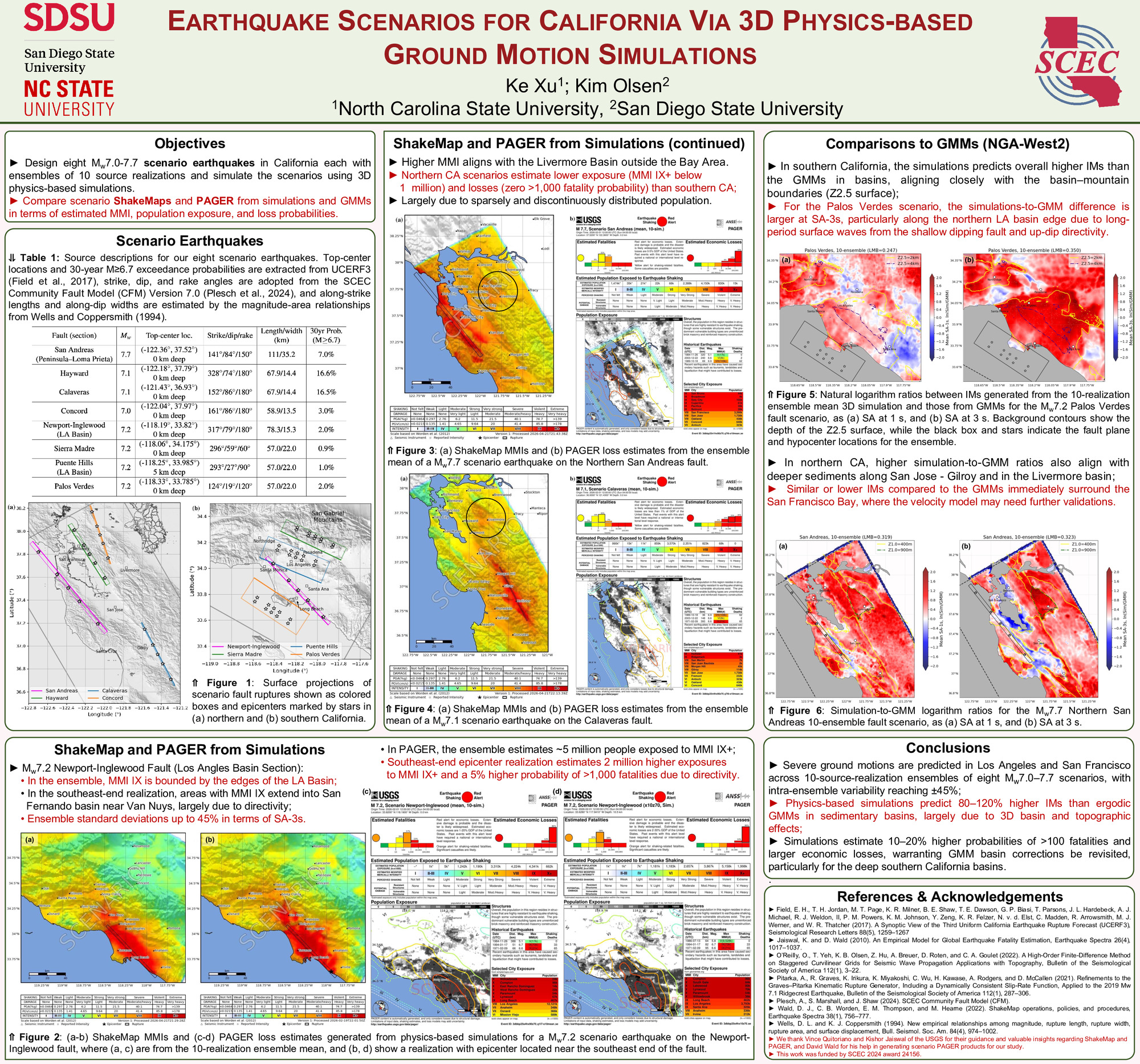 |
GM |
Earthquake Scenarios for California Via 3D Physics-based Ground Motion Simulations
Ke Xu, Kim Olsen Earthquake scenarios can be useful for estimating the extent of damage and economic losses from future earthquakes and to prepare emergency response plans. Here, we have calculated physics-based simulations with ensembles of 10 source realizations... more Themes: Earthquake Scenarios for Hazard and Risk Assessment | Physics-Based Ground Motion Simulations & Validation |
24156
|
|
Group A Poster 157 |
Seismology |
Multi-Data Rupture Imaging of the 2026 Northern Venezuela Mw 7.5 Earthquake: Strong Unilateral Propagation Along a Segmented Fault System
Liuwei Xu, Yunjun Zhang, Hongrui Wang, Chen Ji, Cunren Liang, Zhongwen Zhan, Yuankun Xu The Boconó and San Sebastián faults are the major onshore and offshore components of the Caribbean–South America plate boundary, but their connectivity and roles in hosting large earthquakes remain poorly constrained due to the region’s complex... more Themes: Rapid Post-Earthquake Investigations & Communications |
|
|
Group A Poster 075 |
CEM |
Multi-scale Statewide California Seismic Velocity Models: Version 1
Te-Yang Yeh, Yehuda Ben-Zion, Kim Olsen A high-quality multi-scale description of subsurface seismic velocities is foundational for a range of topics including advancing simulations of ground motion and consistent derivation of earthquake source parameters. In this study, we construct... more Themes: Advancing Community Earth Models for Hazard Analyses | Physics-Based Ground Motion Simulations & Validation |
|
|
Group A Poster 163 |
Seismology |
12 years (2013-2025) of relocated earthquakes and focal mechanisms at Lake Almanor, Northern California, reveals a connection at depth between larger mapped surface faults
Clara Yoon, Robert Skoumal, Jeanne Hardebeck, Katherine Guns, Rufus Catchings, Mark Goldman, Joanne Chan, Robert Sickler Lake Almanor, located in a region of transtensional deformation in northeastern California, experienced two moderate-magnitude earthquake sequences a decade apart. The 11 May 2023 Mw 5.5 Lake Almanor earthquake was followed ~11 hours later by an Mw... more Themes: Earthquake Scenarios for Hazard and Risk Assessment | Rapid Post-Earthquake Investigations & Communications |
|
|
Group B Poster 230 |
GM |
Seismic Site Response of Lunar Regolith: One-Dimensional Equivalent Linear Analysis of Apollo Landing Sites
Elizabeth Yoseph, Rashid Shams, Chukwuebuka Nweke Understanding how near-surface lunar regolith modifies seismic ground motion is critical for the structural design of long-duration habitats, precision instrument deployment, and landing-site selection under Artemis and future lunar surface missions... more Themes: Physics-Based Ground Motion Simulations & Validation | Utilization of Ground Motion Simulations & Records |
|
|
Talk Mon1000 |
Geodesy |
Better Earthquake Imaging Through NISAR
Molly Zebker The NASA-ISRO Synthetic Aperture Radar (NISAR) mission launched in July 2025 and is now distributing high resolution InSAR data globally. NISAR collects new acquisitions over all land and ice-covered surfaces every 12 days. NISAR’s L-band radar... more Themes: Advancing Community Earth Models for Hazard Analyses | Rapid Post-Earthquake Investigations & Communications |
|
|
Group A Poster 061 |
Geodesy |
A GNSS-Derived Strain Rate Map of North America and Implications for Continental
Yuehua Zeng This study presents a geodetic strain-rate model for the North American Continent derived from Global Navigation Satellite System (GNSS) velocity measurements. The model incorporates horizontal GNSS velocities compiled by Zeng (2022) for the western... more Themes: Advancing Community Earth Models for Hazard Analyses | Earthquake Cycle Simulations & Forecasting |
|
|
Group A Poster 161 |
Seismology |
Hidden structural linkages redefine the seismic hazard of the Garlock fault
Hao Zhang, Huiyun Guo, Matthew Salinas, James Dolan, Zhongwen Zhan The extent to which dynamic earthquake ruptures propagate through structural discontinuities on faults is a fundamental determinant of earthquake magnitude and the related seismic hazard. While empirical criteria often rely on fault surface geometry... more Themes: Advancing Community Earth Models for Hazard Analyses | Earthquake Scenarios for Hazard and Risk Assessment |
|
|
Group A Poster 201 |
EFP |
The Collaboratory for the Study of Earthquake Predictability in China: Experiment Design and Preliminary Results of CSEP2.0
Shengfeng Zhang In earlier CSEP1.0 experiments in China, the PI model was used for alarm-based, intermediate-to-long-term forecasts of earthquakes with magnitude MS ≥ 6.0 in the Yunnan–Sichuan region (Zhang et al., 2016). That study adopted a magnitude cutoff of 3.... more Themes: Advancing Community Earth Models for Hazard Analyses | Earthquake Scenarios for Hazard and Risk Assessment |
|
|
Group A Poster 167 |
Seismology |
Symmetric Nearest-Neighbor Analysis for Improved Earthquake Sequence Identification
Siyuan Zhang, Heidi Houston Spatiotemporal earthquake interaction is one of the most widely studied characteristics of seismicity, reflecting fundamental aspects of earthquake physics, such as nucleation mechanisms, stress transfer, and deformation modes. These interactions... more Themes: Advancing Community Earth Models for Hazard Analyses |
|
|
Group A Poster 019 |
FARM |
Adjoint-based inversion for stress and frictional parameters in 3D dynamic earthquake rupture models
Wenqiang Zhang, Eric Dunham Earthquake rupture processes (nucleation, propagation, and arrest) and the stress and frictional conditions that control them are fundamental to seismic and tsunami hazard assessment. Kinematic source inversions recover the space-time evolution of... more Themes: Earthquake Scenarios for Hazard and Risk Assessment | Physics-Based Ground Motion Simulations & Validation | Utilization of Ground Motion Simulations & Records |
25156
|
|
Group B Poster 210 |
RC |
Advancing Physics-Based Ground-Motion Simulations with GPU-Accelerated Hercules
Wenyang Zhang Physics-based ground-motion simulations at frequencies relevant to engineering applications require very large meshes and many thousands of timesteps, making computational cost a major barrier to regional simulation ensembles and model validation.... more Themes: Physics-Based Ground Motion Simulations & Validation |
|
|
Group A Poster 203 |
EFP |
Operation and Prospect of China CSEP Test Center
Yongxian Zhang, Shengfeng Zhang, Huaizhong Yu, Yue Liu, Weixi Tian, Xiaotao Zhang, Zhengyi Yuan, Guiping Liu In the end of 2019, a China-US cooperation project named “CSEP China in the Context of China Seismic Experimental Site (CSEP-CSES)” was approved which is led by Prof. Yongxian Zhang at the Institute of Earthquake Forecasting (IEF), China Earthquake... more Themes: Earthquake Cycle Simulations & Forecasting | Rapid Post-Earthquake Investigations & Communications | Engaging Communities in Earthquake Preparedness |
|
|
Group A Poster 225 |
GM |
Dynamic Rupture Simulations and 0-1 Hz Ground Motions of Two Leading Candidate Models for ShakeOut Scenario 2.0
Chunhui Zhao, Ahmed Elbanna, Kristen Chiama The southern San Andreas Fault has not hosted a major rupture in over 300 years and is widely regarded as capable of a magnitude ~7.8 earthquake. Anticipating how such an event would nucleate, propagate, and shake the Los Angeles region is central... more Themes: Earthquake Scenarios for Hazard and Risk Assessment | Physics-Based Ground Motion Simulations & Validation | Engaging Communities in Earthquake Preparedness |
26067
|
Group A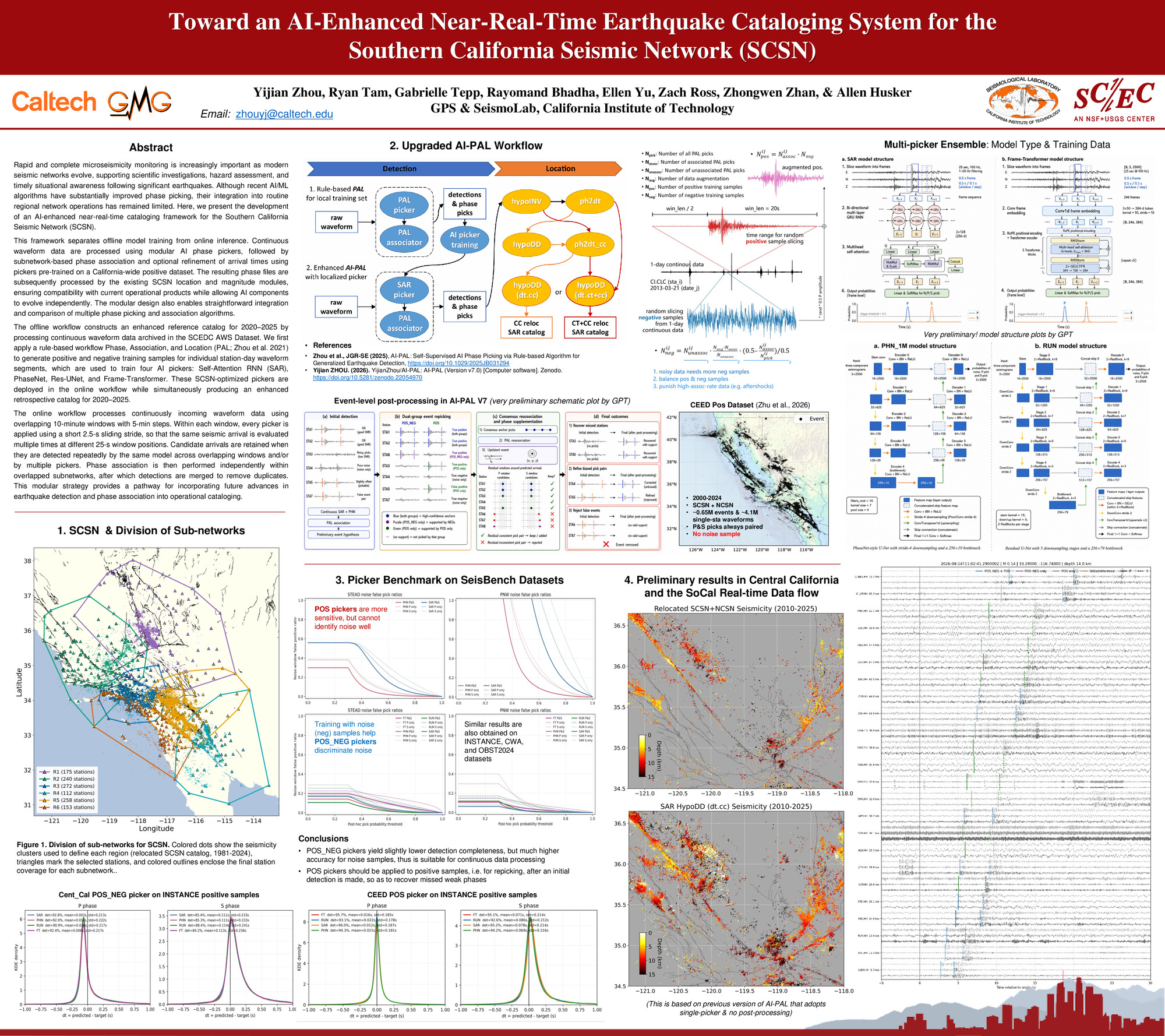 |
Seismology |
Toward an AI-Enhanced Near-Real-Time Earthquake Cataloging System for the Southern California Seismic Network
Yijian Zhou, Ryan Tam, Gabrielle Tepp, Rayomand Bhadha, Ellen Yu, Zachary Ross, Zhongwen Zhan, Allen Husker Rapid and complete microseismicity monitoring is increasingly important as modern seismic networks evolve, supporting scientific investigations, hazard assessment, and timely situational awareness following significant earthquakes. Although recent... more Themes: Advancing Community Earth Models for Hazard Analyses |
|
Group A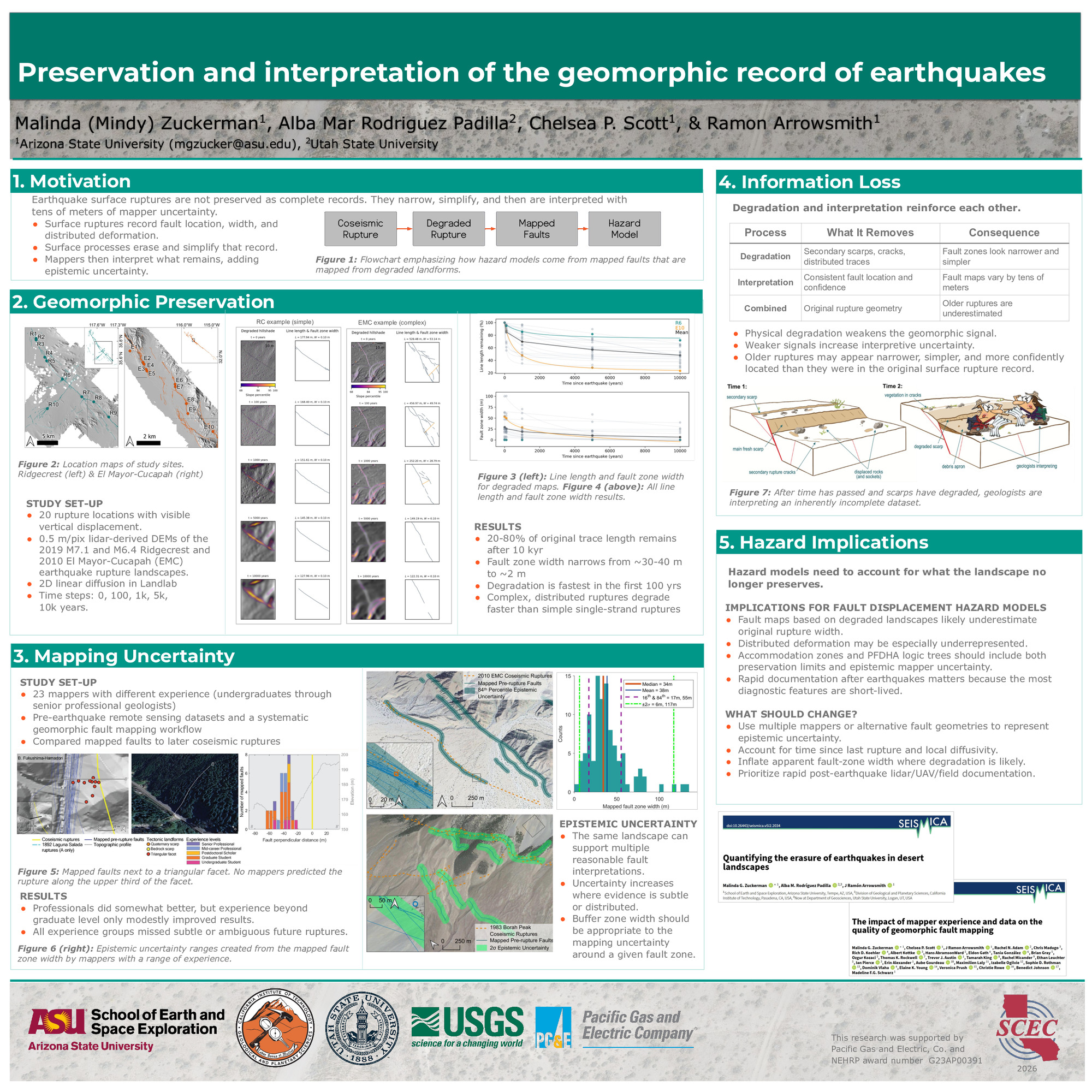 |
Geology |
Preservation and interpretation of the geomorphic record of earthquakes
Malinda Zuckerman, Alba Rodriguez Padilla, Chelsea Scott, Ramon Arrowsmith Surface-rupturing earthquakes leave a geomorphic record that serves as the foundation for fault mapping and probabilistic fault displacement hazard analyses. Over time, the record degrades as surface processes modify fault-related landforms. Both... more |
|
The Statewide California Earthquake Center is committed to providing a safe, productive, and welcoming environment for all participants. We take pride in fostering a diverse and inclusive SCEC community, and therefore expect all participants to abide by the SCEC Activities Code of Conduct.


