
Group B, Poster #202, Research Computing (RC)
Deep Learning Approach to Tsunami Early Warning Predictions and Probabilistic Hazard Assessment


Poster Image:
Poster Presentation
2026 SCEC Annual Meeting, Poster #202, SCEC Contribution #15258 VIEW PDF
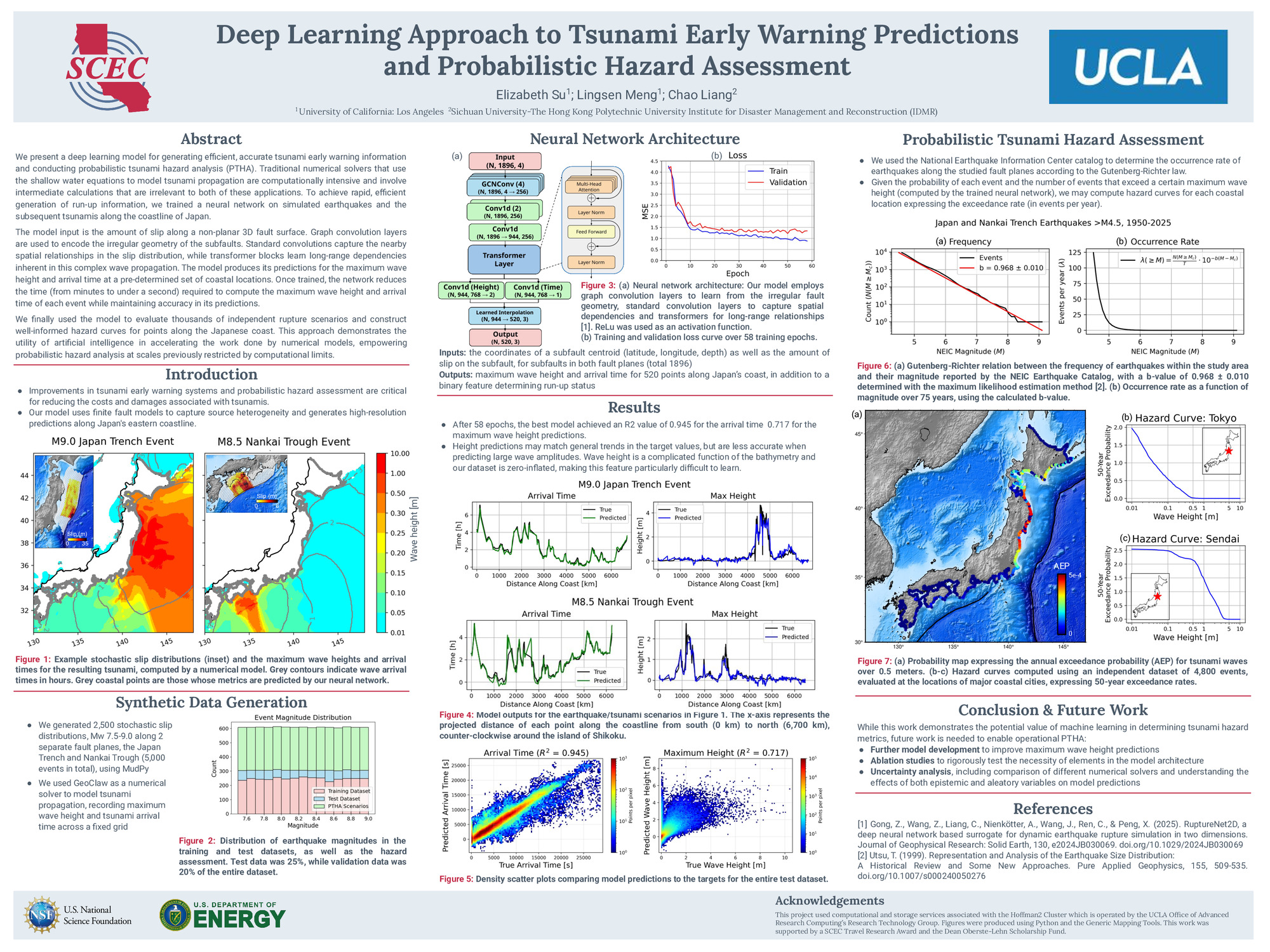
We present a deep learning model for generating efficient, accurate tsunami early warning information and conducting probabilistic tsunami hazard analysis (PTHA). Traditional numerical solvers that use the shallow water equations to model tsunami propagation are computationally intensive and involve intermediate calculations that are irrelevant to both of these applications. To achieve rapid, efficient generation of run-up information, we trained a neural network on simulated earthquakes and the subsequent tsunamis along the coastline of Japan.
The model input is the amount of slip along a non-planar 3D fault surface. Graph convolution layers are used to encode the irregular geometry of the subfaults. Standard convolutions capture the nearby spatial relationships in the slip distribution, while transformer blocks learn long-range dependencies inherent in this complex wave propagation. The model produces its predictions for the maximum wave height and arrival time at a pre-determined set of coastal locations. Once trained, the network reduces the time (from minutes to under a second) required to compute the maximum wave height and arrival time of each event while maintaining accuracy in its predictions.
We finally used the model to evaluate thousands of independent rupture scenarios and construct well-informed hazard curves for points along the Japanese coast. This approach demonstrates the utility of artificial intelligence in accelerating the work done by numerical models, empowering probabilistic hazard analysis at scales previously restricted by computational limits.
The model input is the amount of slip along a non-planar 3D fault surface. Graph convolution layers are used to encode the irregular geometry of the subfaults. Standard convolutions capture the nearby spatial relationships in the slip distribution, while transformer blocks learn long-range dependencies inherent in this complex wave propagation. The model produces its predictions for the maximum wave height and arrival time at a pre-determined set of coastal locations. Once trained, the network reduces the time (from minutes to under a second) required to compute the maximum wave height and arrival time of each event while maintaining accuracy in its predictions.
We finally used the model to evaluate thousands of independent rupture scenarios and construct well-informed hazard curves for points along the Japanese coast. This approach demonstrates the utility of artificial intelligence in accelerating the work done by numerical models, empowering probabilistic hazard analysis at scales previously restricted by computational limits.
Citation: Su, E. K., Meng, L., & Liang, C. (2026, 08). Deep Learning Approach to Tsunami Early Warning Predictions and Probabilistic Hazard Assessment. Poster Presentation at 2026 SCEC Annual Meeting.
Keywords: probabilistic hazard analysis, machine learning, tsunami early warning
Relevant SCEC Themes:
Earthquake Scenarios for Hazard and Risk Assessment


