Group A, Poster #229, Ground Motions (GM)
Earthquake Scenarios for California Via 3D Physics-based Ground Motion Simulations


Poster Image:
Poster Presentation
2026 SCEC Annual Meeting, Poster #229, SCEC Contribution #15279 VIEW PDF
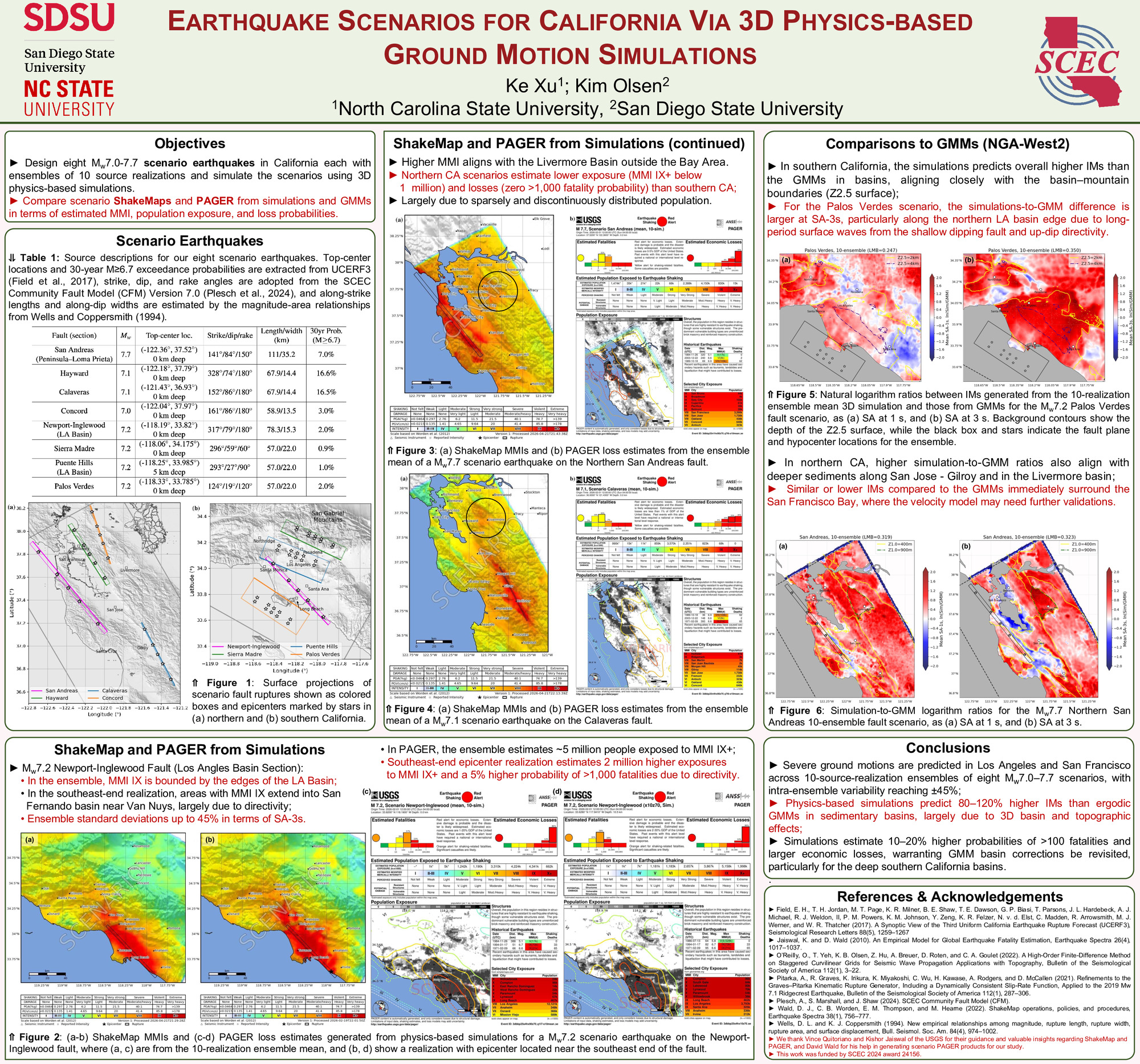
Earthquake scenarios can be useful for estimating the extent of damage and economic losses from future earthquakes and to prepare emergency response plans. Here, we have calculated physics-based simulations with ensembles of 10 source realizations for eight M7.0-7.7 scenario earthquakes on faults in northern and southern California, using state-of-the-art 3D velocity models. For some of the scenarios, severe ground motion levels are reached in major California metropolitan areas, such as spectral accelerations at a period of 1 s reaching up to 1.8 g in Los Angeles and 1.3 g in San Francisco. The simulations exhibit substantial intra-ensemble variability associated with rupture processes and path effects, with deviations of up to ±45% from the ensemble mean for some intensity measures.
Our results indicate that southern California, due to its dense population above some of the scenarios, generally shows greater exposure to higher MMIs than northern California, with its more widely distributed metropolitan areas. Compared to empirical ergodic Ground Motion Models (GMMs) conventionally used for scenario ground motion estimation, we find that our ensemble-averaged physics-based simulations result in up to 120% higher long-period IMs in the Los Angeles and San Fernando basins and the Livermore Valley. Using the USGS PAGER tool, our results indicate that, compared to GMM estimates, up to 2 million additional people may be exposed to Modified Mercalli Intensities (MMIs) of X+ in the southern California scenarios, along with up to a 10% higher probability of exceeding 1,000 fatalities. The northern California physics-based scenarios indicate that up to 30,000 additional people may be exposed to MMI X+ and that the probability of exceeding 1,000 fatalities is up to 5% higher compared to the GMMs. These discrepancies indicate the need for further analysis of the uncertainty associated with both GMMs and physics-based simulations to ensure better planning for and response to future damaging earthquakes.
Our results indicate that southern California, due to its dense population above some of the scenarios, generally shows greater exposure to higher MMIs than northern California, with its more widely distributed metropolitan areas. Compared to empirical ergodic Ground Motion Models (GMMs) conventionally used for scenario ground motion estimation, we find that our ensemble-averaged physics-based simulations result in up to 120% higher long-period IMs in the Los Angeles and San Fernando basins and the Livermore Valley. Using the USGS PAGER tool, our results indicate that, compared to GMM estimates, up to 2 million additional people may be exposed to Modified Mercalli Intensities (MMIs) of X+ in the southern California scenarios, along with up to a 10% higher probability of exceeding 1,000 fatalities. The northern California physics-based scenarios indicate that up to 30,000 additional people may be exposed to MMI X+ and that the probability of exceeding 1,000 fatalities is up to 5% higher compared to the GMMs. These discrepancies indicate the need for further analysis of the uncertainty associated with both GMMs and physics-based simulations to ensure better planning for and response to future damaging earthquakes.
Citation: Xu, K., & Olsen, K. B. (2026, 08). Earthquake Scenarios for California Via 3D Physics-based Ground Motion Simulations. Poster Presentation at 2026 SCEC Annual Meeting.
Keywords: Ground motions, Physics-based simulation, Scenario earthquake, USGS PAGER
SCEC Award: 24156
Relevant SCEC Themes:
Earthquake Scenarios for Hazard and Risk Assessment
Physics-Based Ground Motion Simulations & Validation