Building a Realistic 3D Earth Structure for High-Performance Computation of Elastic Green's Functions in the Cascadia Subduction Zone
Chelsey E. Assor,
Bar Oryan,
Rafael Almeida, &
Alice-Agnes Gabriel
Published August 30, 2026, SCEC Contribution #15548,
2026 SCEC Annual Meeting Poster
#088 (PDF)
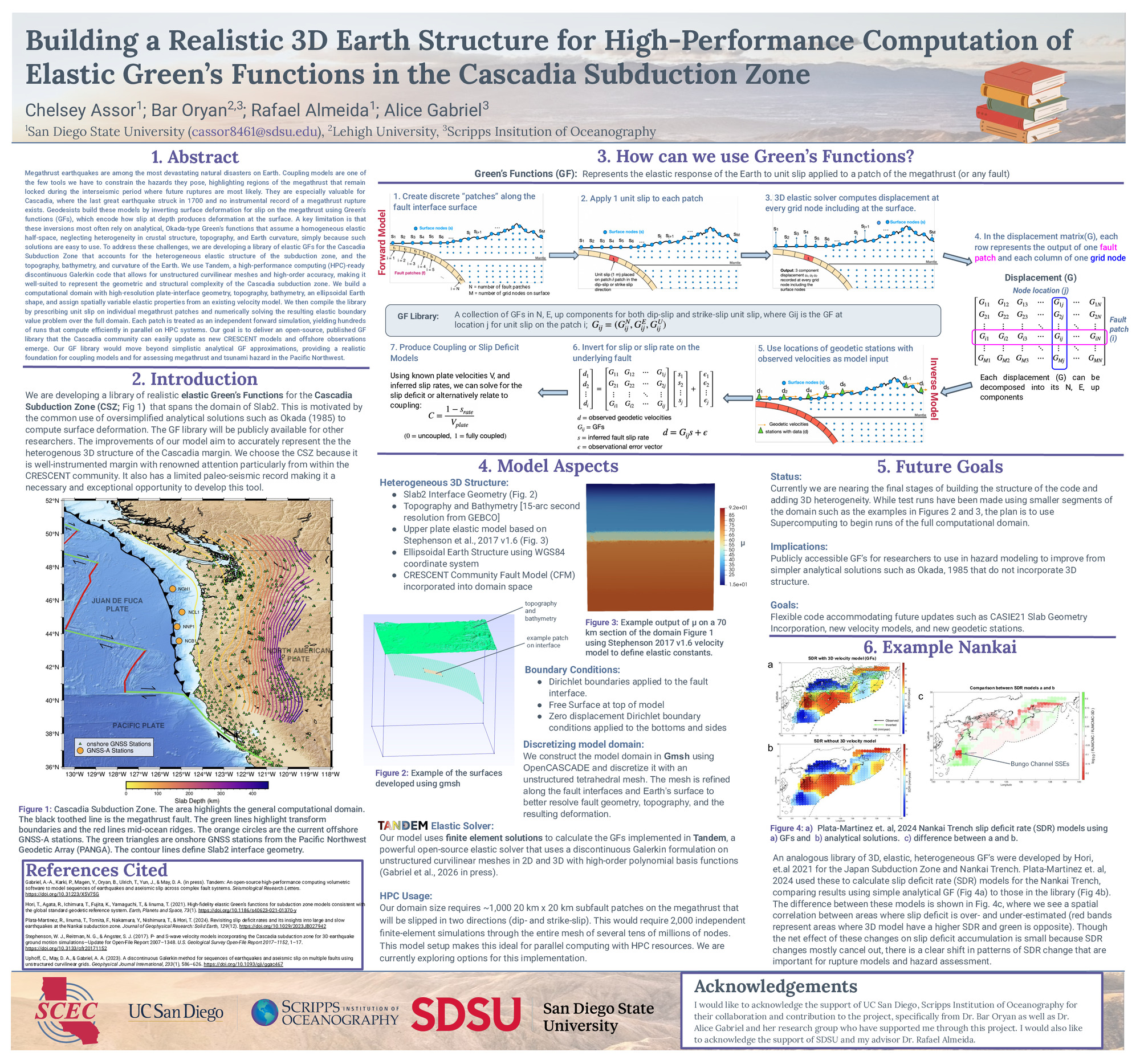
Megathrust earthquakes are among the most devastating natural disasters on Earth. Coupling models are one of the few tools we have to constrain the hazards they pose, highlighting regions of the megathrust that remain locked during the interseismic period where future ruptures are most likely. They are especially valuable for Cascadia, where the last great earthquake struck in 1700 and no instrumental record of a megathrust rupture exists. Geodesists build these models by inverting surface deformation for slip on the megathrust using Green's functions (GFs), which encode how slip at depth produces deformation at the surface. A key limitation is that these inversions most often rely on analytical, Okada-type Green's functions that assume a homogeneous elastic half-space, neglecting heterogeneity in crustal structure, topography, and Earth curvature, simply because such solutions are easy to use. To address these challenges, we are developing a library of elastic GFs for the Cascadia Subduction Zone that accounts for the heterogeneous elastic structure of the subduction zone, and the topography, bathymetry, and curvature of the Earth. We use Tandem, a high-performance computing (HPC)-ready discontinuous Galerkin code that allows for unstructured curvilinear meshes and high-order accuracy, making it well-suited to represent the geometric and structural complexity of the Cascadia subduction zone. We build a computational domain with high-resolution plate-interface geometry, topography, bathymetry, an ellipsoidal Earth shape, and assign spatially variable elastic properties from an existing velocity model. We then compile the library by prescribing unit slip on individual megathrust patches and numerically solving the resulting elastic boundary value problem over the full domain. Each patch is treated as an independent forward simulation, yielding hundreds of runs that compute efficiently in parallel on HPC systems. Our goal is to deliver an open-source, published GF library that the Cascadia community can easily update as new CRESCENT models and offshore observations emerge. Our GF library would move beyond simplistic analytical GF approximations, providing a realistic foundation for coupling models and for assessing megathrust and tsunami hazard in the Pacific Northwest.
Key Words
Green's function library, surface deformation, HPC, heterogeneous elastic structure
Citation
Assor, C. E., Oryan, B., Almeida, R., & Gabriel, A. (2026, 08). Building a Realistic 3D Earth Structure for High-Performance Computation of Elastic Green's Functions in the Cascadia Subduction Zone. Poster Presentation at 2026 SCEC Annual Meeting.
Related Projects & Working Groups
Community Earth Models (CEM)