
ShakeOut Scenario 2.0: Dynamic Rupture Modeling of the M7.8 Earthquake on Southern San Andreas Fault and the Resulting Long-Period Ground Motion
Laura S. Grenot Jones, Clare Ip, Tomoka Ohmori, Ashley Seeman, Chunhui Zhao, & Ahmed E. ElbannaPublished August 30, 2026, SCEC Contribution #15320, 2026 SCEC Annual Meeting Poster #221 (PDF)
Poster Image:
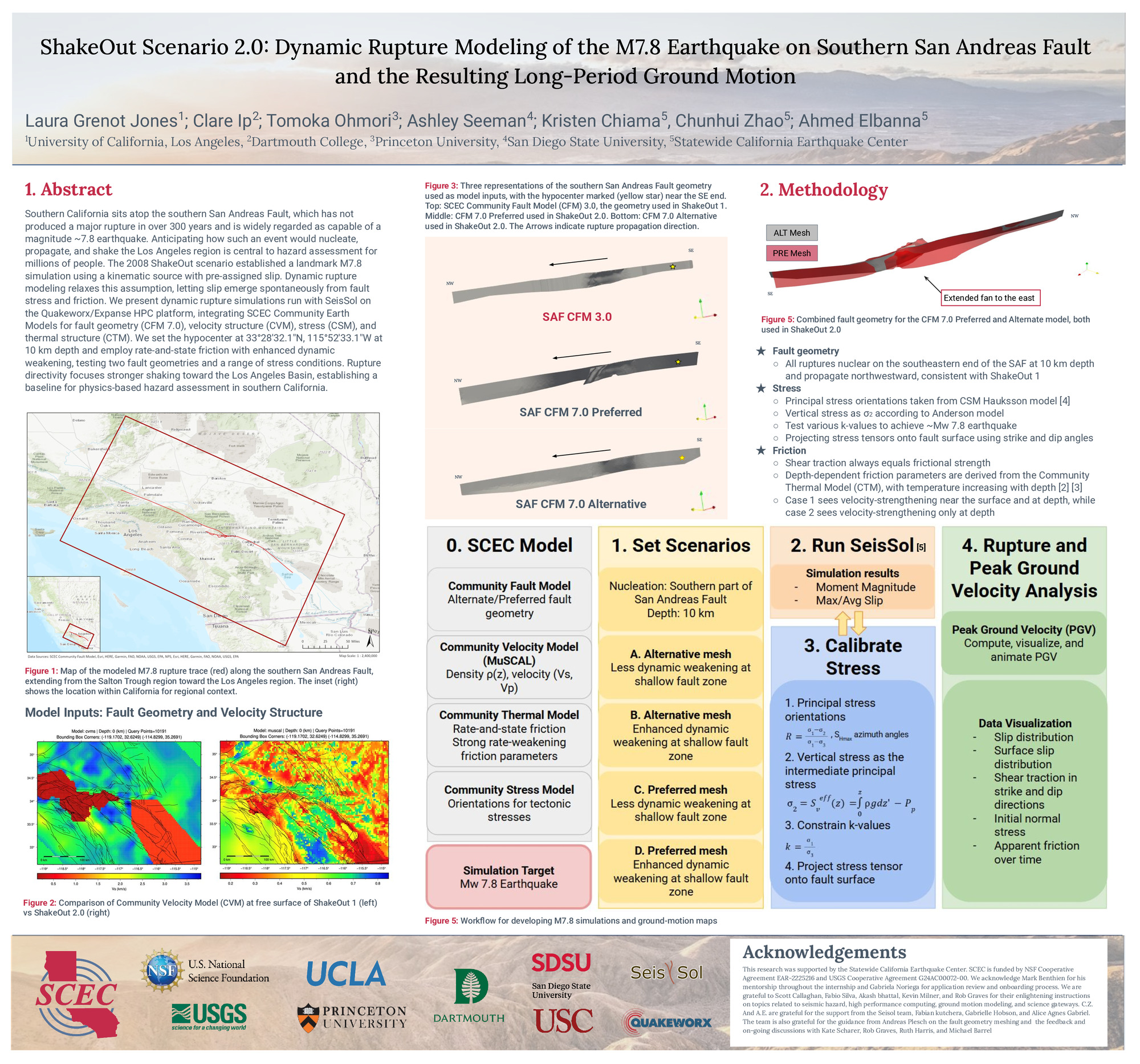
Fault geometry was derived from the SCEC Community Fault Models (CFM), 7.0 ALT and PRE. We also incorporate a three-dimensional seismic velocity structure using the Multiscale Statewide California Velocity Model (MUSCAL). We constrain the directions of principal tectonic stresses by utilizing the SCEC Community Stress Model (CSM). For the nucleation, we set the hypocenter at 33°28'32.1"N, 115°52'33.1"W at 10 km of depth. We employ rate-and-state friction law with enhanced dynamic weakening at co-seismic slip rates, with depth-dependent friction parameters based on the SCEC Community Thermal Model (CTM).
For each of the two fault geometries, we consider two limiting cases corresponding to the absence/presence of strong rate-weakening behavior for the shallow fault zone segments that are velocity-strengthening at low slip rates. We further narrow the range of physically plausible sources for a ~M7.8 rupture by testing different values for the ratio of the maximum and minimum horizontal stresses. All simulations use a 3D elastic medium. Rupture directivity focuses stronger ground motion toward the north, producing pronounced shaking in the Los Angeles Basin. This shaking intensity emerges from both the energetic source characteristics and the amplification due to path and site effects. Our results provide a baseline for next model iterations that incorporate nonlinear rheology and attenuation, and demonstrate the importance of community earth models fusion in physics-based ground motion prediction for southern California earthquake hazard assessment.
Key Words
ShakeOut, physics-based simulations, dynamic ruptures, community earth models, earthquake scenarios
Citation
Grenot Jones, L. S., Ip, C., Ohmori, T., Seeman, A., Zhao, C., & Elbanna, A. E. (2026, 08). ShakeOut Scenario 2.0: Dynamic Rupture Modeling of the M7.8 Earthquake on Southern San Andreas Fault and the Resulting Long-Period Ground Motion. Poster Presentation at 2026 SCEC Annual Meeting.
Related Projects & Working Groups
Ground Motions (GM)


