
Probing nearby small earthquakes with the very dense FaultScan array
John E. Vidale, Mingze Du, & Quentin HigueretPublished August 30, 2026, SCEC Contribution #15613, 2026 SCEC Annual Meeting Poster #139 (PDF)
Poster Image:
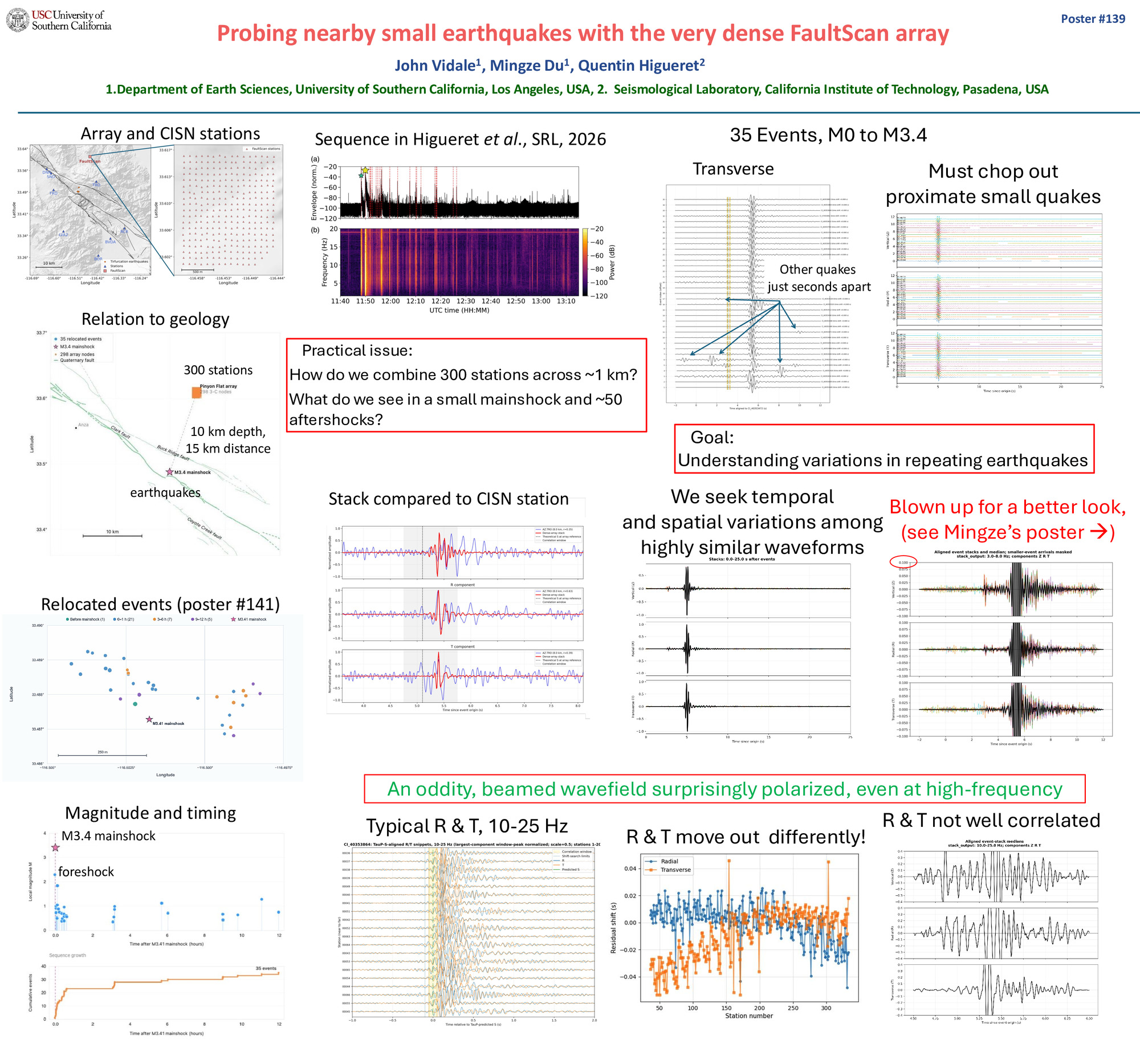
For our initial survey, we examine an M3.5 mainshock very near or on the San Jacinto Fault with 1 foreshock and at least 50 aftershocks in the ensuing 12 hours, which was identified in Higueret [SRL]. It is 15 km from the array at a depth of 10 km. Most of the analyzed seismicity is M0.5 to M1.0. Most of the seismicity shows similar S waveforms at the array.
Standard SCSN catalog locations span several km. Relocation reduced the area activated to about 500m elongated along the direction of the San Jacinto fault, which is close to one plane of the strike-slip focal mechanism of the M3.5 event. The constancy of the S-P time intervals among some of the most similar of the repeating earthquakes suggests the cluster is even tighter than 500 m indicated by relocation. We applied the method of Sneider and Vrijlandt [JGR, 2005], which measures decorrelation of coda with frequency, to estimate relative distances between the events to further constrain the spatial pattern of the seismicity.
We use array stacking to suppress shallow site effects and isolate waveform complexity arising from the earthquake source and near-source structure. Even at the favorable geology of the Pinyon Flats site, the isolation of direct arrivals from converted surfaces waves required attention to differences in the radial and transverse arrivals and careful windowing. Our motivation is the chance to delineate near-source fault zone structure and possible temporal changes due to the mainshock in the fault zone.
We were able to stack to recover 3-component waveforms up to frequencies above 25 Hz. Somewhat surprisingly, even at high frequency, the stacks showed separation into P-SV and SH wavetrains. The S and P wave codas had amplitudes that would be completely unrecoverable from single seismograms, which allows us to seek any signals of reverberations in the fault zone at seismogenic depth or fault zone healing from the M3.5 mainshock.
Key Words
earthquake, fault, arrays
Citation
Vidale, J. E., Du, M., & Higueret, Q. (2026, 08). Probing nearby small earthquakes with the very dense FaultScan array. Poster Presentation at 2026 SCEC Annual Meeting.
Related Projects & Working Groups
Seismology


