A millennium of loading: Paleoseismically constrained Coulomb stress evolution on the Carrizo and Coachella segments of the San Andreas Fault
Liliane Burkhard, &
Bridget R. Smith-Konter
Published August 30, 2026, SCEC Contribution #15133,
2026 SCEC Annual Meeting Poster
#048 (PDF)
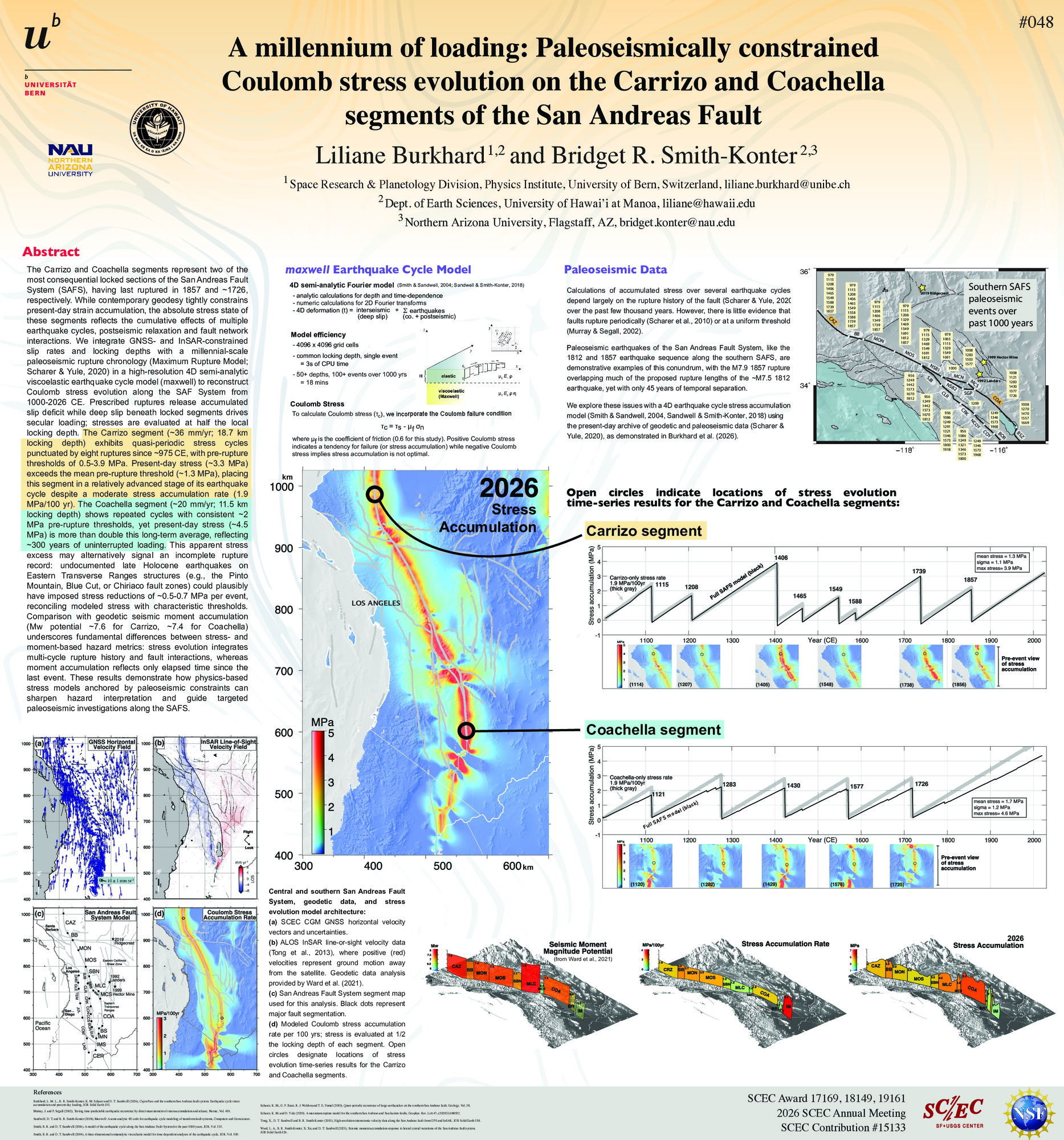
The Carrizo and Coachella segments represent two of the most consequential locked sections of the San Andreas Fault System (SAFS), having last ruptured in 1857 and ~1726, respectively. While contemporary geodesy tightly constrains present-day strain accumulation, the absolute stress state of these segments reflects the cumulative effects of multiple earthquake cycles, postseismic relaxation and fault network interactions. We integrate GNSS- and InSAR-constrained slip rates and locking depths with a millennial-scale paleoseismic rupture chronology (Maximum Rupture Model; Scharer & Yule, 2020) in a high-resolution 4D semi-analytic viscoelastic earthquake cycle model (maxwell) to reconstruct Coulomb stress evolution along the SAF System from 1000-2026 CE. Prescribed ruptures release accumulated slip deficit while deep slip beneath locked segments drives secular loading; stresses are evaluated at half the local locking depth. The Carrizo segment (~36 mm/yr; 18.7 km locking depth) exhibits quasi-periodic stress cycles punctuated by eight ruptures since ~975 CE, with pre-rupture thresholds of 0.5-3.9 MPa. Present-day stress (~3.3 MPa) exceeds the mean pre-rupture threshold (~1.3 MPa), placing this segment in a relatively advanced stage of its earthquake cycle despite a moderate stress accumulation rate (1.9 MPa/100 yr). The Coachella segment (~20 mm/yr; 11.5 km locking depth) shows repeated cycles with consistent ~2 MPa pre-rupture thresholds, yet present-day stress (~4.5 MPa) is more than double this long-term average, reflecting ~300 years of uninterrupted loading. This apparent stress excess may alternatively signal an incomplete rupture record: undocumented late Holocene earthquakes on Eastern Transverse Ranges structures (e.g., the Pinto Mountain, Blue Cut, or Chiriaco fault zones) could plausibly have imposed stress reductions of ~0.5-0.7 MPa per event, reconciling modeled stress with characteristic thresholds. Comparison with geodetic seismic moment accumulation (Mw potential ~7.6 for Carrizo, ~7.4 for Coachella) underscores fundamental differences between stress- and moment-based hazard metrics: stress evolution integrates multi-cycle rupture history and fault interactions, whereas moment accumulation reflects only elapsed time since the last event. These results demonstrate how physics-based stress models anchored by paleoseismic constraints can sharpen hazard interpretation and guide targeted paleoseismic investigations along the SAFS.
Key Words
San Andreas Fault, Coachella, Carrizo, stress accumulation, earthquake cycle
Citation
Burkhard, L., & Smith-Konter, B. R. (2026, 08). A millennium of loading: Paleoseismically constrained Coulomb stress evolution on the Carrizo and Coachella segments of the San Andreas Fault. Poster Presentation at 2026 SCEC Annual Meeting.
Related Projects & Working Groups
Stress and Deformation Over Time (SDOT)