
Group B, Poster #048, Stress and Deformation Over Time (SDOT)
A millennium of loading: Paleoseismically constrained Coulomb stress evolution on the Carrizo and Coachella segments of the San Andreas Fault


Poster Image:
Poster Presentation
2026 SCEC Annual Meeting, Poster #048, SCEC Contribution #15133 VIEW PDF
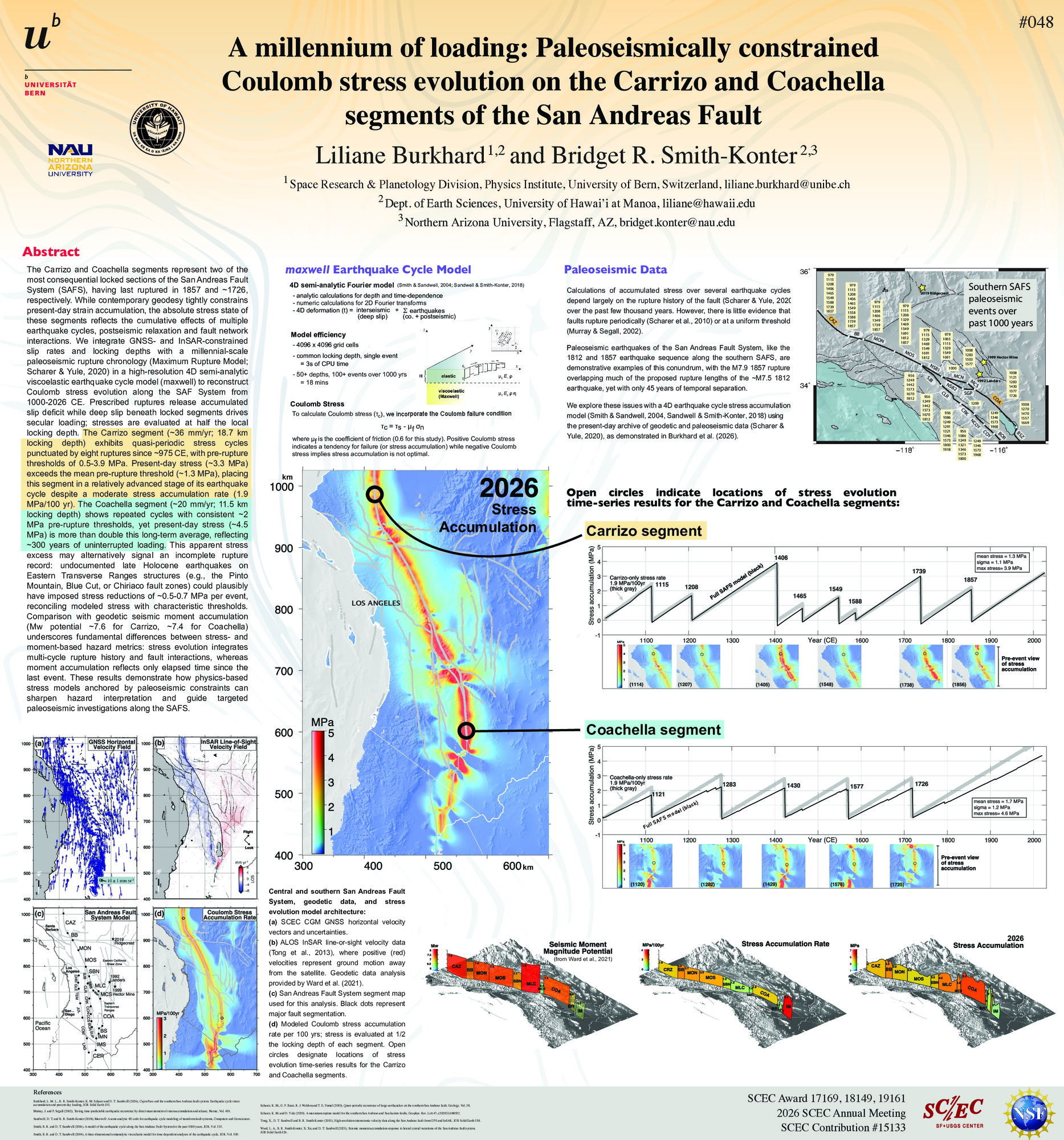
The Carrizo and Coachella segments represent two of the most consequential locked sections of the San Andreas Fault System (SAFS), having last ruptured in 1857 and ~1726, respectively. While contemporary geodesy tightly constrains present-day strain accumulation, the absolute stress state of these segments reflects the cumulative effects of multiple earthquake cycles, postseismic relaxation and fault network interactions. We integrate GNSS- and InSAR-constrained slip rates and locking depths with a millennial-scale paleoseismic rupture chronology (Maximum Rupture Model; Scharer & Yule, 2020) in a high-resolution 4D semi-analytic viscoelastic earthquake cycle model (maxwell) to reconstruct Coulomb stress evolution along the SAF System from 1000-2026 CE. Prescribed ruptures release accumulated slip deficit while deep slip beneath locked segments drives secular loading; stresses are evaluated at half the local locking depth. The Carrizo segment (~36 mm/yr; 18.7 km locking depth) exhibits quasi-periodic stress cycles punctuated by eight ruptures since ~975 CE, with pre-rupture thresholds of 0.5-3.9 MPa. Present-day stress (~3.3 MPa) exceeds the mean pre-rupture threshold (~1.3 MPa), placing this segment in a relatively advanced stage of its earthquake cycle despite a moderate stress accumulation rate (1.9 MPa/100 yr). The Coachella segment (~20 mm/yr; 11.5 km locking depth) shows repeated cycles with consistent ~2 MPa pre-rupture thresholds, yet present-day stress (~4.5 MPa) is more than double this long-term average, reflecting ~300 years of uninterrupted loading. This apparent stress excess may alternatively signal an incomplete rupture record: undocumented late Holocene earthquakes on Eastern Transverse Ranges structures (e.g., the Pinto Mountain, Blue Cut, or Chiriaco fault zones) could plausibly have imposed stress reductions of ~0.5-0.7 MPa per event, reconciling modeled stress with characteristic thresholds. Comparison with geodetic seismic moment accumulation (Mw potential ~7.6 for Carrizo, ~7.4 for Coachella) underscores fundamental differences between stress- and moment-based hazard metrics: stress evolution integrates multi-cycle rupture history and fault interactions, whereas moment accumulation reflects only elapsed time since the last event. These results demonstrate how physics-based stress models anchored by paleoseismic constraints can sharpen hazard interpretation and guide targeted paleoseismic investigations along the SAFS.
Citation: Burkhard, L., & Smith-Konter, B. R. (2026, 08). A millennium of loading: Paleoseismically constrained Coulomb stress evolution on the Carrizo and Coachella segments of the San Andreas Fault. Poster Presentation at 2026 SCEC Annual Meeting.
Keywords: San Andreas Fault, Coachella, Carrizo, stress accumulation, earthquake cycle
Relevant SCEC Themes:
Earthquake Scenarios for Hazard and Risk Assessment
Earthquake Cycle Simulations & Forecasting


