Gas compressibility suppresses injection induced fault rupture
Dimitri Trifunac,
Taeho Kim, & Hamdi Tchelepi
Published August 30, 2026, SCEC Contribution #15637,
2026 SCEC Annual Meeting Poster
#011 (PDF)
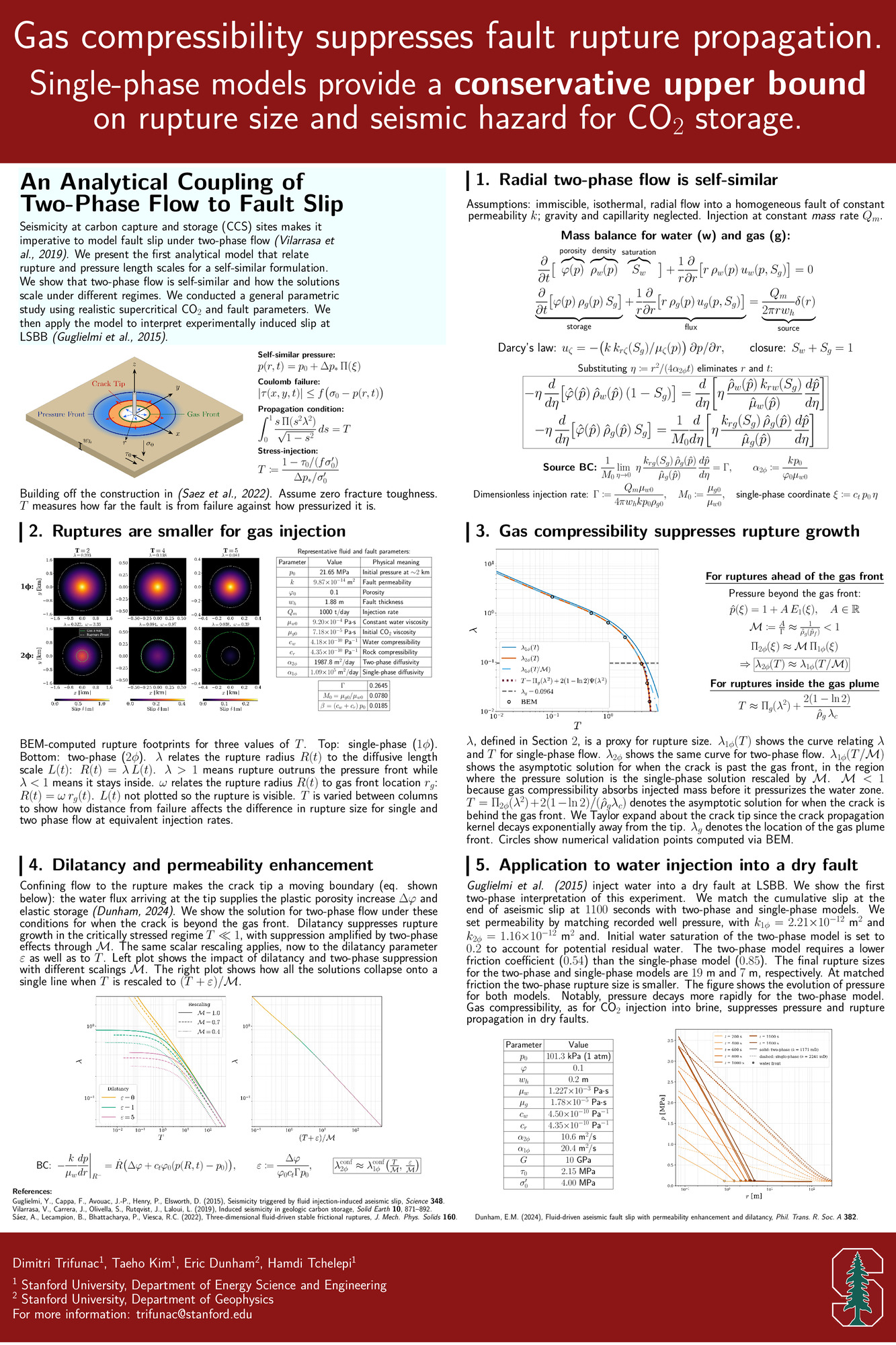
Fluid injection can activate faults by reducing the effective normal stress acting on the fault. Occurrences of microseismicity at the Decatur and In Salah carbon capture and sequestration (CCS) sites, and two recent magnitude 4 earthquakes in central Alberta attributed to CO2 injection at the Quest CCS site, make it imperative to model fault slip in the context of two-phase flow. Scaling relations between injection and rupture length scales exist for single-phase water injection (Viesca 2021, Saez et al. 2022), but none account for a second, more compressible phase. We present, to our knowledge, the first analytical coupling of compressible two-phase flow to fault slip, modeling gas injected at a constant rate into a brine saturated fault slipping quasi-statically. We find that, under realistic conditions, gas injection produces smaller ruptures than for single-phase water injection with identical parameters. At leading order, for ruptures larger than the gas plume, the entire two-phase effect reduces to a rescaling of the stress-injection parameter (Saez et al. 2022) by a constant inversely proportional to the gas density at the gas plume front. For small ruptures which lie within the gas plume, the rupture is suppressed further, and the rescaling breaks down. In the small rupture regime, the rupture is locally sensitive to the pressure profile near the crack tip. Because the injected phase is compressible, single-phase scaling systematically overestimates rupture extent, providing a conservative bound on rupture size at CCS sites.
Key Words
Fault rupture, induced seismicity, multiphase flow
Citation
Trifunac, D., Kim, T., & Tchelepi, H. (2026, 08). Gas compressibility suppresses injection induced fault rupture. Poster Presentation at 2026 SCEC Annual Meeting.
Related Projects & Working Groups
Fault and Rupture Mechanics (FARM)