Operationalizing regional risk assessments in the development of the National Seismic Hazard Model
Anne Hulsey
Published August 30, 2026, SCEC Contribution #15523,
2026 SCEC Annual Meeting Poster
#172 (PDF)
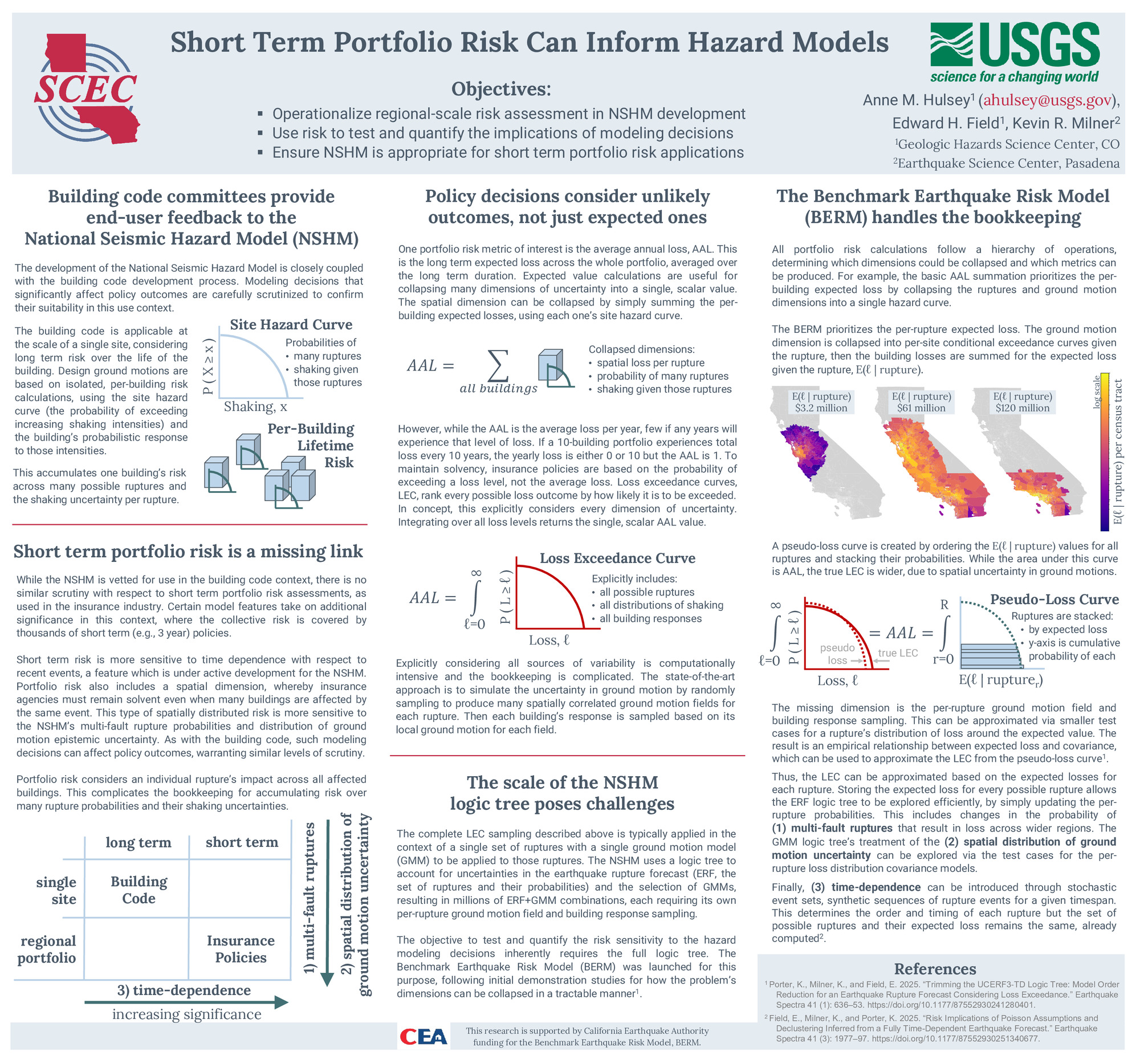
The National Seismic Hazard Model (NSHM) incorporates many sources of epistemic uncertainty to reflect current scientific understanding and to identify areas where further research could most improve hazard characterization and support downstream risk applications. Development of the NSHM has historically considered its application in seismic design provisions, refining the model with respect to building-level seismic risk across multi-decadal time scales. However, validation at the building scale does not necessarily ensure appropriate behavior when risk is aggregated across portfolios or evaluated over the shorter time horizons relevant to insurance and financial risk assessments. The Benchmark Earthquake Risk Model (BERM) quantifies how hazard epistemic uncertainty propagates into aggregated losses, with particular focus on short-term time dependence (including aftershocks and otherwise triggered events), the likelihood of multi-fault ruptures, and the spatial distribution of epistemic uncertainty in ground-motion models—factors that may have limited influence on long term risk to individual structures, i.e., building codes, but strongly affect portfolio and regional risk outcomes.
The BERM is currently under development, restructuring the OpenSHA risk analysis workflow to better accommodate the automation and bookkeeping necessary at scale. Additional features, such as spatially correlated ground motion simulations, are being incorporated to test and improve the approximate solutions used in the existing risk analysis workflow.
Citation
Hulsey, A. (2026, 08). Operationalizing regional risk assessments in the development of the National Seismic Hazard Model. Poster Presentation at 2026 SCEC Annual Meeting.
Related Projects & Working Groups
Applied Science Implementation (ASI)