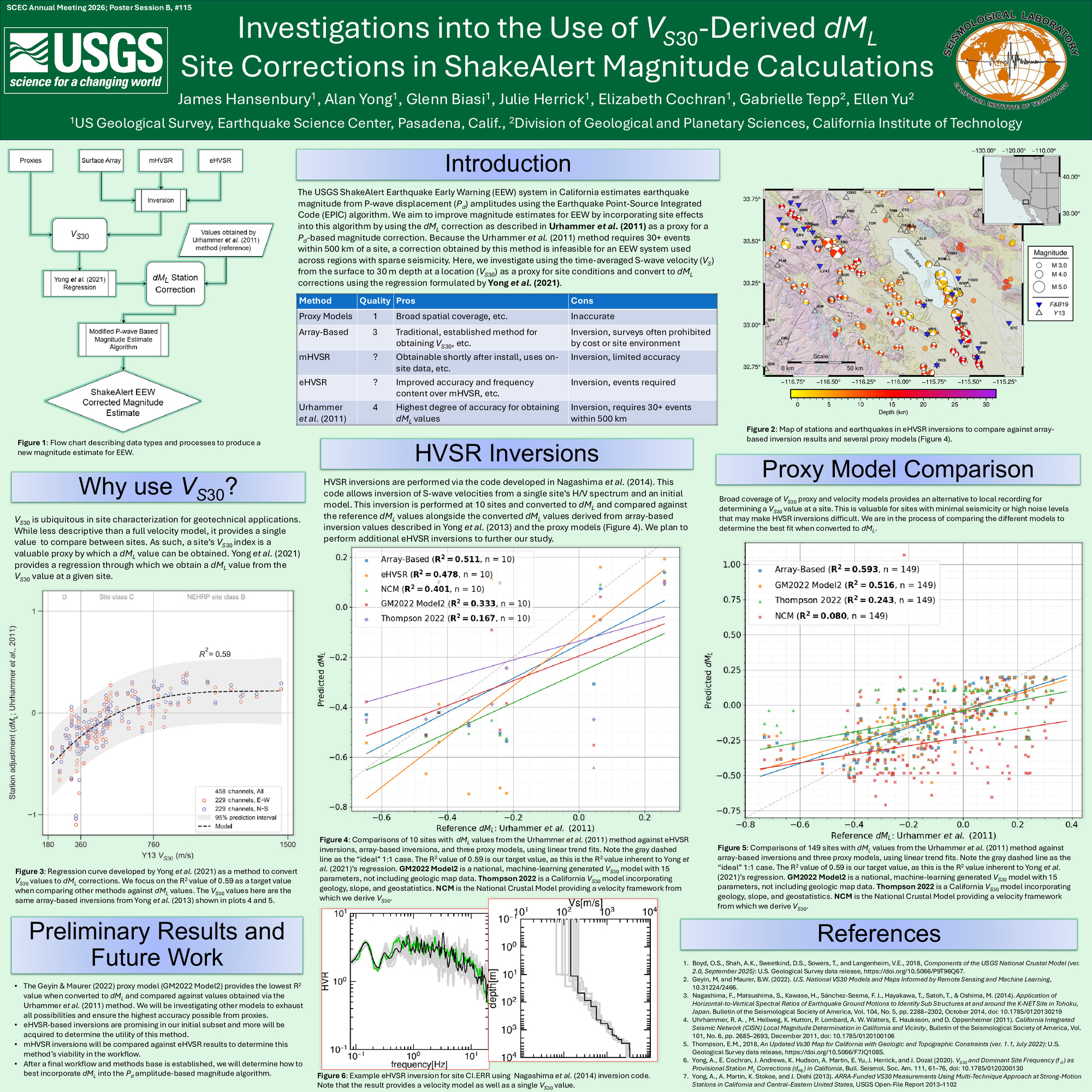
Investigations into the use of VS30-derived dML site corrections in ShakeAlert magnitude calculations
James I. Hansenbury,
Alan Yong,
Glenn P. Biasi, Julie Herrick,
Elizabeth S. Cochran,
Gabrielle Tepp, &
Ellen Yu
Published August 30, 2026, SCEC Contribution #15507,
2026 SCEC Annual Meeting Poster
#114 (PDF)
The USGS ShakeAlert Earthquake Early Warning (EEW) system in California, Oregon, and Washington estimates earthquake magnitude from P-wave displacement (Pd) amplitudes recorded by as few as four seismic stations. This small sample size means site amplification effects at one or two stations can have a disproportionate effect on ShakeAlert magnitude and subsequent alerting area. Strong site amplifications contributed to a significant overestimate in the 20 August 2023 Ojai, CA, earthquake, in which ShakeAlert initially estimated a Mw 6.0 for a Mw 5.1 event. Station dML (Urhammer et al., 2011) is a displacement-based station magnitude correction commonly used in California to partially account for this effect in regional network ML estimation. However, the Urhammer et al. method is not immediately suitable for ShakeAlert because new stations in California and most stations in Oregon and Washington have not recorded enough local seismicity to provide proper calibration. We instead investigate using the site-effect methodology of Yong et al. (2021) to estimate dML corrections from the site’s time-averaged shear wave velocity of the top 30 m (VS30). Specifically, we compare alternative methods of acquiring values including map-level proxy models (Geyin and Maurer, 2022) and earthquake horizontal-to-vertical-spectral-ratios based inversions (Nagashima et al., 2014) against traditional surface array-based inversions (Yong et al., 2013). Our goal is to develop a hierarchy of methods to obtain dML values based on availability of data and a framework in which these values could be used by ShakeAlert with Pd-based magnitude estimates. Preliminary comparisons among methods suggest varying degrees of predictive power, with inversions from earthquake horizontal-to-vertical ratios currently slightly favored.
Key Words
Site Effects, Site Corrections, VS30, ShakeAlert, EEW
Citation
Hansenbury, J. I., Yong, A., Biasi, G. P., Herrick, J., Cochran, E. S., Tepp, G., & Yu, E. (2026, 08). Investigations into the use of VS30-derived dML site corrections in ShakeAlert magnitude calculations. Poster Presentation at 2026 SCEC Annual Meeting.
Related Projects & Working Groups
Seismology