Incorporating distributed acoustic sensing observations into the FinDer earthquake early warning algorithm
Jessie K. Saunders,
Qiushi Zhai,
Jingchuan Wang,
Claude Felizardo, Andrew Good,
Zhongwen Zhan, &
Allen L. Husker
Published August 30, 2026, SCEC Contribution #15493,
2026 SCEC Annual Meeting Poster
#133 (PDF)
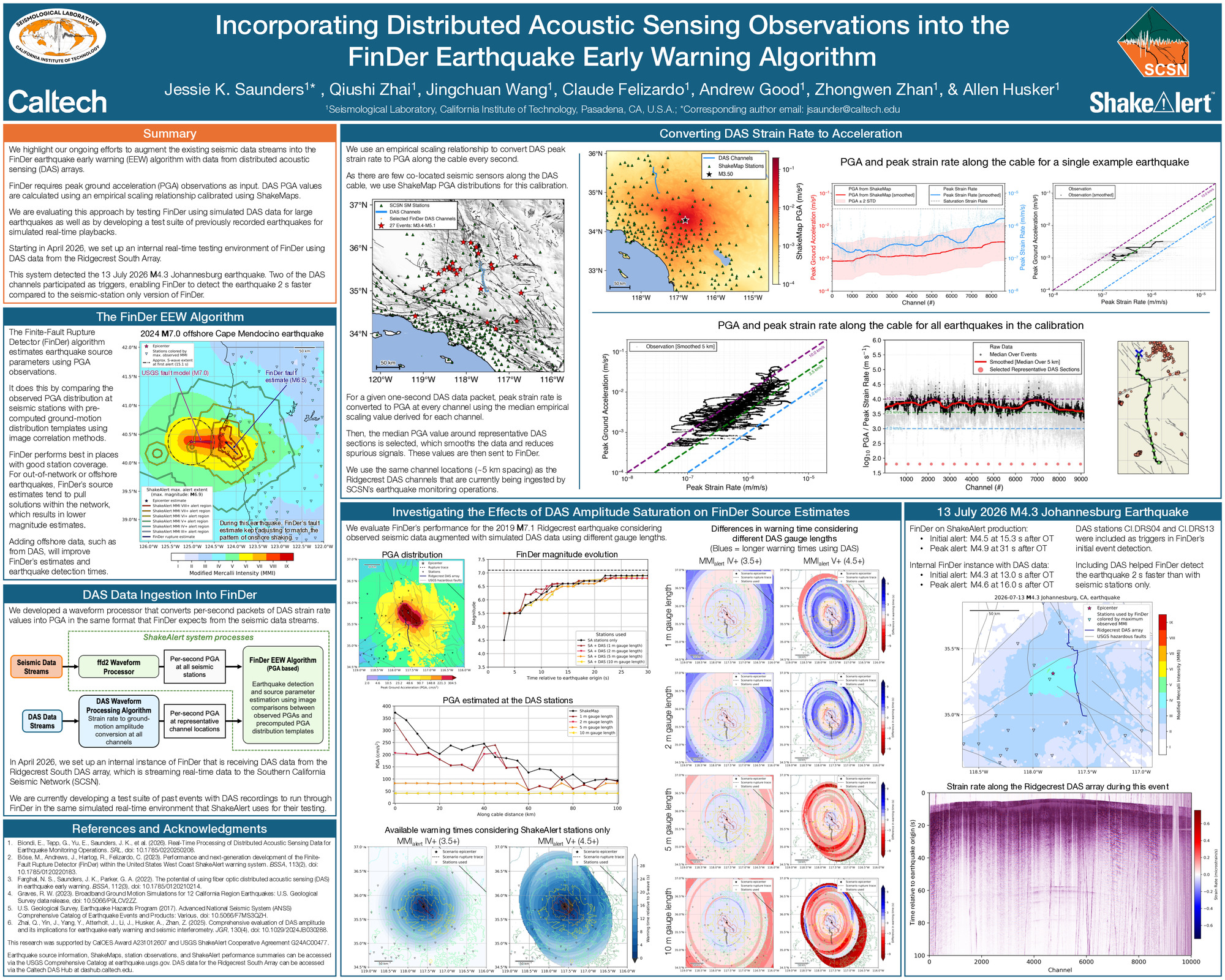
The Finite-Fault Rupture Detector (FinDer) earthquake early warning (EEW) algorithm rapidly estimates earthquake source parameters by matching pre-computed ground-motion templates with the observed peak ground acceleration (PGA) distribution. Earthquake source estimates and alert times within FinDer are thus reliant on the existing seismic station coverage, and can be negatively impacted for earthquakes that occur in regions where real-time conventional seismic sensors are difficult to deploy, such as in offshore environments. Here, we discuss our ongoing investigations to augment the existing seismic data stream into FinDer with data from distributed acoustic sensing (DAS) arrays. We use a 100-km-long DAS array located in Ridgecrest, California, as our main testbed, which is already being used in regular earthquake monitoring operations for location and timing calculations. We use ShakeMap ground-motion distributions to calibrate an empirical scaling relationship between DAS strain-rate measurements and PGA. These converted PGA values at representative channel locations along the fiber-optic cable are then sent to the FinDer algorithm every second alongside the seismic station data stream. This internal real-time testing environment of the FinDer algorithm using DAS data has been operational since April 2026. We are in the process of developing a suite of example recorded earthquakes to assess this FinDer DAS setup in a simulated real-time testing environment. We are also testing with larger-magnitude scenario simulations to evaluate the effects of DAS saturation on FinDer’s source parameter estimates. Lastly, we highlight the real-time performance during the recent 2026 July 13 M4.3 Johannesburg earthquake. Due to the proximity of this earthquake to the Ridgecrest DAS array, two of the DAS channels participated as triggers, enabling FinDer to detect the earthquake two seconds faster compared to the seismic-station-only version of FinDer.
Key Words
earthquake early warning, distributed acoustic sensing
Citation
Saunders, J. K., Zhai, Q., Wang, J., Felizardo, C., Good, A., Zhan, Z., & Husker, A. L. (2026, 08). Incorporating distributed acoustic sensing observations into the FinDer earthquake early warning algorithm. Poster Presentation at 2026 SCEC Annual Meeting.
Related Projects & Working Groups
Seismology