An Updated San Andreas Fault Geometry in Parkfield, California
Adam Margolis, &
David D. Oglesby
Published August 30, 2026, SCEC Contribution #15458,
2026 SCEC Annual Meeting Poster
#033 (PDF)
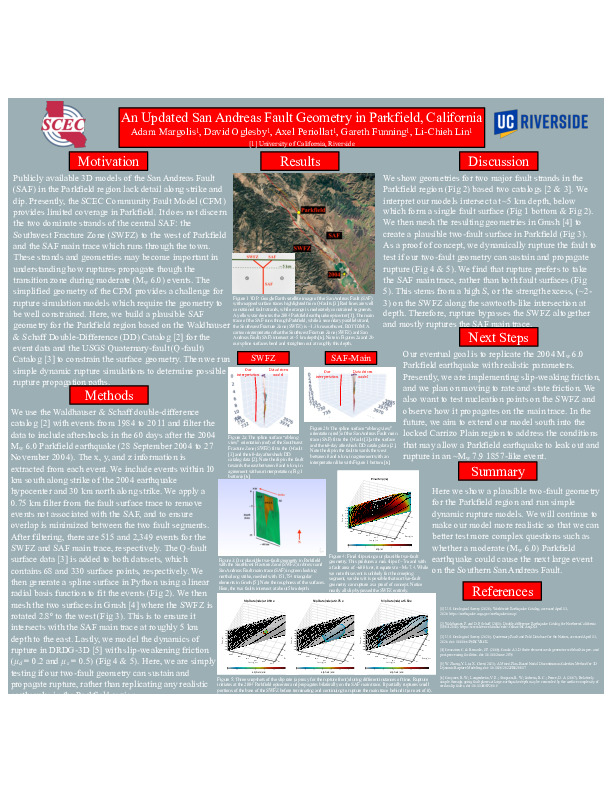
Publicly available 3D models of the San Andreas Fault (SAF) in the Parkfield region lack fine details along strike and dip. Presently, the Statewide California Earthquake Center – Community Fault Model (SCEC-CFM) provides limited coverage along the Parkfield segment. The simplified geometry of the SCEC-CFM provides a challenge for rupture simulation models which require the geometry to be well constrained. Additionally, it does not discern between the two dominant strands of the central SAF: the Southwest Fracture Zone (SWFZ) to the west of Parkfield and the SAF main trace which runs through the town. These strands and geometries may become important in understanding how ruptures propagate through the transition zone during moderate (Mw 6.0) events. Here, we build plausible SAF geometries for the Parkfield region based on the Waldhauser & Schaff Double-Difference (DD) Catalog for the event data and the USGS Quaternary-fault (Q-fault) Catalog to constrain the surface geometry. We aim to produce a high-resolution Parkfield best-fit model using a two-fault geometry for the community to use. Using this, we run simple dynamic rupture simulations of the 2004 Mw 6.0 event to evaluate the goodness of the geometrical fit. Eventually, we will use our best-fit Parkfield model to test if moderate (Mw 6.0) events can leak out towards the south and rupture the Carrizo Plain segment, propagating into a major (> Mw 7.0) earthquake of the Southern SAF.
Key Words
San, Andreas, Fault, Parkfield, Dynamic, Rupture, Model, 2004
Citation
Margolis, A., & Oglesby, D. D. (2026, 08). An Updated San Andreas Fault Geometry in Parkfield, California. Poster Presentation at 2026 SCEC Annual Meeting.
Related Projects & Working Groups
Fault and Rupture Mechanics (FARM)