Constraining earthquake stress drop methods using point-source simulations for the Community Stress Drop Validation Study
Annemarie S. Baltay,
Rachel E. Abercrombie, Dino Bindi,
Peter M. Shearer, &
Chen Ji
Published August 30, 2026, SCEC Contribution #15455,
2026 SCEC Annual Meeting Poster
#120 (PDF)
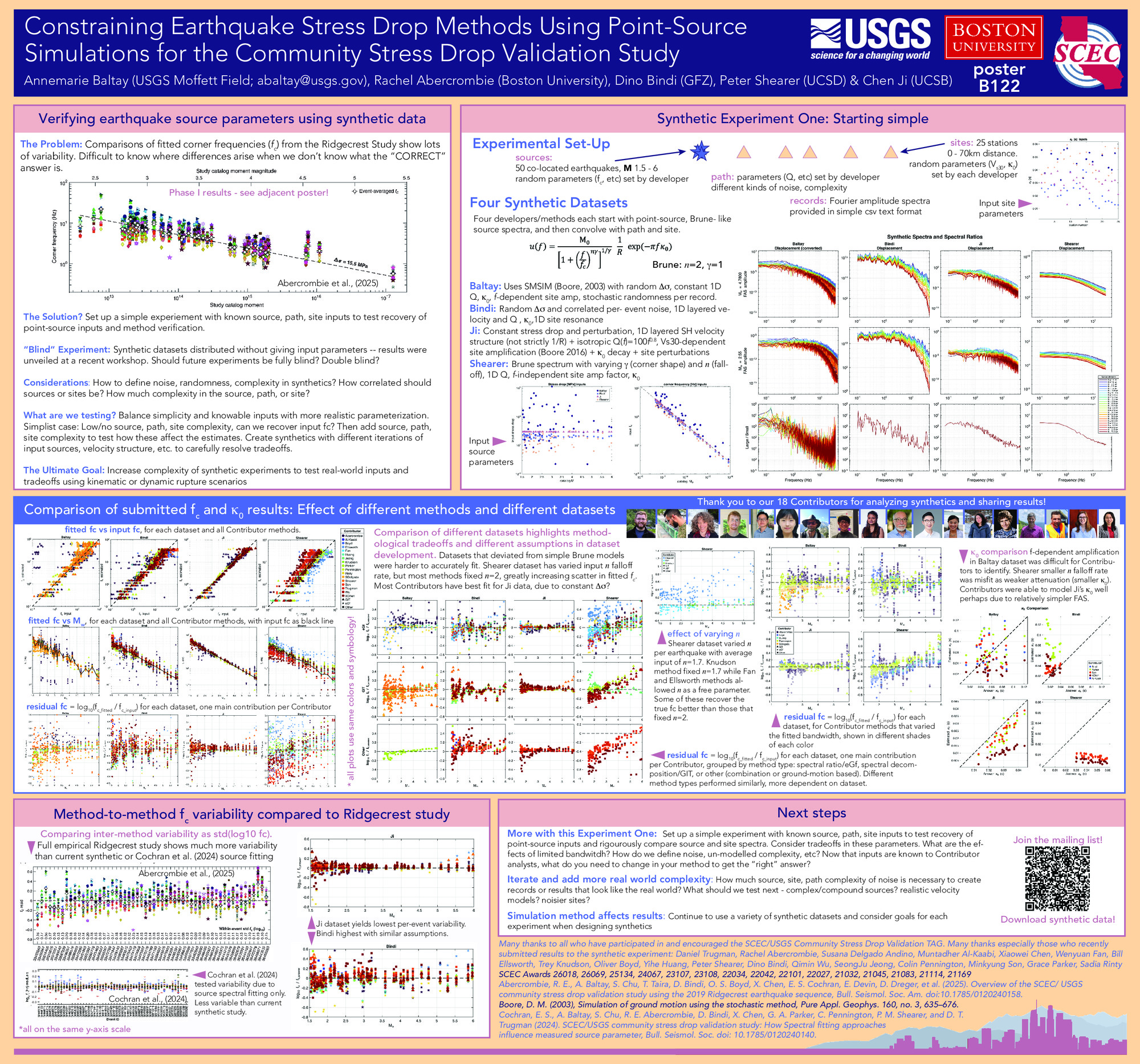
As a part of the newly supported Community Stress Drop Validation Study Technical Activity Group (TAG), we present recent initial results from several datasets of simple, point-source simulated earthquake Fourier amplitude spectra for use in evaluating different earthquake stress drop estimation methods. The Community Study TAG has brought together over 100 participants worldwide to address questions of variability and uncertainty in estimated spectral earthquake stress drops. In the first stage of the study, over 20 research groups analyzed and submitted stress drop estimates from the 2019 Ridgecrest sequence common dataset; through Phase I of this community effort, we found considerable variability among methods and assumptions. To more fully quantify the sources of these discrepancies, Phase II explores how well different methods can separate source, site, and path effects with known physical quantities as inputs. We develop several different synthetic datasets of point-source, simplistic Fourier Amplitude Spectra, in which we precisely prescribe parameters. These parameters include spectral shape (Brune, Boatwright or double corner), corner frequency, seismic moment, path attenuation (Q), layered velocity structure and site amplification and diminution (kappa). The first experimental setup consists of co-located earthquakes of various magnitudes, recorded at stations at a range of distances, with varying spectral complexity, stress drop, path attenuation, and site properties. We shared these initial synthetics to the larger Stress Drop Validation TAG for analysis using spectral stress drop estimation methods, including spectral decomposition and empirical Green’s function approaches. We compare initial results to determine the relative strengths of different methods in isolating the input parameters. Ultimately, we aim to add complexity to the synthetics and develop a set of more realistic synthetics that mirror (in earthquake magnitude and location, and station location) the proposed empirical San Francisco Bay Area data set. We will also consider kinematic models in order to replicate the different contributions to the variability observed in the empirical results.
Key Words
stress drop, synthetics, validation, source spectra, source parameters
Citation
Baltay, A. S., Abercrombie, R. E., Bindi, D., Shearer, P. M., & Ji, C. (2026, 08). Constraining earthquake stress drop methods using point-source simulations for the Community Stress Drop Validation Study. Poster Presentation at 2026 SCEC Annual Meeting.
Related Projects & Working Groups
Seismology