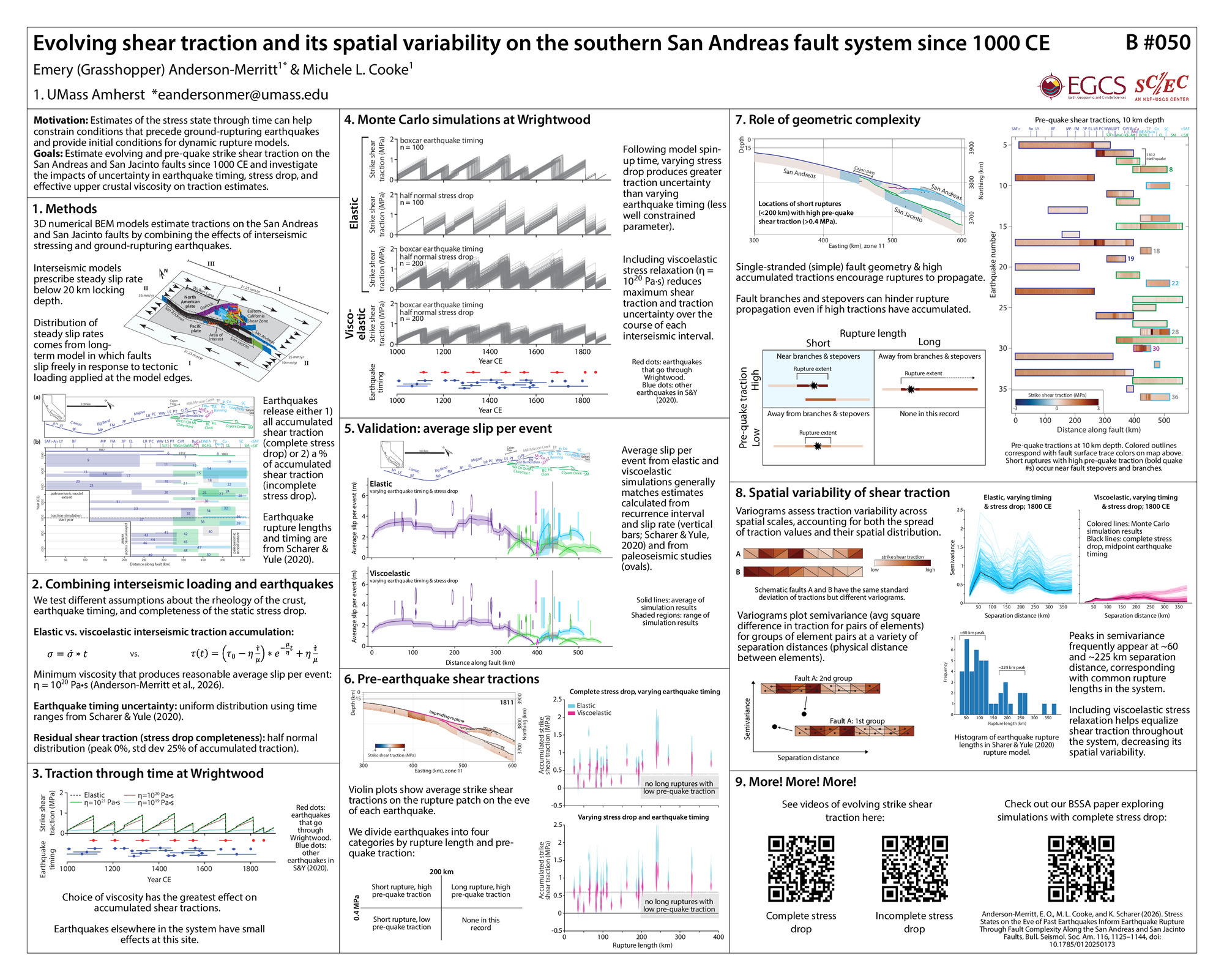
Evolving shear traction and its spatial variability on the southern San Andreas fault system since 1000 CE
Emery O. Anderson-Merritt, &
Michele L. Cooke
Published August 30, 2026, SCEC Contribution #15428,
2026 SCEC Annual Meeting Poster
#050 (PDF)
Estimates of evolving strike shear tractions across multiple earthquake cycles can shed light on the conditions that produce large earthquakes, inform the interpretation of earthquake recurrence and open intervals, and provide key inputs for dynamic rupture models. We use three-dimensional quasi-static numerical models to simulate evolving strike shear tractions on the southern San Andreas and San Jacinto faults from 1000 – 1900 CE based on the rupture model of Sharer & Yule (2020). We assess the effects of uncertainty in stress drop completeness and earthquake timing on evolving shear traction and its spatial variability, considering both an elastic and a viscoelastic rheology for the upper crust. To simulate uncertainty of stress drop completeness, we use a stochastic approach, selecting the percentage of accumulated shear traction to release from a half normal distribution. To simulate earthquake timing uncertainty, we use a boxcar distribution of event times. We validate the simulations by comparing model average slip per event with estimates based on field studies. Earthquakes with long (>200 km) rupture lengths all have high pre-quake shear tractions and occur in areas with simple fault geometry, while shorter rupture length earthquakes with high pre-quake tractions all occur in areas of geometric complexity; this suggests that high accumulated shear traction is necessary to generate a long earthquake rupture, but geometric complexity can hinder rupture propagation despite high accumulated traction. Spatial variability analysis of shear traction reveals frequent peaks in variability at spatial scales of ~60 and ~225 km, reflecting common earthquake rupture lengths in the system: shear tractions near rupture endpoints are typically greater than tractions along the rest of the fault. Including viscoelastic stress relaxation greatly reduces spatial variability in shear traction because high shear tractions in the viscoelastic simulations dissipate during the time between earthquakes. Uncertainty in the effective upper crustal rheology contributes greater uncertainty to shear traction history than uncertainty in stress drop completeness and earthquake timing. This finding suggests that advances in shear traction estimates, which are valuable inputs for dynamic rupture simulations, will be gained from tighter constraints on effective upper crustal viscosity.
Key Words
stress, shear traction, San Andreas, San Jacinto
Citation
Anderson-Merritt, E. O., & Cooke, M. L. (2026, 08). Evolving shear traction and its spatial variability on the southern San Andreas fault system since 1000 CE. Poster Presentation at 2026 SCEC Annual Meeting.
Related Projects & Working Groups
Stress and Deformation Over Time (SDOT)