
Toward an AI-Enhanced Near-Real-Time Earthquake Cataloging System for the Southern California Seismic Network
Yijian Zhou, Ryan Tam, Gabrielle Tepp, Rayomand Bhadha, Ellen Yu, Zachary E. Ross, Zhongwen Zhan, & Allen L. HuskerPublished August 30, 2026, SCEC Contribution #15369, 2026 SCEC Annual Meeting Poster #149 (PDF)
Poster Image:
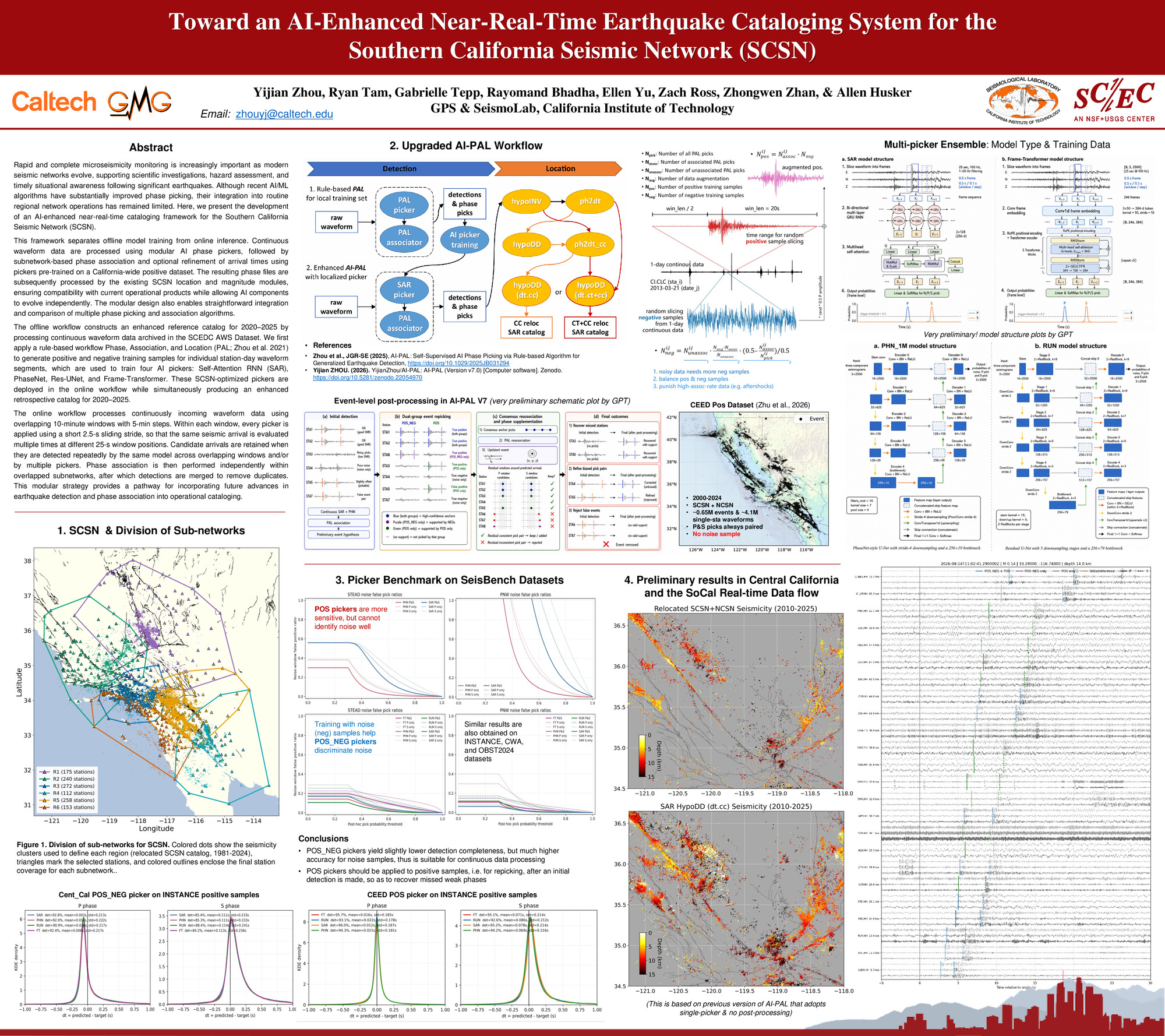
This framework separates offline model training from online inference. Continuous waveform data are processed using modular AI phase pickers, followed by subnetwork-based phase association and optional refinement of arrival times using pickers pre-trained on a California-wide positive dataset. The resulting phase files are subsequently processed by the existing SCSN location and magnitude modules, ensuring compatibility with current operational products while allowing AI components to evolve independently. The modular design also enables straightforward integration and comparison of multiple phase picking and association algorithms.
The offline workflow constructs an enhanced reference catalog for 2020–2025 by processing continuous waveform data archived in the SCEDC AWS Dataset. We first apply a rule-based workflow Phase, Association, and Location (PAL; Zhou et al. 2021) to generate positive and negative training samples for individual station-day waveform segments, which are used to train four AI pickers: Self-Attention RNN (SAR), PhaseNet, Res-UNet, and Frame-Transformer. These SCSN-optimized pickers are deployed in the online workflow while simultaneously producing an enhanced retrospective catalog for 2020–2025.
The online workflow processes continuously incoming waveform data using overlapping 10-minute windows with 5-min steps. Within each window, every picker is applied using a short 2.5-s sliding stride, so that the same seismic arrival is evaluated multiple times at different 25-s window positions. Candidate arrivals are retained when they are detected repeatedly by the same model across overlapping windows and/or by multiple pickers. Phase association is then performed independently within overlapped subnetworks, after which detections are merged to remove duplicates. This modular strategy provides a pathway for incorporating future advances in earthquake detection and phase association into operational cataloging.
Citation
Zhou, Y., Tam, R., Tepp, G., Bhadha, R., Yu, E., Ross, Z. E., Zhan, Z., & Husker, A. L. (2026, 08). Toward an AI-Enhanced Near-Real-Time Earthquake Cataloging System for the Southern California Seismic Network. Poster Presentation at 2026 SCEC Annual Meeting.
Related Projects & Working Groups
Seismology


