Exploring the Paleoseismic Solution Space: An Optimization-based Paleoseismic Event Correlation Technique
Erik Perkins
Published August 30, 2026, SCEC Contribution #15318,
2026 SCEC Annual Meeting Poster
#123 (PDF)
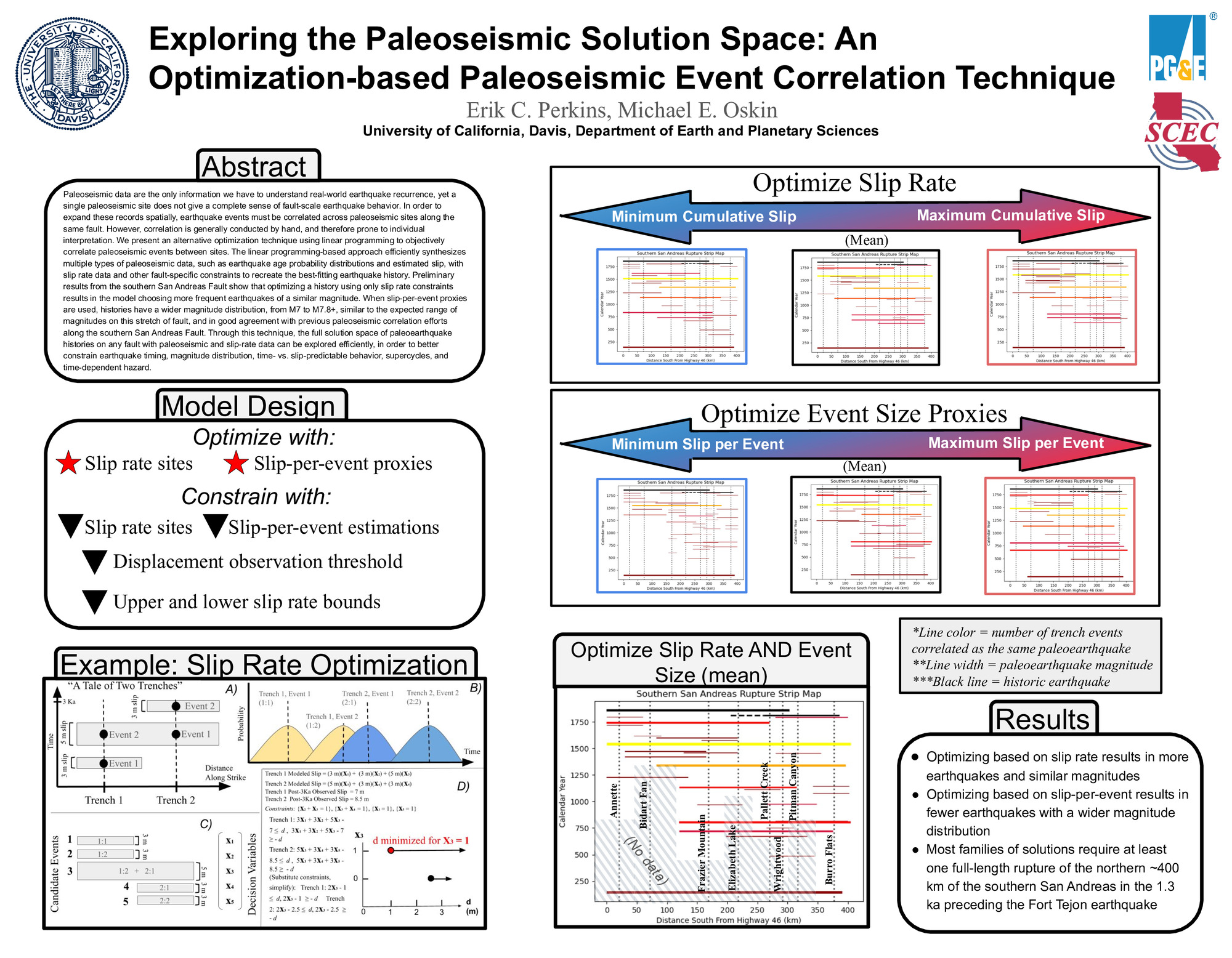
Paleoseismic data are the only information we have to understand real-world earthquake recurrence, yet a single paleoseismic site does not give a complete sense of fault-scale earthquake behavior. In order to expand these records spatially, earthquake events must be correlated across paleoseismic sites along the same fault. However, correlation is generally conducted by hand, and therefore prone to individual interpretation. We present an alternative optimization technique using linear programming to objectively correlate paleoseismic events between sites. The linear programming-based approach efficiently synthesizes multiple types of paleoseismic data, such as earthquake age probability distributions and estimated slip, with slip rate data and other fault-specific constraints to recreate the best-fitting earthquake history. Preliminary results from the southern San Andreas Fault show that optimizing a history using only slip rate constraints results in the model choosing more frequent earthquakes of a similar magnitude. When slip-per-event proxies are used, histories have a wider magnitude distribution, from M7 to M7.8+, similar to the expected range of magnitudes on this stretch of fault, and in good agreement with previous paleoseismic correlation efforts along the southern San Andreas Fault. Through this technique, the full solution space of paleoearthquake histories on any fault with paleoseismic and slip-rate data can be explored efficiently, in order to better constrain earthquake timing, magnitude distribution, time- vs. slip-predictable behavior, supercycles, and time-dependent hazard.
Key Words
Paleoseismology, paleoseismic event correlation
Citation
Perkins, E. (2026, 08). Exploring the Paleoseismic Solution Space: An Optimization-based Paleoseismic Event Correlation Technique. Poster Presentation at 2026 SCEC Annual Meeting.
Related Projects & Working Groups
Earthquake Geology