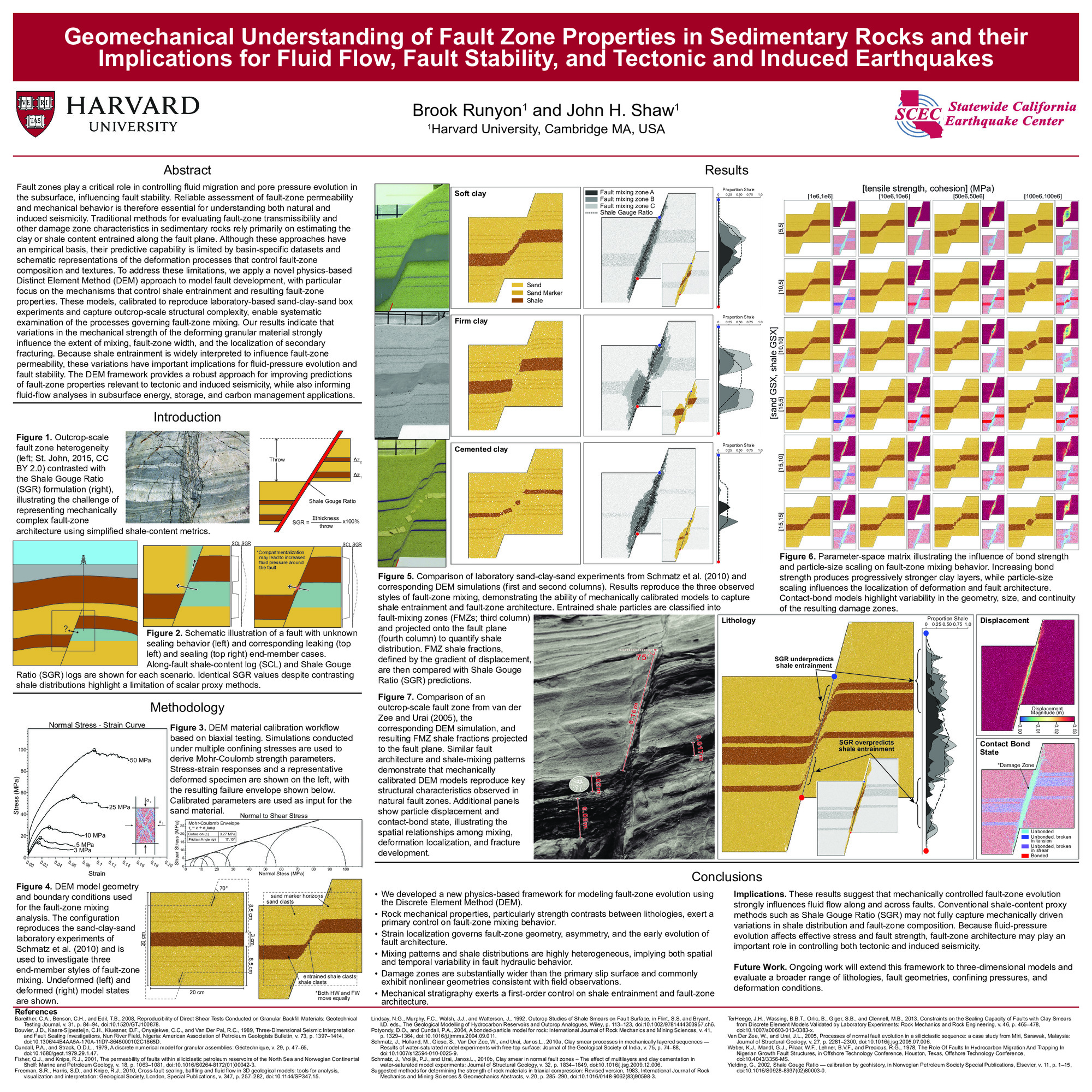
Geomechanical Understanding of Fault Zone Properties in Sedimentary Rocks and their Implications for Fluid Flow, Fault Stability, and Tectonic and Induced Earthquakes
Brook Runyon, &
John H. Shaw
Published August 30, 2026, SCEC Contribution #15295,
2026 SCEC Annual Meeting Poster
#005 (PDF)
Fault zones play a critical role in controlling fluid migration and pore pressure evolution in the subsurface, influencing fault stability. Reliable assessment of fault-zone permeability and mechanical behavior is therefore essential for understanding both natural and induced seismicity. Traditional methods for evaluating fault-zone transmissibility and other damage zone characteristics in sedimentary rocks rely primarily on estimating the clay or shale content entrained along the fault plane. Although these approaches have an empirical basis, their predictive capability is limited by basin-specific datasets and schematic representations of the deformation processes that control fault-zone composition and textures. To address these limitations, we apply a novel physics-based Distinct Element Method (DEM) approach to model fault development, with particular focus on the mechanisms that control shale entrainment and resulting fault-zone properties. These models, calibrated to reproduce laboratory-based sand-clay-sand box experiments and capture outcrop-scale structural complexity, enable systematic examination of the processes governing fault-zone mixing. Our results indicate that variations in the mechanical strength of the deforming granular material strongly influence the extent of mixing, fault-zone width, and the localization of secondary fracturing. Because shale entrainment is widely interpreted to influence fault-zone permeability, these variations have important implications for fluid-pressure evolution and fault stability. The DEM framework provides a robust approach for improving predictions of fault-zone properties relevant to tectonic and induced seismicity, while also informing fluid-flow analyses in subsurface energy, storage, and carbon management applications.
Citation
Runyon, B., & Shaw, J. H. (2026, 08). Geomechanical Understanding of Fault Zone Properties in Sedimentary Rocks and their Implications for Fluid Flow, Fault Stability, and Tectonic and Induced Earthquakes. Poster Presentation at 2026 SCEC Annual Meeting.
Related Projects & Working Groups
Fault and Rupture Mechanics (FARM)