Real-time Ground Motion Prediction Using Edge-computed Amplitude Features from the Community Seismic Network
John Rekoske,
Robert W. Clayton,
Zachary E. Ross, &
Monica D. Kohler
Published August 30, 2026, SCEC Contribution #15286,
2026 SCEC Annual Meeting Poster
#228 (PDF)
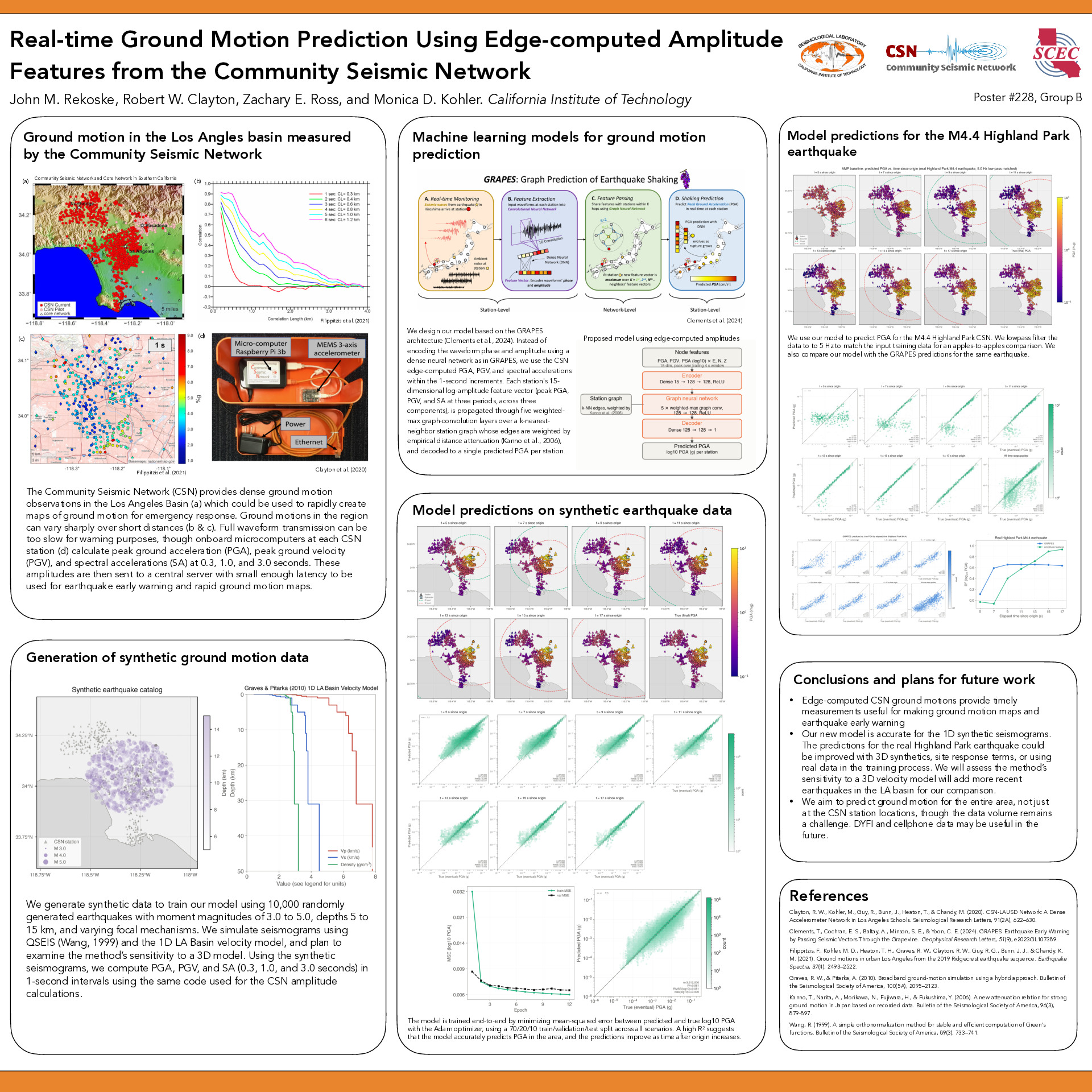
Ground motion in the urban Los Angeles basin can vary sharply over short distances, and capturing that variability in real time is essential for effective earthquake early warning and damage estimates. Transmitting full waveforms from a dense network to a central processor for this purpose introduces significant latency and bandwidth costs. The Community Seismic Network (CSN) instead computes amplitude features directly at each station using small onboard computers, including peak ground acceleration (PGA), peak ground velocity, and spectral accelerations at 0.3, 1.0, and 3.0 seconds. These features are typically available before the raw waveforms could reach a central processor. Here, we present a deep learning model that reconstructs network-wide ground motion in real time directly from these edge-computed features. Our model adapts the GRAph Prediction of Earthquake Shaking (GRAPES; Clements et al., 2024) method, which originally encoded 128 features from raw waveforms before predicting PGA. We instead use the CSN stations’ amplitude information directly as graph node features, giving a 15-dimensional vector per station spanning five amplitude measures across three components. We connect the stations through a distance-weighted graph that represents the CSN geometry, and the model predicts the eventual PGA at every station from partial, early observations elsewhere in the network. We train and evaluate our model using synthetic seismograms computed with a 1D velocity model developed for the Los Angeles basin, sampling earthquakes with random magnitude, depth, focal mechanism, and location across the basin. We plan to test the sensitivity of PGA predictions to a 3D velocity model, apply the model over a dense receiver grid to produce high-resolution ground-motion maps for rapid response and loss estimation, and validate predictions against real earthquakes including crowdsourced Did You Feel It intensity reports and smartphone accelerometer data.
Key Words
community seismic network, edge computing, deep learning
Citation
Rekoske, J., Clayton, R. W., Ross, Z. E., & Kohler, M. D. (2026, 08). Real-time Ground Motion Prediction Using Edge-computed Amplitude Features from the Community Seismic Network. Poster Presentation at 2026 SCEC Annual Meeting.
Related Projects & Working Groups
Ground Motions (GM)