Earthquake-to-fault associations across northern California
Esmeralda Callejas,
Scott T. Marshall,
Andreas Plesch,
Walker S. Evans, &
John H. Shaw
Published August 30, 2026, SCEC Contribution #15224,
2026 SCEC Annual Meeting Poster
#074 (PDF)
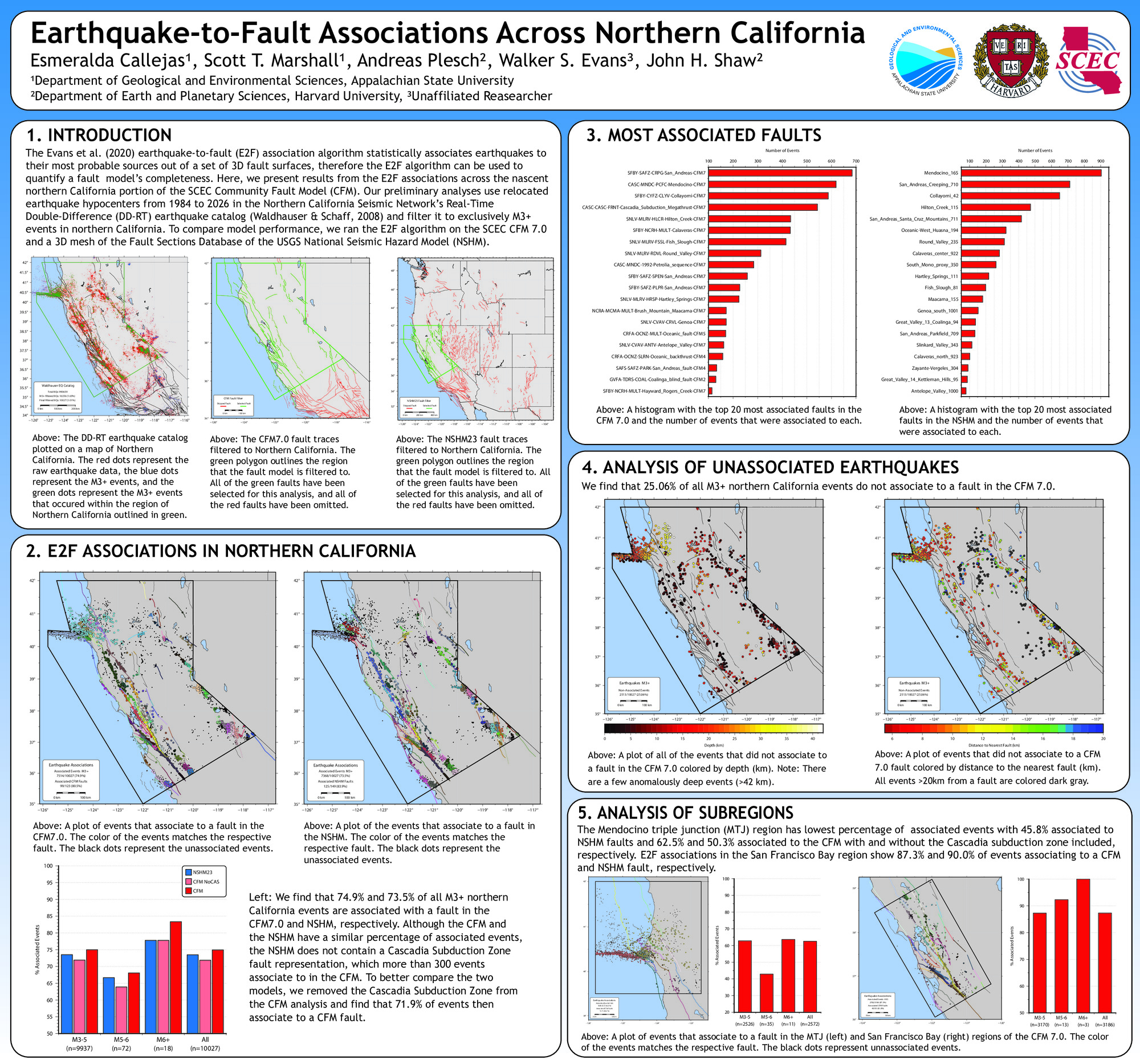
The Evans et al. (2020) earthquake-to-fault (E2F) association algorithm statistically associates earthquakes to their most probable sources out of a set of 3D fault surfaces. Importantly, the E2F algorithm also assigns a probability to whether earthquakes are not associated with any modeled faults. The E2F algorithm can therefore be used to quantify a fault model’s completeness, in terms of its success explaining historic seismicity. The southern California portion of the SCEC Community Fault Model (CFM) has been tested with the E2F algorithm, with 89.7% of M3+ events associating to a CFM fault (Plesch et al., 2026). Here, we present results from E2F associations across the nascent northern California portion of the CFM. Our preliminary analyses use relocated earthquake hypocenters from 1984 to 2026 in the Northern California Seismic Network’s Real-Time Double-Difference earthquake catalog (Waldhauser & Schaff, 2008) and filter it to exclusively M3+ events in northern California and several subregions of interest. Future analyses will integrate focal mechanism data. To compare model performance, we ran the E2F algorithm on two different fault models: the SCEC CFM 7.0 and a 3D mesh of the Fault Sections Database of the USGS National Seismic Hazard Model (NSHM). We find that 73.6% and 72.1% of all M3+ northern California events are associated with a fault in the CFM7.0 and NSHM, respectively. Although the CFM and the NSHM have a similar percentage of associated events, the NSHM does not contain a Cascadia Subduction Zone fault representation, which more than 300 events associate to in the CFM. To better compare the two models, we removed the Cascadia Subduction Zone from the CFM analysis and find that 70.5% of events then associate to a CFM fault. The Mendocino triple junction region has the fewest associated events with 45.8% associated to NSHM faults and 62.5% and 50.3% associated to the CFM with and without the Cascadia subduction zone included, respectively. Many of these unassociated earthquakes are west of the Cascadia megathrust which is an area not currently covered by the CFM or NSHM. E2F associations in the San Francisco Bay region show 87.3% and 90.0% of events associating to a CFM and NSHM fault, respectively. Detailed spatial and statistical analyses of these results may provide insight into which model representations perform better in different regions, as well as guide future development of the CFM in northern California.
Key Words
Community fault model, earthquake catalog, relocated seismicity, earthquake to fault association
Citation
Callejas, E., Marshall, S. T., Plesch, A., Evans, W. S., & Shaw, J. H. (2026, 08). Earthquake-to-fault associations across northern California. Poster Presentation at 2026 SCEC Annual Meeting.
Related Projects & Working Groups
Community Earth Models (CEM)