
Group B, Poster #232, Ground Motions (GM)
Nonlinear Site Response at a Soft Port Site: Vertical-Array Constraints for California's Liquefaction-Susceptible Waterfronts

Poster Image:
Poster Presentation
2026 SCEC Annual Meeting, Poster #232, SCEC Contribution #15648 VIEW PDF
24–29 m where N falls to 1–3.
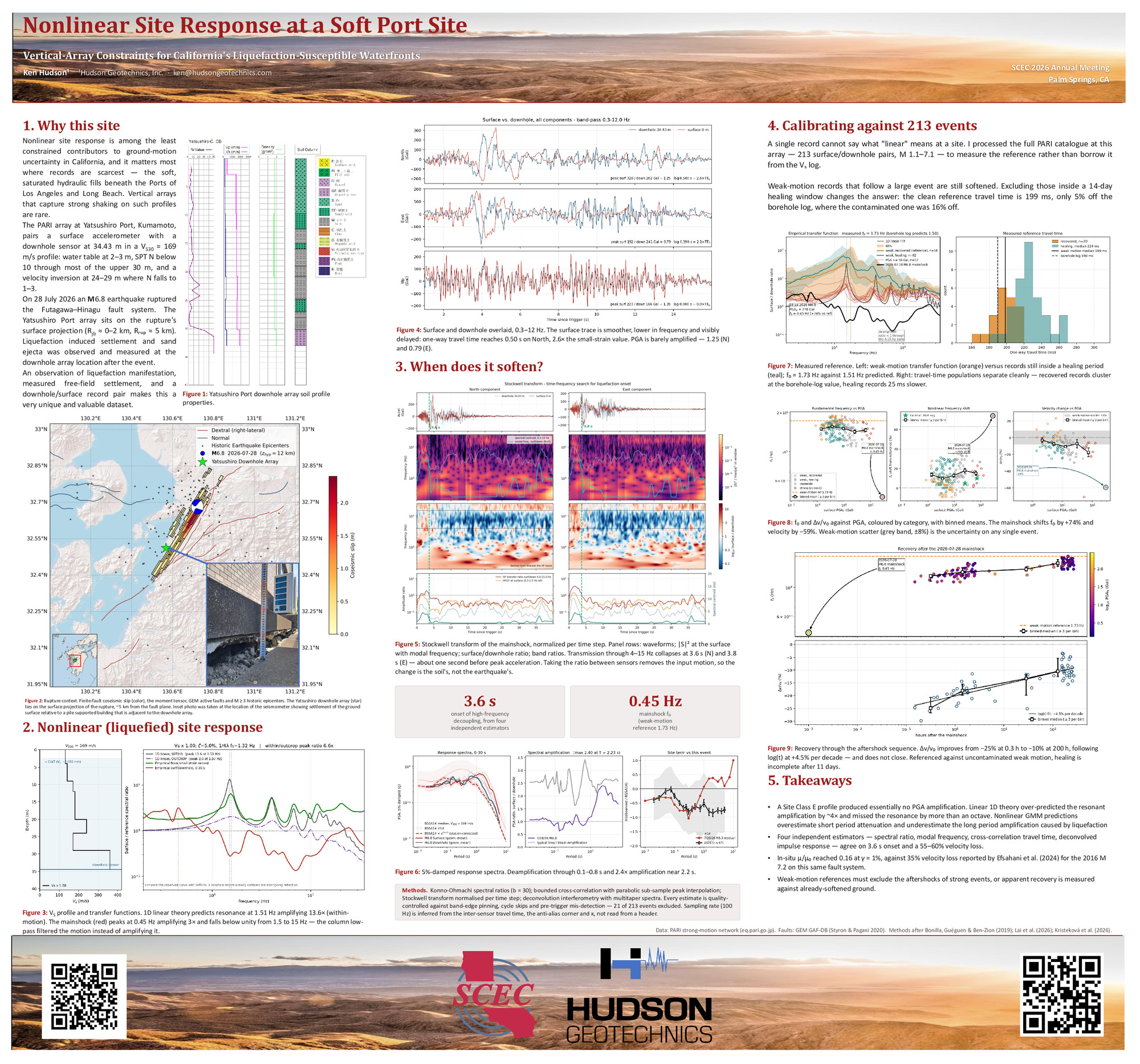
The record inverts expected soft-site behavior. Linear 1D theory for the logged profile predicts resonance at 1.5 Hz with amplification near 30×; observed surface/downhole ratios instead peak at 0.46 Hz with amplification of 3, fall below unity from 1.5 to 15 Hz, and yield PGA ratios of 1.35 (N) and 0.83 (E). Response spectra show deamplification at 0.1–0.3 s and 2.4× amplification near 2.4 s.
Two independent, model-free measurements localize the transition. Sliding-window cross-correlation of the sensor pair gives apparent time-averaged Vs falling from 150 to 51 m/s — 28% of the 181 m/s borehole value — within 15 s, recovering only to ~100 m/s over the following two minutes. Stockwell transforms, ratioed between surface and downhole to remove the input motion, place the collapse of 4–15 Hz transmission at 3.6 s (N) and 3.8 s (E), roughly one second before peak acceleration, with the spectral centroid dropping from 6–7 Hz to 2.2 Hz.
SHOW MORE
The record inverts expected soft-site behavior. Linear 1D theory for the logged profile predicts resonance at 1.5 Hz with amplification near 30×; observed surface/downhole ratios instead peak at 0.46 Hz with amplification of 3, fall below unity from 1.5 to 15 Hz, and yield PGA ratios of 1.35 (N) and 0.83 (E). Response spectra show deamplification at 0.1–0.3 s and 2.4× amplification near 2.4 s.
Two independent, model-free measurements localize the transition. Sliding-window cross-correlation of the sensor pair gives apparent time-averaged Vs falling from 150 to 51 m/s — 28% of the 181 m/s borehole value — within 15 s, recovering only to ~100 m/s over the following two minutes. Stockwell transforms, ratioed between surface and downhole to remove the input motion, place the collapse of 4–15 Hz transmission at 3.6 s (N) and 3.8 s (E), roughly one second before peak acceleration, with the spectral centroid dropping from 6–7 Hz to 2.2 Hz.
SHOW MORE
Citation: Hudson, K. S. (2026, 08). Nonlinear Site Response at a Soft Port Site: Vertical-Array Constraints for California's Liquefaction-Susceptible Waterfronts. Poster Presentation at 2026 SCEC Annual Meeting.
Keywords: Nonlinear Site Response, Vertical Array, Liquefaction, Soft Soils, Ground Motion Amplification
Relevant SCEC Themes:
Physics-Based Ground Motion Simulations & Validation


