Group B, Poster #096, Earthquake Geology
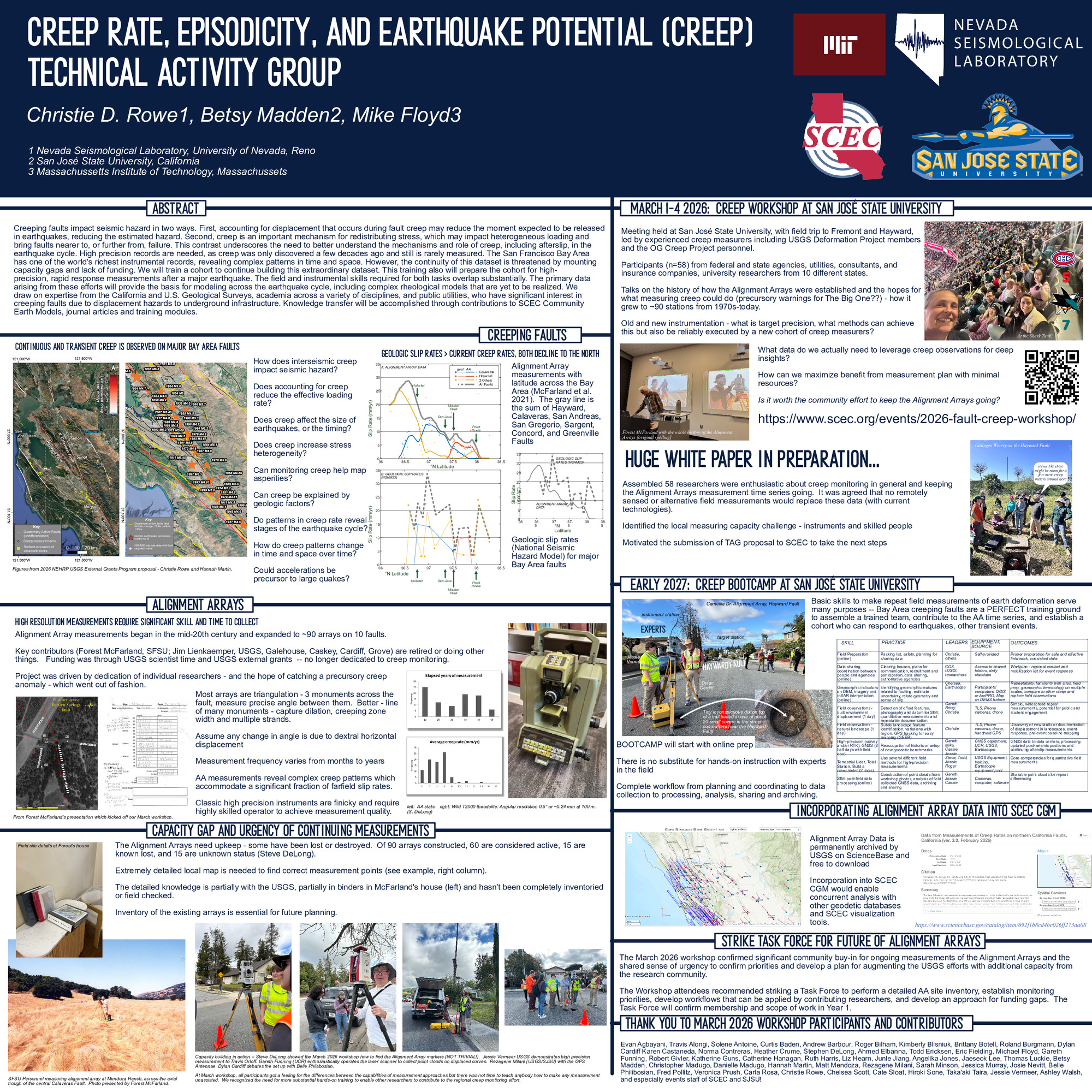
CREEP: Creep Rate, Episodicity, and Earthquake Potential - Technical Activity Group


Poster Image:
Poster Presentation
2026 SCEC Annual Meeting, Poster #096, SCEC Contribution #15583 VIEW PDF
s, revealing complex patterns in time and space. However, the continuity of this dataset is threatened by mounting capacity gaps and lack of funding. We propose to train a cohort to continue building this extraordinary dataset. This training also will prepare the cohort for high-precision, rapid response measurements after a major earthquake. The field and instrumental skills required for both tasks overlap substantially. The primary data arising from these efforts will provide the basis for modeling across the earthquake cycle, including complex rheological models that are yet to be realized. We draw on expertise from the California and U.S. Geological Surveys, academia across a variety of disciplines, and public utilities, who have significant interest in creeping faults due to displacement hazards to underground infrastructure. Knowledge transfer will be accomplished through contributions to SCEC Community Earth Models, journal articles and training modules.
SHOW MORE
SHOW MORE
Citation: Rowe, C. D., Madden, E. H., & Floyd, M. (2026, 08). CREEP: Creep Rate, Episodicity, and Earthquake Potential - Technical Activity Group. Poster Presentation at 2026 SCEC Annual Meeting.
Keywords: TAG, creep, field measurements, instrumentation
SCEC Award: 26066
Relevant SCEC Themes:
Advancing Community Earth Models for Hazard Analyses
Rapid Post-Earthquake Investigations & Communications