
Group B, Poster #004, Fault and Rupture Mechanics (FARM)
Effect of Coseismic Stress Changes from the 1999 Chi-Chi and 2024 Hualien Earthquakes on the Ambient Stress Field


Poster Image:
Poster Presentation
2026 SCEC Annual Meeting, Poster #004, SCEC Contribution #15442 VIEW PDF
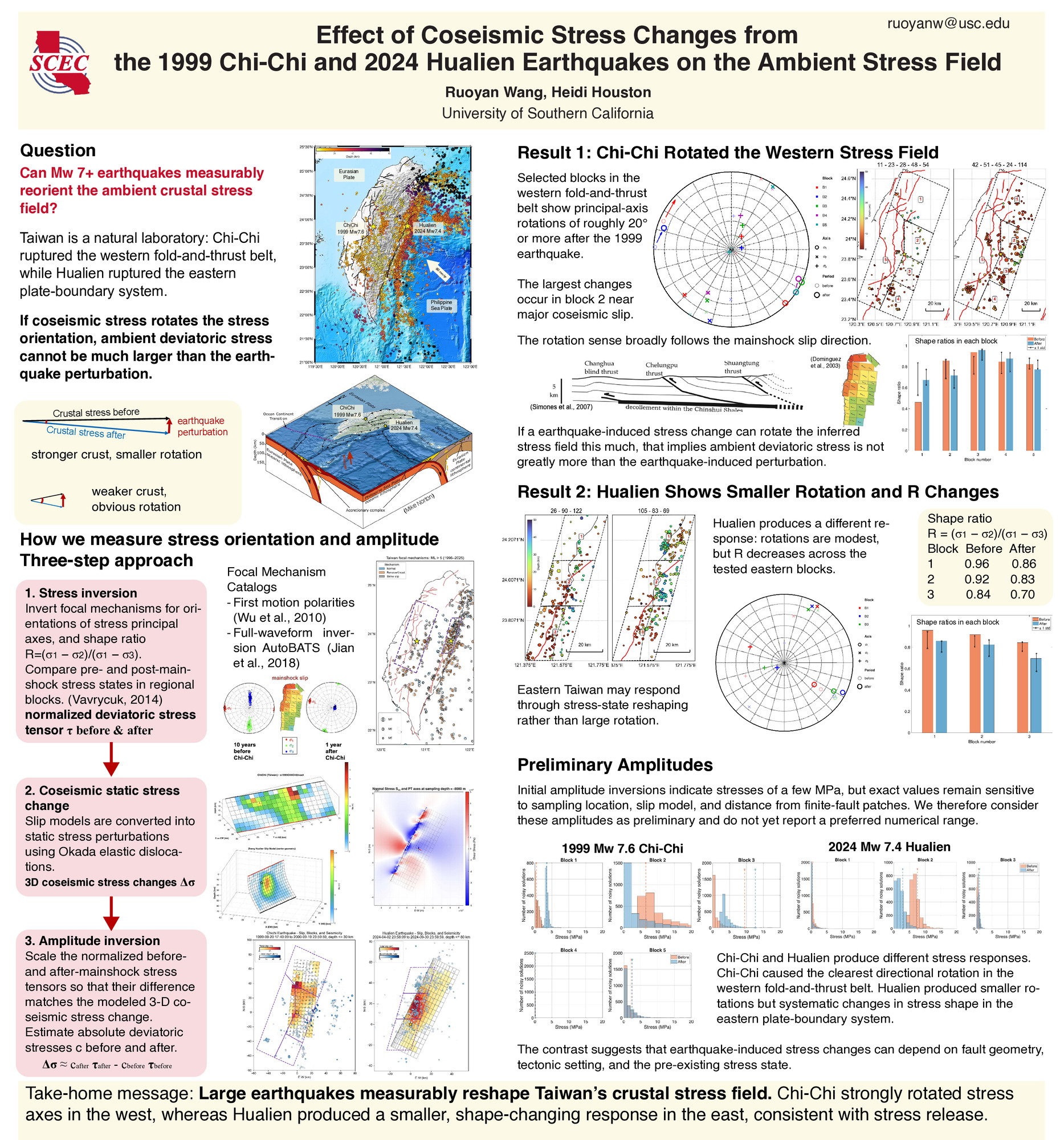
from Wu et al. (2008, 2010) and AutoBATS (Jian et al., 2018), we invert for pre- and post-mainshock stress tensors in multiple subregions surrounding each rupture. We also calculate the mainshock coseismic stress changes using Okada elastic dislocation solutions based on published finite-fault slip models.
Both earthquakes produced measurable stress-field changes, including rotations of principal stress axes and changes in the stress shape ratio. Around the Chi-Chi rupture, stress axes northeast of the fault rotated by up to ~20 degrees after the mainshock. By comparing these observed rotations in three dimensions with modeled coseismic stress perturbations, we estimate the ambient deviatoric stress amplitudes implied by the observed focal-mechanism-derived stress rotations. Large rotations imply low levels of absolute deviatoric stress even prior to the mainshock.
This combined approach moves beyond documenting stress reorientations to constraining the absolute levels of deviatoric stresses before and after large mainshocks. Comparing the Chi-Chi and Hualien earthquakes also highlights how fault geometry, slip distribution, and tectonic setting control the degree to which large earthquakes modify the regional stress field.
SHOW MORE
Both earthquakes produced measurable stress-field changes, including rotations of principal stress axes and changes in the stress shape ratio. Around the Chi-Chi rupture, stress axes northeast of the fault rotated by up to ~20 degrees after the mainshock. By comparing these observed rotations in three dimensions with modeled coseismic stress perturbations, we estimate the ambient deviatoric stress amplitudes implied by the observed focal-mechanism-derived stress rotations. Large rotations imply low levels of absolute deviatoric stress even prior to the mainshock.
This combined approach moves beyond documenting stress reorientations to constraining the absolute levels of deviatoric stresses before and after large mainshocks. Comparing the Chi-Chi and Hualien earthquakes also highlights how fault geometry, slip distribution, and tectonic setting control the degree to which large earthquakes modify the regional stress field.
SHOW MORE
Citation: Wang, R., & Houston, H. (2026, 08). Effect of Coseismic Stress Changes from the 1999 Chi-Chi and 2024 Hualien Earthquakes on the Ambient Stress Field. Poster Presentation at 2026 SCEC Annual Meeting.
Keywords: Coseismic stress change, Chi-Chi earthquake, Hualien earthquake
Relevant SCEC Themes:
Earthquake Cycle Simulations & Forecasting


