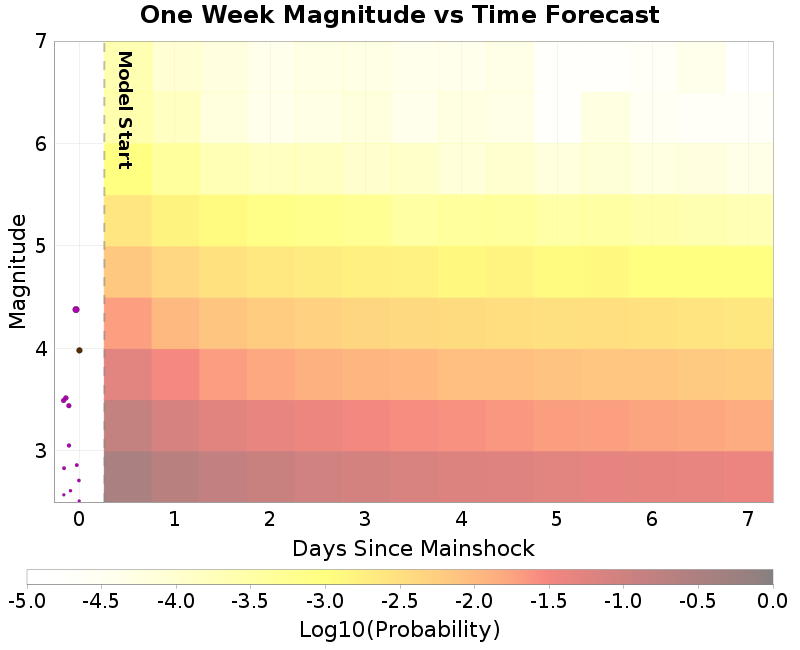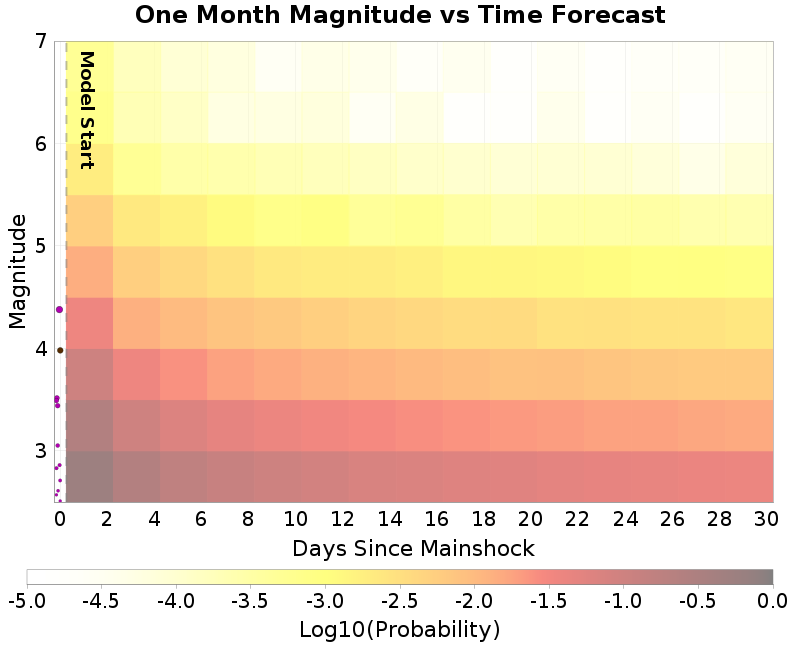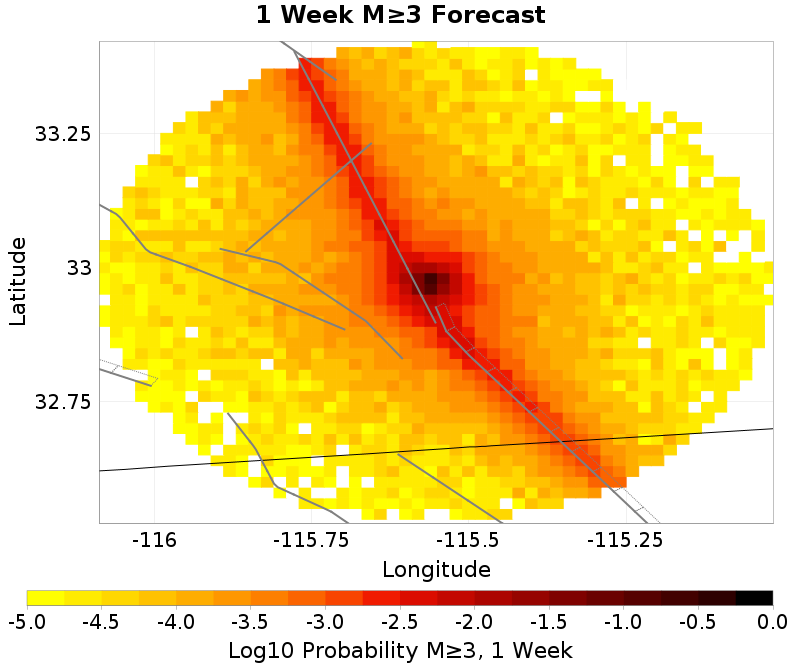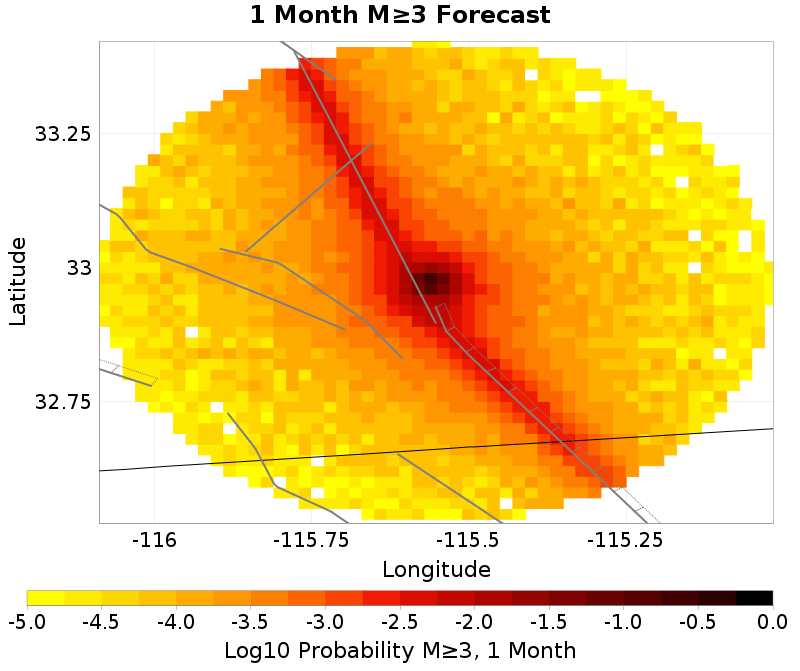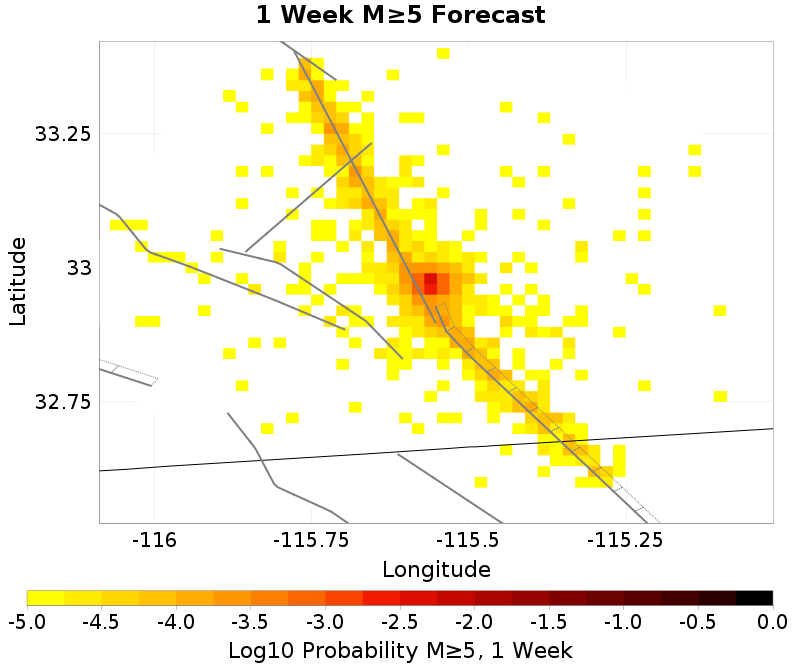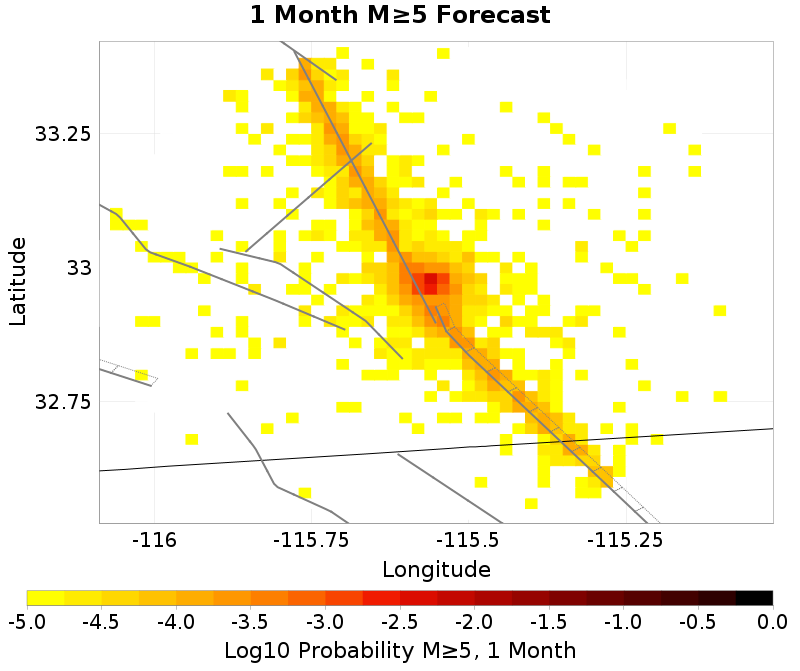

3.98, 2 km WSW of Brawley, CA
Disclaimer: This information is intended solely for research and should not be used for communications with the media or the public.
Table Of Contents
Mainshock Details
Information and plots in the section are taken from the USGS event page, accessed through ComCat.
| Field | Value |
|---|---|
| Magnitude | 3.98 (mw) |
| Time (UTC) | Sun, 10 May 2026 03:13:23 UTC |
| Time (UTC) | Sun, 10 May 2026 03:13:23 UTC |
| Location | 32.972668, -115.55233 |
| Depth | 9.73 km |
| Status | reviewed |
USGS Products
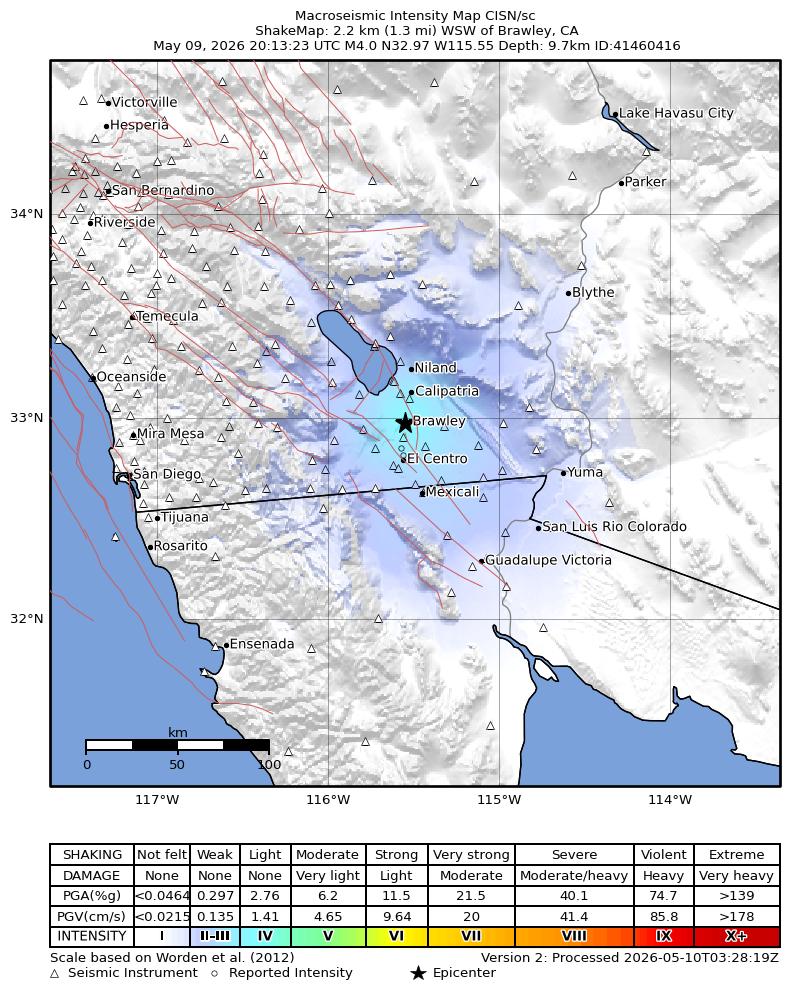 | 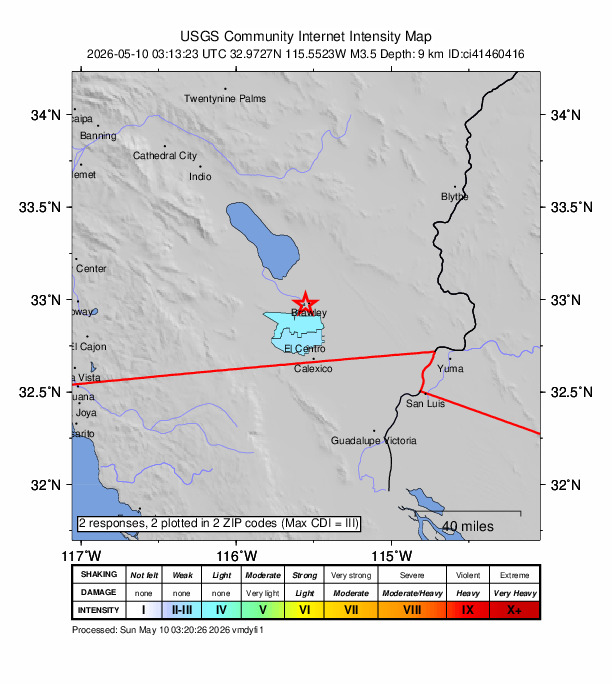 |
Nearby Faults
3 UCERF3 fault sections are within 10km of this event's hypocenter:
- Brawley (Seismic Zone) alt 1: 3.01km
- Imperial: 4.95km
- Brawley (Seismic Zone) alt 2: 5.36km
Sequence Details
These plots show the aftershock sequence, using data sourced from ComCat. They were last updated at 2026/05/10 14:15:21 UTC, 11.03 hours after the mainshock.
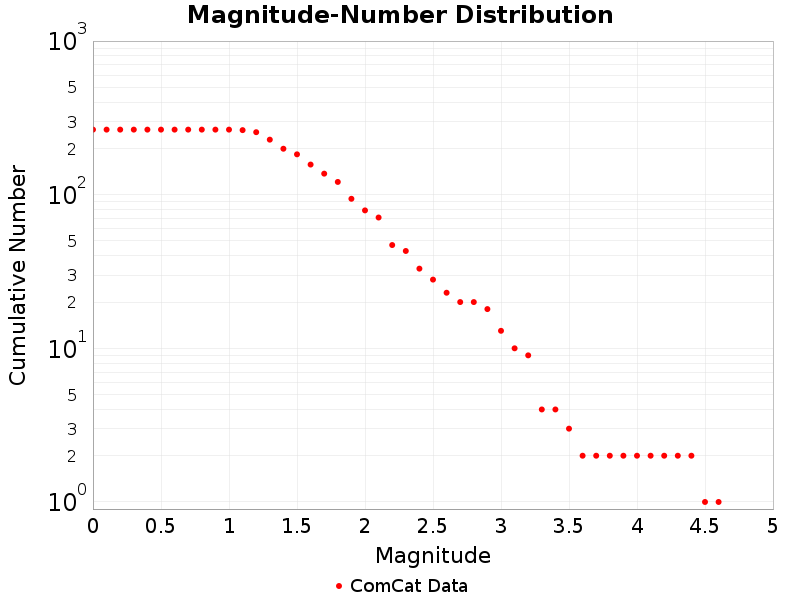
265 M≥0 earthquakes within 10 km of the mainshock's epicenter.
| First Hour | To Date | |
|---|---|---|
| M 0 | 32 | 265 |
| M 1 | 32 | 265 |
| M 2 | 10 | 79 |
| M 3 | 3 | 13 |
| M 4 | 1 | 2 |
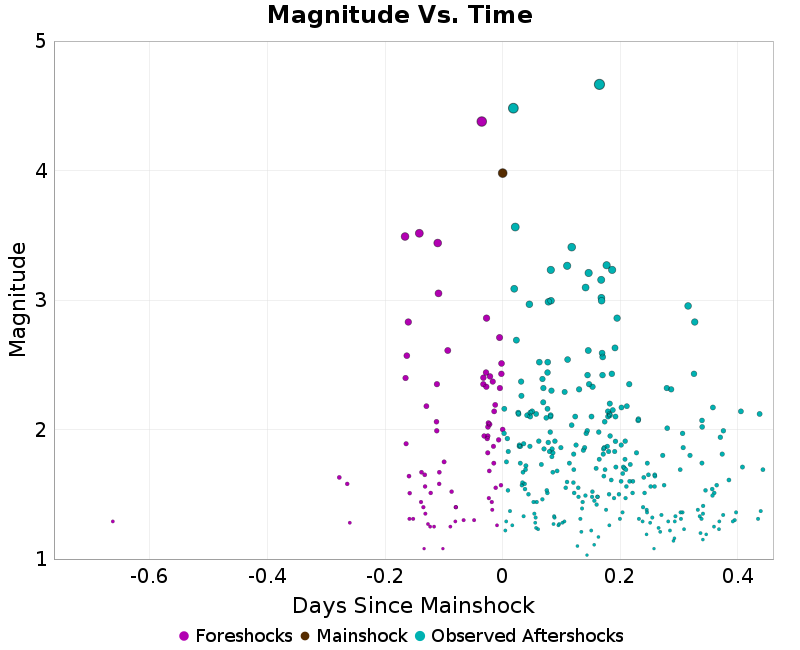
Magnitude Vs. Time Plot
This plot shows the magnitude vs. time evolution of the sequence. The mainshock is ploted as a brown circle, foreshocks are plotted as magenta circles, and aftershocks are plotted as cyan circles.
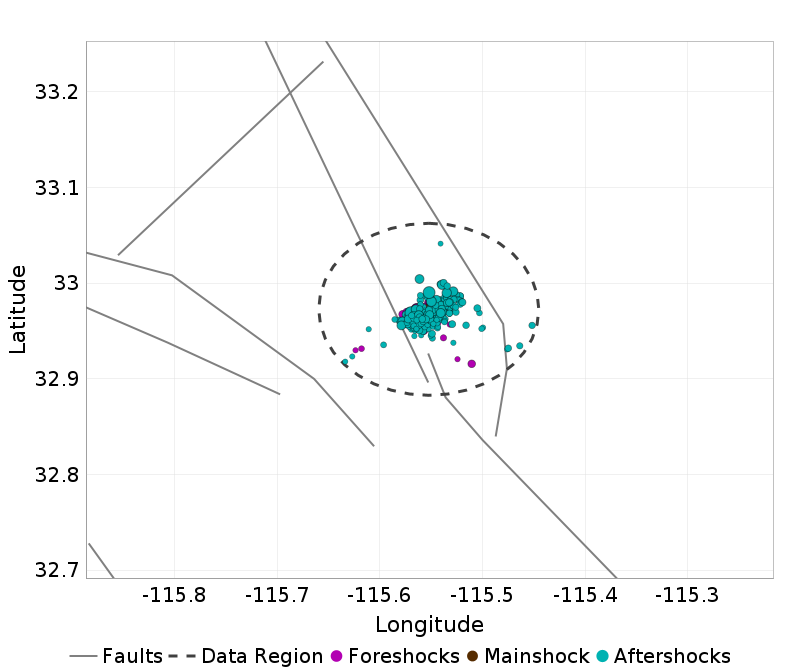
Aftershock Locations
Map view of the aftershock sequence, plotted as cyan circles. The mainshock and foreshocks are plotted below in brown and magenta circles respectively, but may be obscured by aftershocks. Nearby UCERF3 fault traces are plotted in gray lines, and the region used to fetch aftershock data in a dashed dark gray line.
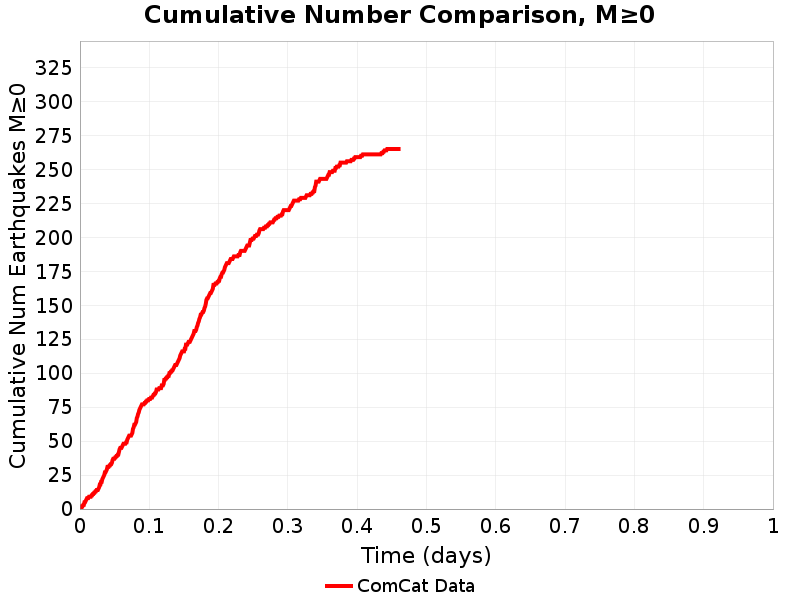
Cumulative Number Plot
This plot shows the cumulative number of M≥0 aftershocks as a function of time since the mainshock.
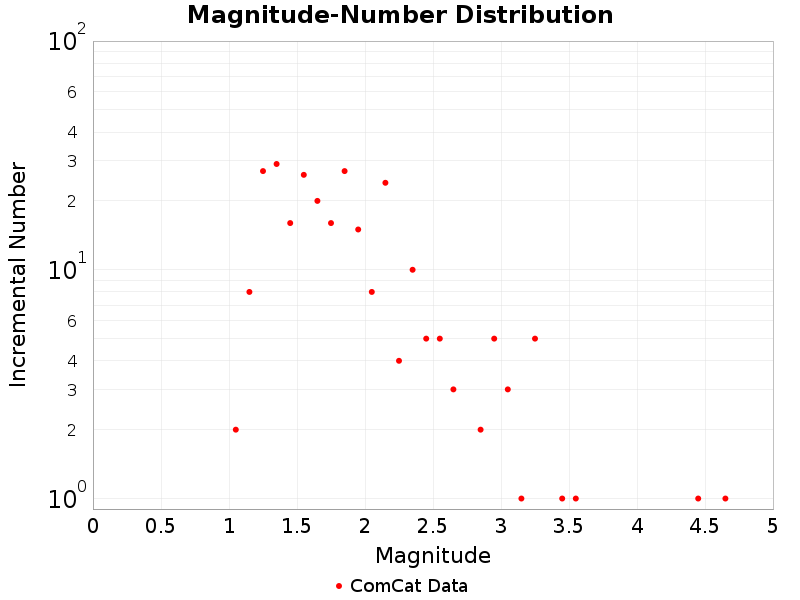
Magnitude-Number Distributions (MNDs)
These plot shows the magnitude-number distribution of the aftershock sequence thus far. The left plot gives an incremental distribution (the count in each magnitude bin), and the right plot a cumulative distribution (the count in or above each magnitude bin).
| Incremental MND | Cumulative MND |
|---|---|
 |  |
Significant Foreshocks
Foreshock(s) with M≥6 or with M≥MMainshock-1.
M4.38 0.04 days before
Information and plots in the section are taken from the USGS event page, accessed through ComCat.
| Field | Value |
|---|---|
| Magnitude | 4.38 (mw) |
| Time (UTC) | Sun, 10 May 2026 03:13:23 UTC |
| Time (UTC) | Sun, 10 May 2026 03:13:23 UTC |
| Location | 32.972668, -115.563835 |
| Depth | 14.64 km |
| Status | reviewed |
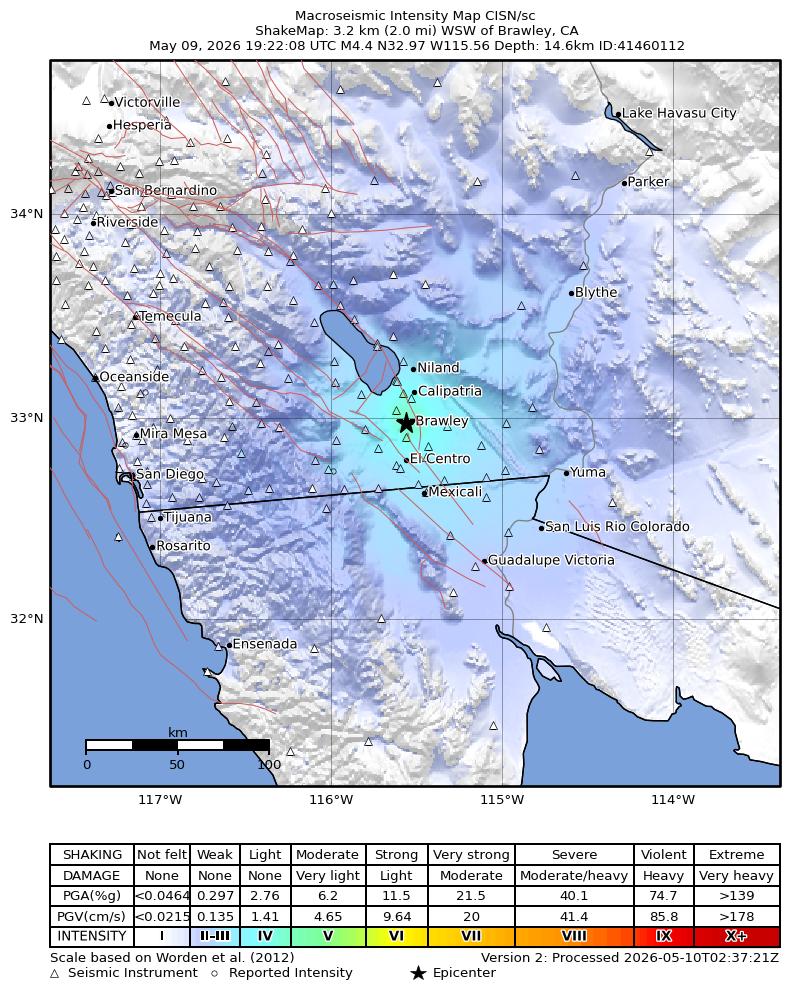
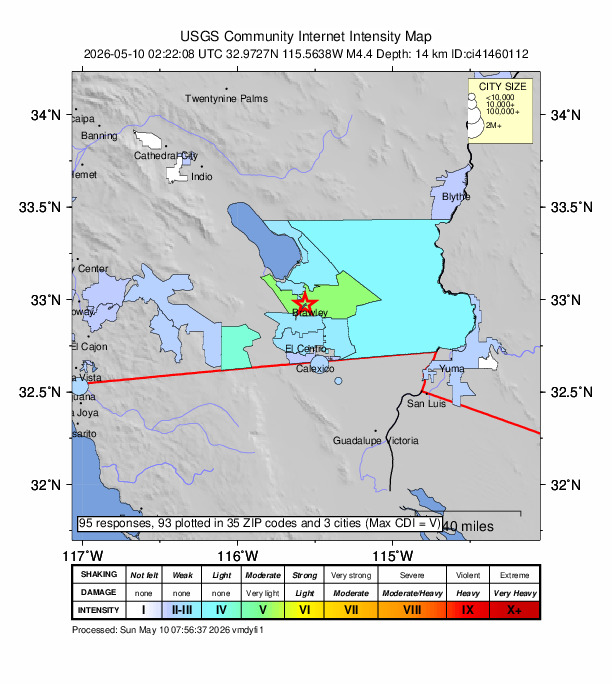
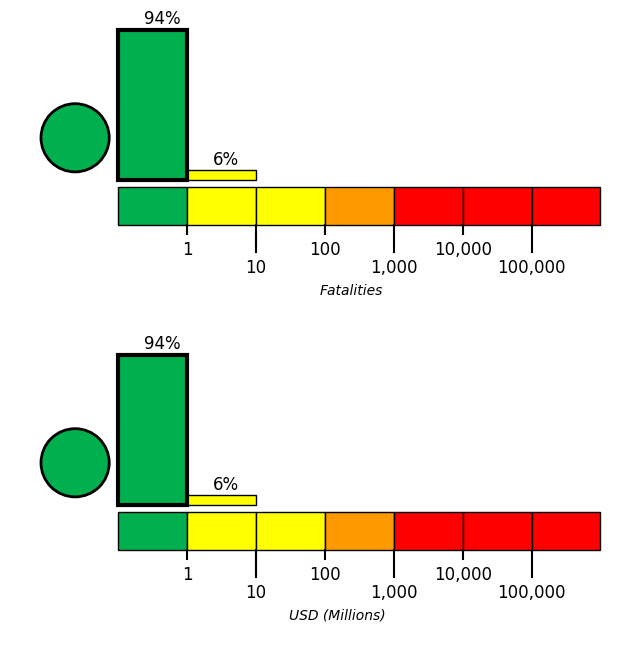
USGS Products
 |  |  |
Nearby Faults
3 UCERF3 fault sections are within 10km of this event's hypocenter:
- Brawley (Seismic Zone) alt 1: 2.6km
- Imperial: 6.42km
- Brawley (Seismic Zone) alt 2: 6.51km
Significant Aftershocks
Aftershocks(s) with M≥6 or with M≥MMainshock-1.
M4.66 0.16 days after
Information and plots in the section are taken from the USGS event page, accessed through ComCat.
| Field | Value |
|---|---|
| Magnitude | 4.66 (mw) |
| Time (UTC) | Sun, 10 May 2026 03:13:23 UTC |
| Time (UTC) | Sun, 10 May 2026 03:13:23 UTC |
| Location | 32.969, -115.5695 |
| Depth | 13.7 km |
| Status | reviewed |
USGS Products
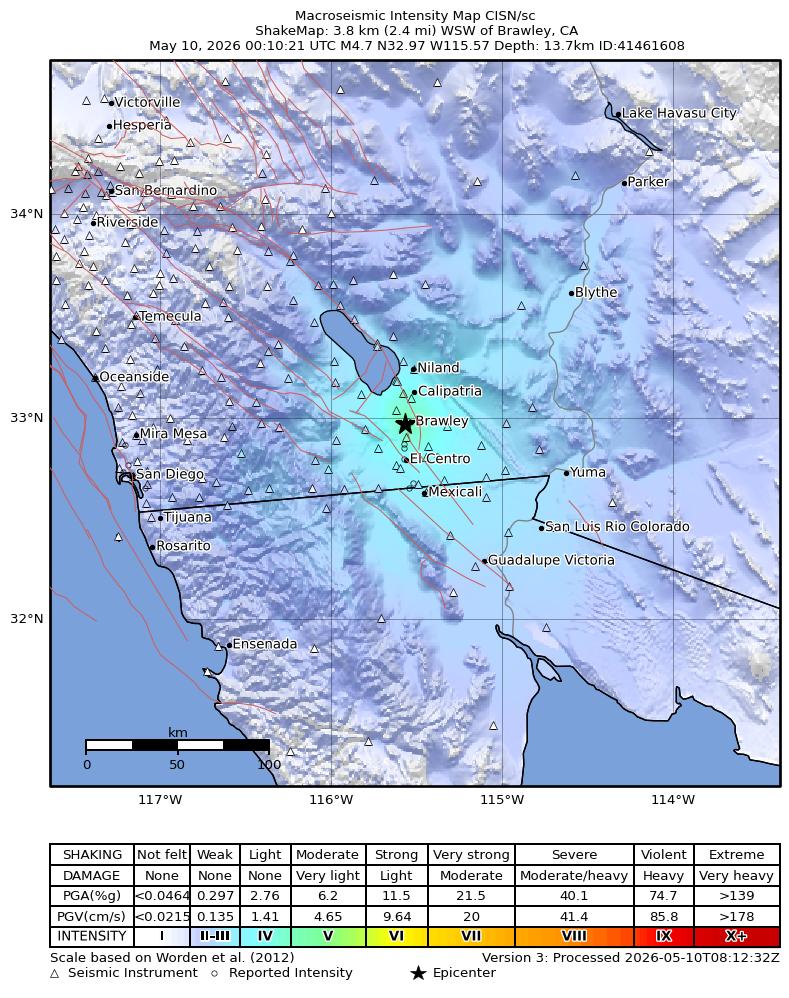 | 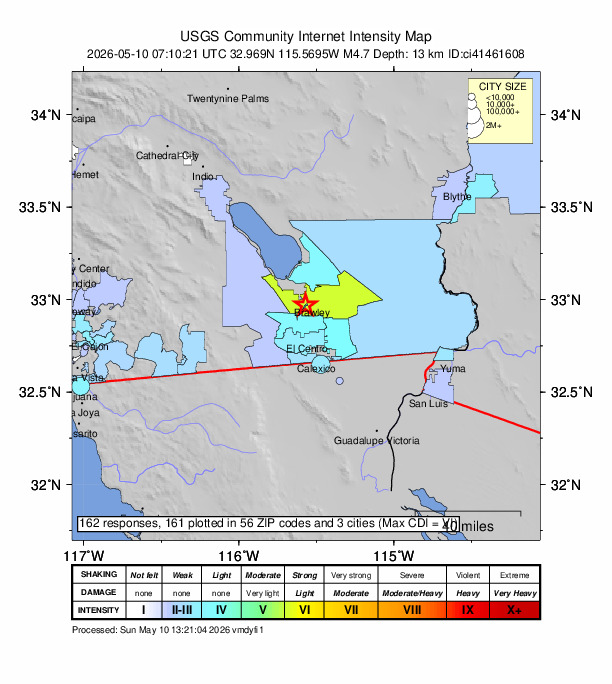 | 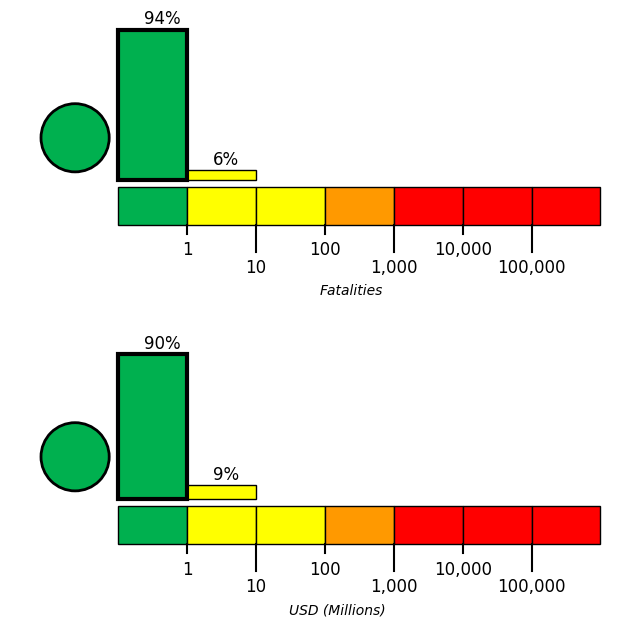 |
Nearby Faults
3 UCERF3 fault sections are within 10km of this event's hypocenter:
- Brawley (Seismic Zone) alt 1: 1.53km
- Imperial: 5.87km
- Brawley (Seismic Zone) alt 2: 6.99km
M4.48 0.02 days after
Information and plots in the section are taken from the USGS event page, accessed through ComCat.
| Field | Value |
|---|---|
| Magnitude | 4.48 (mw) |
| Time (UTC) | Sun, 10 May 2026 03:13:23 UTC |
| Time (UTC) | Sun, 10 May 2026 03:13:23 UTC |
| Location | 32.990166, -115.552 |
| Depth | 16.21 km |
| Status | reviewed |
USGS Products
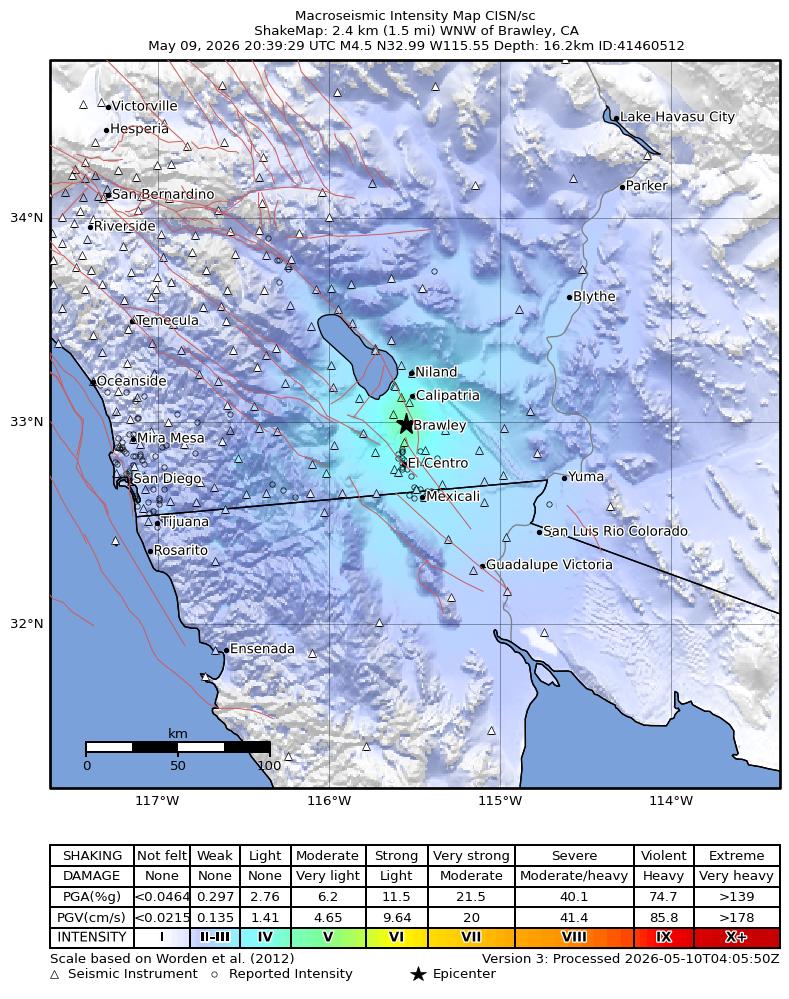 | 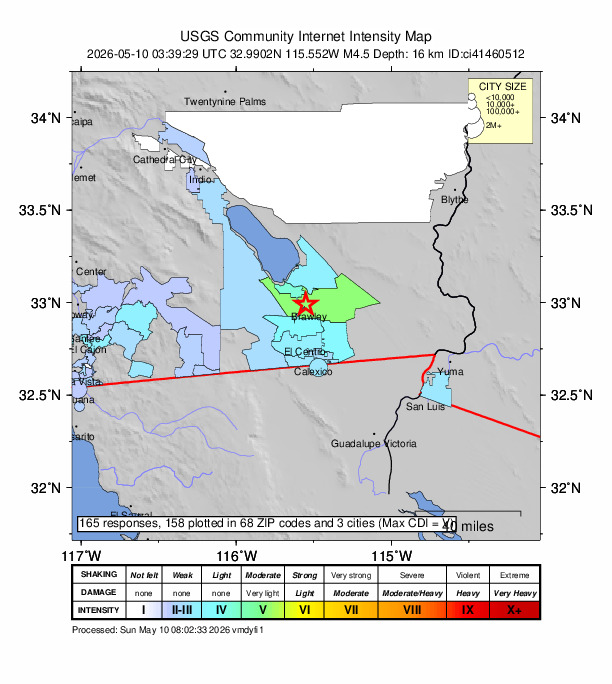 | 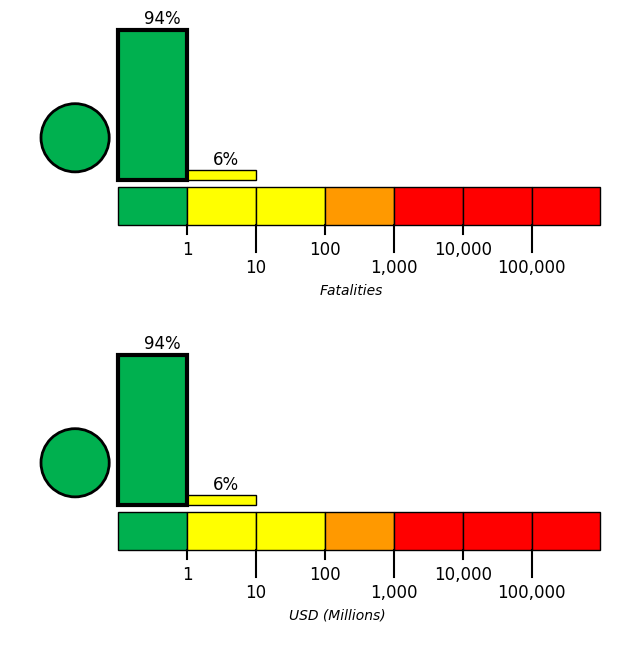 |
Nearby Faults
3 UCERF3 fault sections are within 10km of this event's hypocenter:
- Brawley (Seismic Zone) alt 1: 4.91km
- Brawley (Seismic Zone) alt 2: 5.5km
- Imperial: 8.55km